3I/ATLAS Live Tracker: Did 3I/ATLAS do anything strange near the Sun? Yes, 3 things

&imwidth=600&imheight=450&format=webp&quality=medium "3I/ATLAS Live Tracker: Did 3I/ATLAS do anything strange near the Sun? Yes, 3 things")
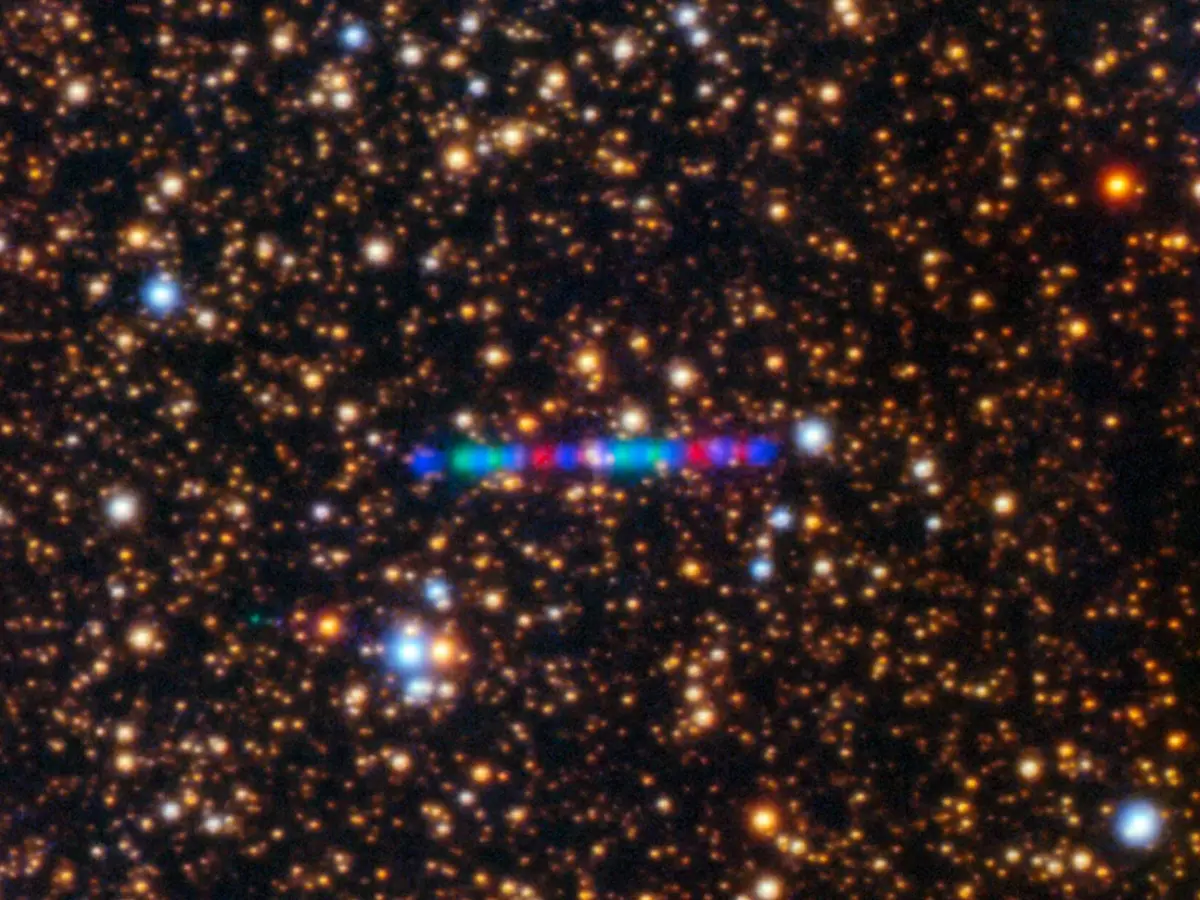
3I/ATLAS as seen by Gemini Photograph: (Gemini North Telescope)
3I/ATLAS update: The interstellar comet is out of the Sun's glare and was seen by a bunch of satellites that are a part of the PUNCH mission. Details of its appearance and changes will only emerge in the coming days.
Interstellar comet 3I/ATLAS is getting stranger and more mysterious by the day as it reaches its halfway distance in its trip through our solar system. At perihelion, that is, its closest point to the sun, the alien comet was expected to undergo major transformations. It seems things have changed for 3I/ATLAS, as new observations show it is not the same object it was before its encounter with our star. Its colour has changed and so has its brightness. It also made some weird changes in its trajectory, according to NASA data. Now scientists are waiting with bated breath for it to reemerge so they can see how much mass it has lost due to sublimation.
Yes. For the first time, 3I/ATLAS showed non-gravitational acceleration at perihelion, according to NASA and Avi Loeb. The comet also became extremely bright, so much so that it can be compared to stars. Its colour has also changed to blue instead of red, which typically happens with comets when they reach near the Sun.
The interstellar comet was seen by the PUNCH mission, a group of small satellites studying the Sun, as it came out of the Sun’s glare. There is no data yet in the comet and how it might have changed during solar conjunction and perihelion. During its time with the sun, 3I/ATLAS was expected to perform the Oberth Maneuver, meaning it could have flung itself towards Earth. However, nothing like this has happened and it is now on its way. However, clear data will emerge only in the coming days.
In August, scientists saw hydroxyl (OH) gas, a chemical fingerprint of water, releasing from the interstellar comet. When comets come near the Sun, the water ice on the surface starts turning into a gas. But 3I/ATLAS was shooting jets when it was nearly three times farther from the Sun than Earth. The alien comet was recorded losing water at a rate of about 40 kg per second. Experts say the detection of water gas holds clues about life in other star systems.
Loeb cited several anomalies in the interstellar object to claim that there is a high chance that it is not a natural object. According to him, the size, light, speed, trajectory, the lack of a cometary tail are not in line with a regular comet. He has cited a total of eight anomalies till now in 3I/ATLAS.
The European Space Agency released one picture of the interstellar comet by its ExoMars Trace Gas Orbiter (TGO). It said the distance was immense, comparable to how you would see the Moon from Earth. That is why not a lot could be gathered about 3I/ATLAS. ExoMars TGO captured the series of images using its Colour and Stereo Surface Imaging System (CaSSIS). ESA said that the "slightly fuzzy white dot moving downwards near the centre of the image" is 3I/Atlas.
3I/Atlas photo taken by Mars orbiter
NASA has gone completely silent on 3I/ATLAS. Barring some info that is released on basic comets and asteroids, the space agency has not said anything about the comet. It came 29 million kilometres near Mars on October 3, and its Reconnaissance Orbiter is said to have been best positioned to capture the comet's photos. However, NASA has not released any pictures yet, creating fear that it is hiding something.
3I/ATLAS is believed to be only a kilometre wide, but some say it is the size of a whole city. The Hubble Space Telescope observations suggest that the diameter of 3I/ATLAS's nucleus is between 0.32 and 5.6 km. However, Avi Loeb, a Harvard scientist, cites the brightness of 3I/ATLAS at a wavelength of 1 micrometre to claim that it has a nucleus that measures 46 kilometres in diameter. His claims have been disputed by others.
AGE - The alien comet is estimated to be anywhere between 7 - 14 billion years old. That means it could have been born with the universe. Even if it is 7 billion years old, it is still older than our solar system which is only about 4.6 billion years old.
The non-gravitational acceleration observed on 3I/ATLAS might be linked to 3I/ATLAS getting bluer than the Sun. There was a radial acceleration and a transverse acceleration, and an unexpected change in colour.
The alien comet is likely to lose considerable mass because of its trip to the Sun. "Over the month it takes 3I/ATLAS to cross a spatial scale of order its perihelion separation from the Sun, and it would lose about a tenth of its mass," Loeb wrote. "Such a massive mass loss should be detectable in the form of a large plume of gas surrounding 3I/ATLAS during the upcoming months of November and December 2025."
On October 28, two researchers posted a study to the preprint server arXiv saying that 3I/ATLAS rapidly brightened ahead of perihelion. According to them, the comet will have brightened to roughly magnitude 9 at perihelion.
3I/ATLAS did something shocking near the Sun, leaving scientists stunned. According to data from NASA, the comet showed non-gravitational acceleration at perihelion. The non-gravitational acceleration was measured at the perihelion distance of 1.36 times the Earth-Sun separation. This has added fuel to the fire about whether it is an alien spaceship and if the movement is a technological signature of an internal engine.
Harvard scientist Avi Loeb calls this shift in colour the ninth anomaly. “For a natural comet, this blue colour is very surprising. Dust is expected to redden the scattered sunlight, and the surface of 3I/ATLAS is expected to be ~20 times colder than the 5,800 degrees Kelvin at the photosphere of the Sun, resulting in it having a redder colour than the Sun,” he wrote. Loeb says this could likely be explained by a “hot engine or a source of artificial light.”
The interstellar comet turned blue as it reached perihelion, according to new data. A paper states that the photometry from GOES-19’s CCOR-1 instruments and others revealed that the comet turned blue. Ideally, the dust around the comet should turn the scattered sunlight red. But, with 3I/ATLAS, the colour has shifted to blue.

