Life on Mars probably not existed on surface, finds study

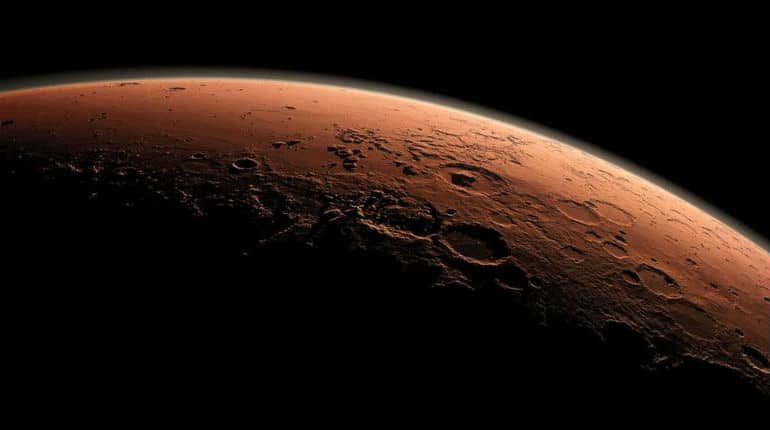
Mars
If there was life on Mars, it may not be on the surface, but many miles below it.
A new research has found that the most habitable part of the red planet in the past was probably its subsurface.
Published in the journal Science Advances, the research examined various Mars datasets to find out if heating through geothermal or underground heat would have been possible 4.1 billion to 3.7 billion years ago or in the Noachian era.
It found out that the conditions required for subsurface melting would have been ubiquitous on ancient Mars.
Even if the red planet had a warm and wet climate 4 billion years ago, with the absence of the magnetic field, atmospheric thinning and subsequent decline in global temperatures over time, liquid water may have been stable only at great depths, the study said.
Therefore, if life ever was present on Mars, researchers said, may have followed liquid water to progressively greater depths.
"At such depths, life could have been sustained by hydrothermal (heating) activity and rock-water reactions. So, the subsurface may represent the longest-lived habitable environment on Mars," said lead author Lujendra Ojha, an assistant professor at the US's Rutgers University-New Brunswick.
The findings are crucial as it may help understanding in what is known as the faint young sun paradox.
"Even if greenhouse gases like carbon dioxide and water vapour are pumped into the early Martian atmosphere in computer simulations, climate models still struggle to support a long-term warm and wet Mars," said Ojha.
"I and my co-authors propose that the faint young sun paradox may be reconciled, at least partly, if Mars had high geothermal heat in its past."