&imwidth=800&imheight=600&format=webp&quality=medium "Shocking 8,850 km long brown 'ribbon' spreading from Atlantic Ocean to Gulf of Mexico alarms scientists")
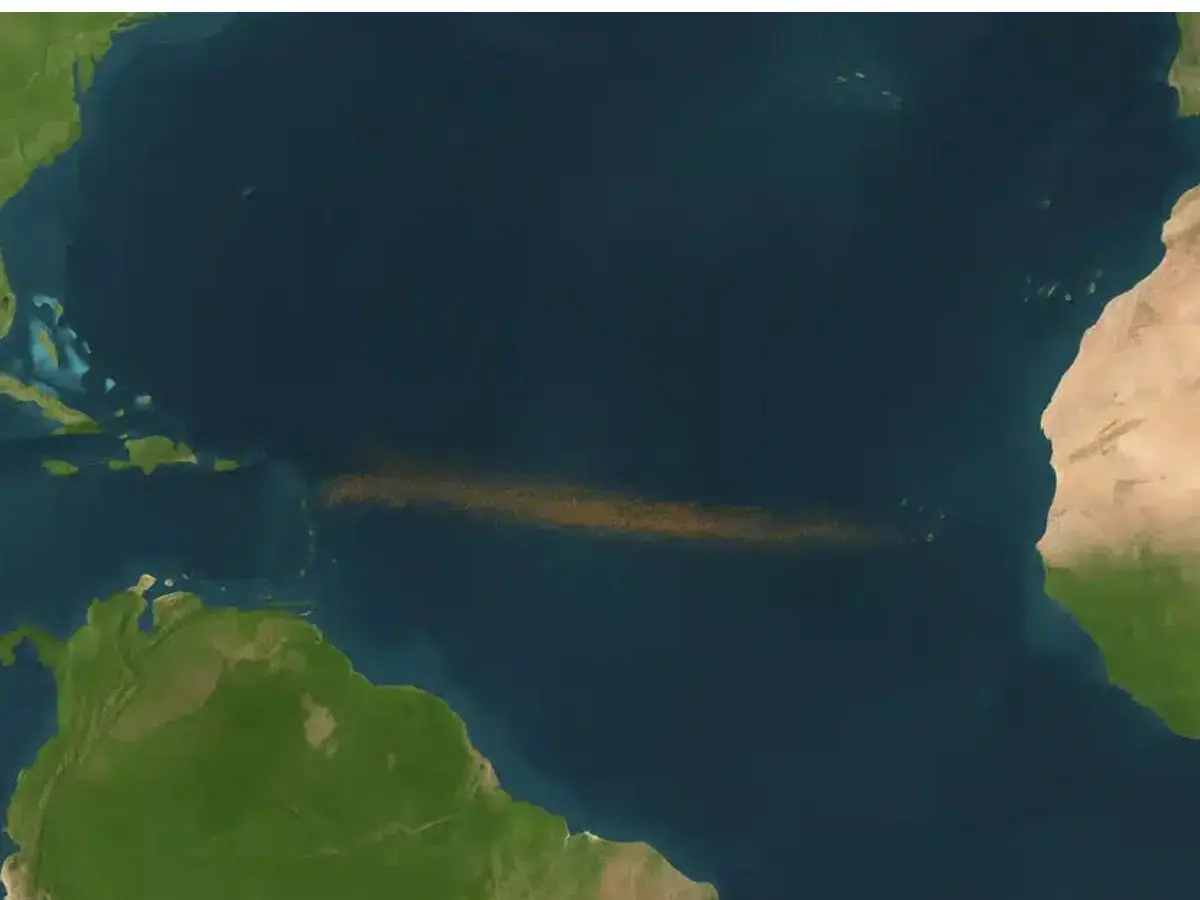
For the last 15 years, a massive belt of algae has been growing, from space it looks like a giant brown ‘ribbon’ connecting the West Coast of Africa to the Gulf of Mexico. Once confined only to the Sargasso Sea, satellite images captured in May indicated that the massive brown ‘ribbon’ weighing 37.5 million tonnes of sargassum was spreading over 8,850 km. The phenomenon is termed the Great Atlantic Sargassum Belt (GASB). First major bloom observed in 2011, it has been growing ever since, and now almost double the width of the continent of America.
Key Driver behind the growth of the Great Atlantic Sargassum Belt
Sargassum generally inhabits oligotrophic or nutrient-poor, warm, and saline waters of the Sargasso Sea. But because of its explosive nutrient-driven growth, it is now found in nutrient-rich waters that are high in nitrogen and phosphorus. This is directly linked to the nutrient-driven algae boom. This can be traced back to the increased nutrient runoff from major rivers and other anthropogenic sources, such as agricultural runoff, wastewater, and airborne nutrients. A scientific study named Harmful Algae, by the Harbour Branch Oceanographic Institute at Florida Atlantic University, reveals that between 1980 and 2020, the nitrogen content within the Sargassum tissue increased by 55 per cent, and the nitrogen to phosphorus ratio increased by 50 per cent. The Amazon River specifically contributes to the large nutrient loads. Natural ocean currents like the Gluf stream, Loop Current, transport the algae across the continent.

Major ecological and economic impacts of the growth of the Great Atlantic Sargassum Belt
The Sargassum Belt provide a diverse and complex ecosystem for many species, like fish, crab, shrimps, invertebrates like spiders, eels, turtles, etc. However, the rapid proliferation of it has raised a series of concerns among scientists. They block sunlight for coral reefs, which is necessary for photosynthesis. They can damage massive carbon sinks. Its decomposition releases hydrogen sulfide, methane and other greenhouse gases. When it washes up on shore, it causes Coastal damage, disruption to tourism, fisheries, and local economies. The cleanup process is costly and potentially damaging to infrastructure. In 1991, the accumulation of Sargassum across the Florida coast led to the temporary closure of a nuclear power plant. As oceans warm up, these will also provide an optimal temperature range for the growth of the Belt. Scientists predict a massive bloom of the Great Atlantic Sargassum Belt; climate variability change in wind and currents could lead to the spread of the Sargassum Belt far north of the Sargasso Sea.