For the first time, scientists found traces of water on the surface of an asteroid

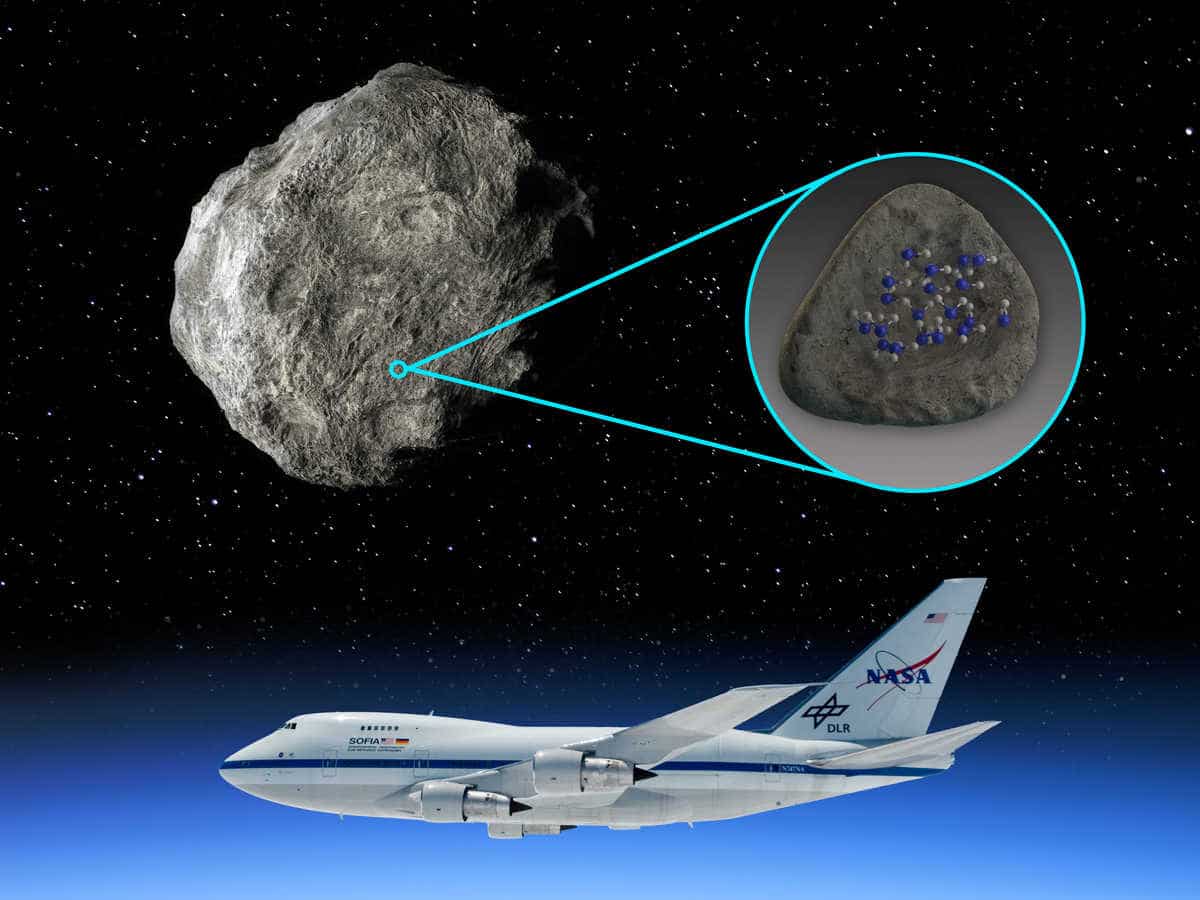
Water discovered on asteroid
When humans found traces of water on the Moon, it was the first sign of life on other celestial bodies, and our quest to explore the outer world more hasn’t stopped since then. Now, scientists have found water on the surface of asteroids for the first time.
The discovery was made with the help of data from the SOFIA infrared telescope on the targeted Iris and Massalia asteroids.
Iris is 199 km (124 miles) in diameter, about 99 per cent larger than other asteroids. Massalia, on the other hand, is 135 km in diameter and shares an orbit similar to Iris's.
Just like other asteroids, Iris and Massalia also orbit the Sun, and it was long believed by scientists that any form of water on them should have evaporated long ago. But therecent discovery busted all those theories.
Talking about the locations of the asteroids, both Iris and Massalia are situated between Mars and Jupiter at an average distance of 2.39 astronomical units taking 3.7 years to complete one orbit.
How water was found on asteroids?
Data captured by SOFIA, the Stratospheric Observatory for Infrared Astronomy which retired in 2022, has revealed the existence of water on asteroids Iris and Massalia. It's not the first time SOFIA has made such a discovery; in October 2020 SOFIA also identified water on the Moon.
SOFIA used its Faint InfraRed Camera (FORCAST) to detect the traces of water molecules on the surface equivalent to 350 millimetres of water in a cubic metre of soil.
Also Read |Potential prevention of rheumatoid arthritis with injection? Clinical study brings hope for millions
Dr Anicia Arredondo, the lead author ofthe paper from the Southwest Research Institute confirmed that based on the strength of the spectral lines, the volume and prevalence of water on the asteroids was consistent as found on the Moon. It was also locked up, bound to minerals andabsorbed by silicates, just like it is on the Moon.
Data was also analysed from two fainter asteroids, Parthenope and Melpomene, but there was too much noise to yield a conclusive result, said Arredondo.
This highlights that the FORCAST instrument lacks the necessary sensitivity to identify the spectral feature of water on these asteroids if indeed it was present.
The team said further investigation is required to grasp the distribution of water throughout the Solar System comprehensively.But based on the current study, the team intends to leverage the capabilities of the James Webb Space Telescope, which is of superior quality optics and has significantly improved signal-to-noise ratio, to dig deeper into this matter.
(With inputs from agencies)