Fossilised jawbone of a mammoth dating back 10,000 years found in Florida

Mammoth
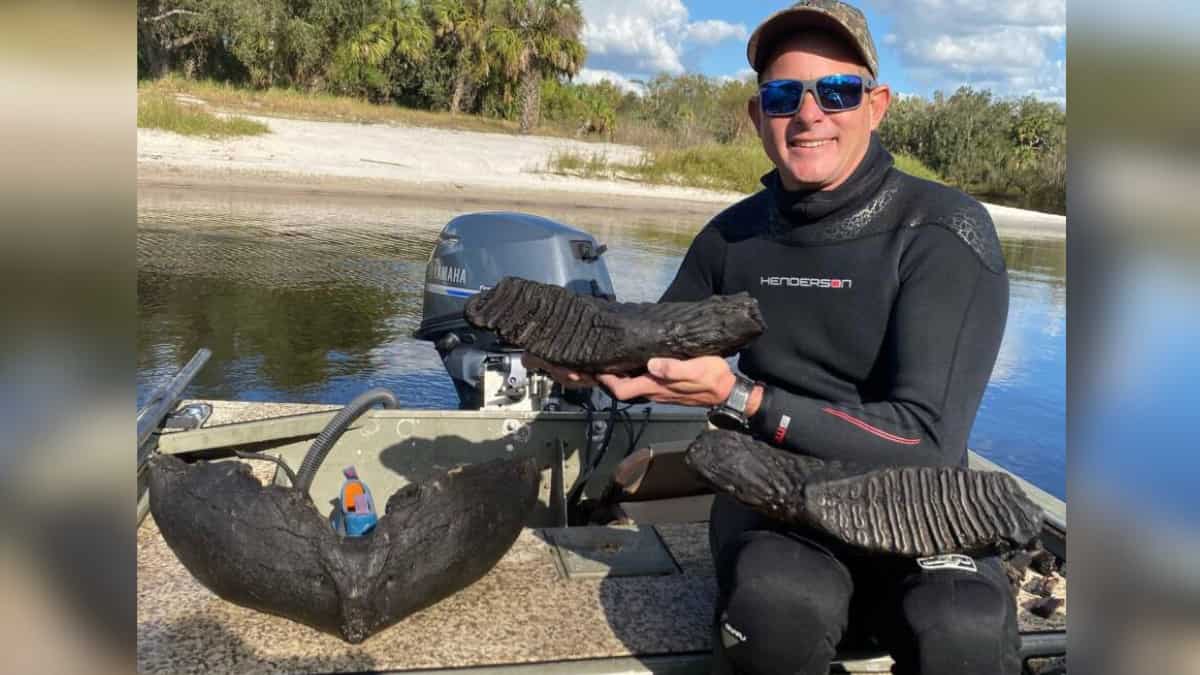
A man in the US state of Florida has discovered a huge fossilised jawbone of a mammoth, believed to be at least 10,000 years old. John Kreatsoulas, a self-proclaimed fossil junkie made the discovery while diving in the alligator-infested waters of the Peace River, near the city of Arcadia.
Kreatsoulas, who runs Fossil Junkies Dig and Dive Charters, an organisation specialising in hosting fossil-hunting trips, made the discovery of the lifetime by innocuously stumbling upon the item, which he initially thought was a log.However, upon closer inspection, he realised it was amandible.
"I grabbed onto it just to hold on for a second, and I realised,'wait for a second, that's not a tree, that was a mammoth jaw,'"Kreatsoulas was quoted as saying by NBC2.
Kreatsoulas explained that he only dives in the alligator-filled river in the wintertime when the gators are dormant. Moreover, it was tenacity that led to the discovery as a day earlier, one ofKreatsoulas' friendshad to pull him out of the river after spotting an alligator nearby.
“So I went up to the surface, and when I got back up there, he said, ‘You didn’t see that big gator?’ I said, ‘No, I wasn’t looking for gators, I was looking for fossils!” saidKreatsoulas.
Watch | Aliens? Mysterious non-human-like fossils revealed in Mexico
Explaining his fascination with the remnants of the past, Kreatsoulas added:“As a kid, my grandmother took me to the library, and they had a little fossil dig. There was a little shark’s teeth in a gravel box kit, and I was hooked."
Kreatsoulas will be taking his discovery toAncient Artworks in Tampa where the jaw will be restored by adding the molars back onto it. He will also register the fossil with the state of Florida with the officials having the decisive say in if he can keep the discovery.
What kind of mammoth?
While it is unknown at this stage what kind of mammoth species headKreatsoulas stumbled upon, experts argue that it could belong toColumbian mammoths (Mammuthus columbi) who inhabited North America during thePleistocene epoch (2.6 million years to 11,700 years ago).
Apart from North America, the Columbian mammoths were also found in Costa Rica. They were likely a hybrid betweenwoolly mammoth (Mammuthus primigenius) and an unknown lineage of mammoth after arriving on the continent from Siberia around 1.5 million years ago.
(With inputs from agencies)