Explained | What exactly is NASA's Lucy Mission?

Lucy Explained
'Lucy' is probably not a name we'd have first impulse to associate with a space mission. Such missions and spacecrafts, at least those from NASA, have crossing-the-final-frontier sort of names. New Horizons, Voyager, Curiosity, Pathfinder and more such names have a sense of grandeur attached to them.
But Lucy?
We'd first look at our phonebook rather than list of space missions to find such a word.
Even if we keep the cliched Shakespearean quote aside, it needs to be impressed that the neatly named Lucy mission attempts to study something that's much grander than what it has in its name.
We've studied planets are the main aspects of our our Solar System, but the asteroid belt has its own secrets and wonders. Lucy aims to focus on that. Lucy is going to study the Trojan Swarms.
Trojan swarms are chunks that were left over after formation of outer planets in our solar system. They locked in an orbit around the Sun same as that of Jupiter.
Lucy was in news just a couple of days ago, as it flew past an asteroid named Dinkinesh. It was its first asteroid target. And the spacecraft's first discovery was indeed a new discovery.
Scientists thought that Dinkinesh was a single piece of rock. But as Lucy found out, Dinkinesh was made up of two space rocks: one is the main asteroid while the other is a 'moon' around it.
When was Lucy launched?
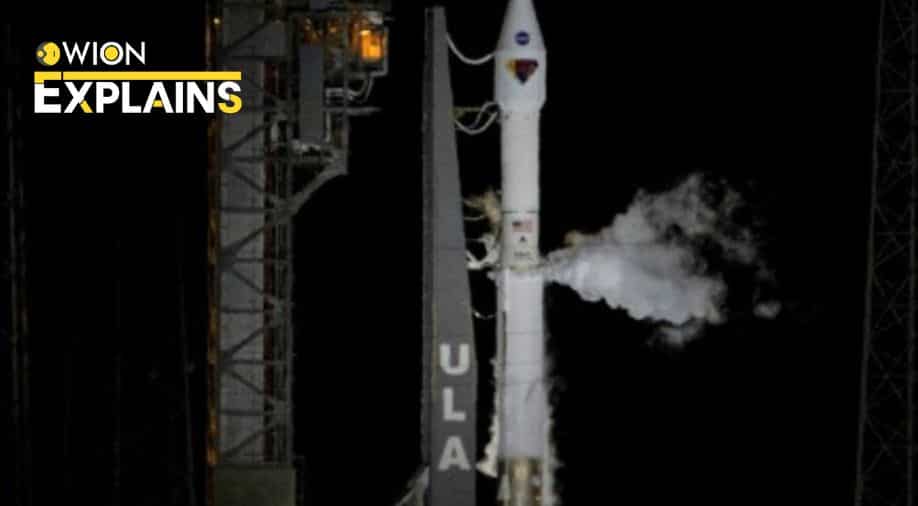
Lucy was launched on October 16, 2021 from Cape Canaveral Space Force station in Florida, USA. A United Launch Alliance (ULA) Atlas V rocket took Lucy to the sky.
What is on cards for Lucy?
A flyby of Dinkinesh was not Lucy's final aim. The spacecraft will visit nine other space rocks through 2033.
“The Trojans are the last big population of objects that we have not yet seen close up,” said Thomas Statler, a NASA planetary scientist on the mission. “And Lucy is going to do that for the first time.”
He was quoted by The New York Times.
Asteroids are often regarded as 'fossils' of planet formation as they are largely made of material that was left behind after the eight planets were formed.
And it is believed by scientists that Trojan asteroids are most likely made of the same primordial material that led to formation of outer planets (Jupiter, Saturn, Uranus, Neptune). They can hence even be considered as 'time capsules' from the time our solar system was forming four billion years ago. Studying these asteroids may give us vital clues about outer planets and even formation of the solar system.
Although Trojan asteroids are clubbed in one group, they differ from one another in their surface composition. This points to a possibility that they formed in different part s of the solar system and then they travelled to their current location as planets formed and evolved. It is possible that these asteroids contain chemical signatures or some other sort of evidence that'll help us understand new corners of our immediate neighbourhood, the Solar System.
Which asteroids will Lucy fly by?
Lucy has already flown past one of eight asteroids it was to say 'hi' to.
So the seven asteroids still waiting for Lucy are:
Eurybates
Queta
Polymele
Leucus
Orus
Patroclus
Menoetius
Lucy will study the asteroids with respect to these properties
Surface Geology
As it studies the asteroids, Lucy will map surface, reflectivity and craters. It will also study spatial and size-frequency distribution of these craters.
Surface colour and composition
Lucy will take a look at composition, colour and regolith properties of the asteroid surface to check distribution of minerals ices and organic species. Regolith refers to the surface 'soil' of the asteroid.
Interior properties
Lucy will check mass and density and also study sub-surface composition.
Satellites and rings
Lucy will also keep its 'eyes' open to check if any Trojan asteroid has rings or satellites.
What will happen when the mission ends?
According to NASA website, when the mission ends, 'Lucy will continue on a stable orbit, traveling from near Earth’s orbit out to the Trojan swarms. The team has carefully designed the trajectory to ensure that Lucy will not hit Earth or contaminate any place that could have signs of life for more than 100,000 years.'
Wow!
And if humans in that distant future don't decide to bring Lucy back, the massive gravity of Jupiter will likely send the spacecraft into the Sun or out of the Solar System.
Watch | Why are some countries changing their clock timings? Trending on WION
And last but not least, why is it named 'Lucy' after all?
NASA missions are famous for pointing to a greater meaning. If not, they at least stand for something.
The careful nomenclature system may appear to have taken a backseat in case of Lucy, as NASA itself says, "Lucy doesn’t stand for anything!"
But name is not without significance. Lucy was a name given to a fossilised human ancestor found in Ethiopia in 1974. The findings revolutionised the scientific understanding of human evolution.
It is expected that the 'Lucy' spacecraft would spark a similar trend but with respect to our solar system.
(With inputs from agencies)