

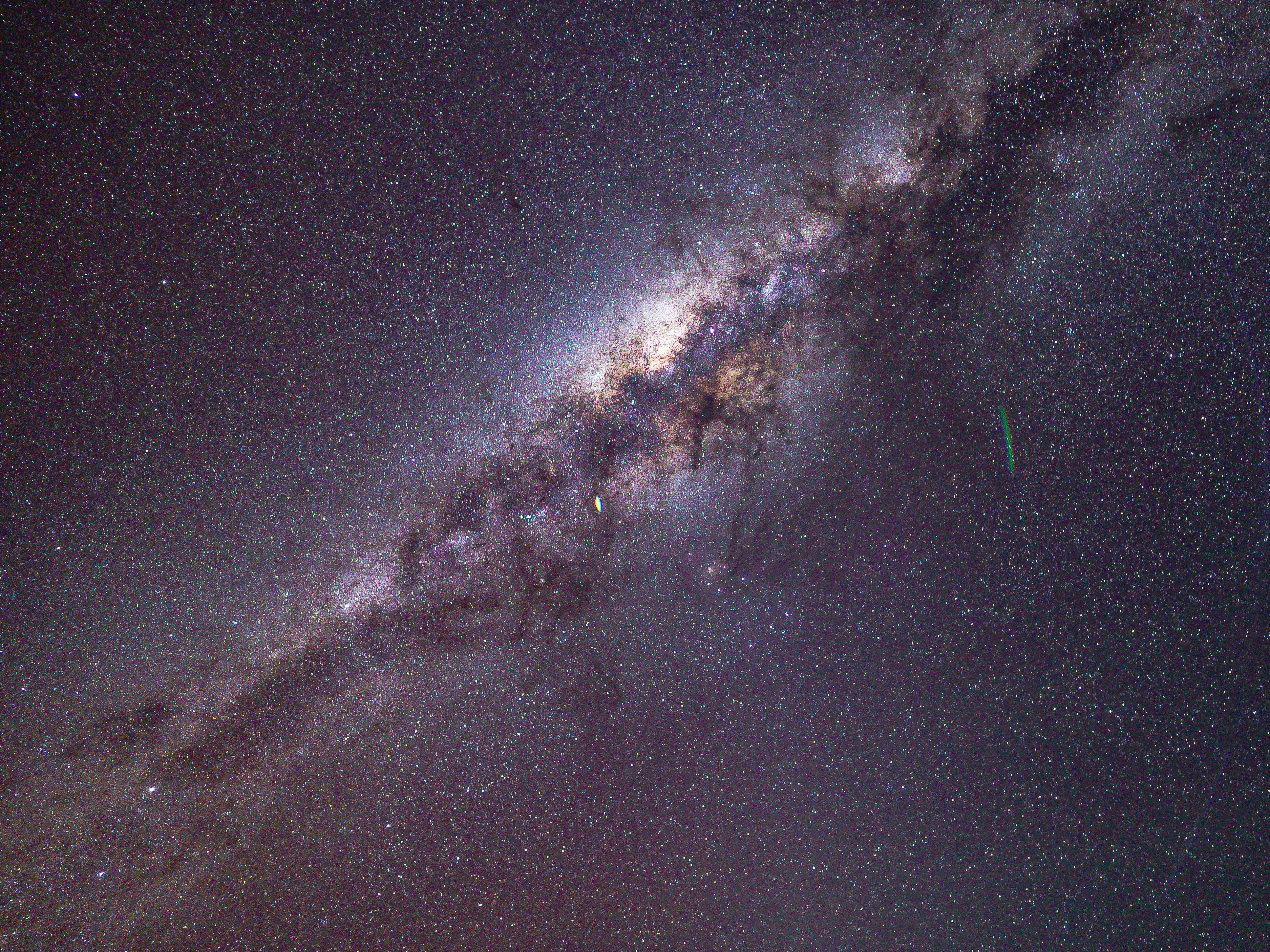
&imwidth=800&imheight=600&format=webp&quality=medium "Eerie glow at the centre of Milky Way could reveal a cosmic giant never seen before")
A team of scientists thinks they might have finally seen dark matter after all these years of speculation about whether it is real or not. Researchers from Johns Hopkins University and the Leibniz Institute for Astrophysics have found a way to locate dark matter in the Milky Way. According to their study, the mysterious gamma–ray glow coming from inside our galaxy is nothing but dark matter. This is because a collision between dark matter particles produces a burst of gamma–ray radiation. If their theory proves to be true, then this would be the first solid proof of the existence of dark matter. Professor Joseph Silk, co–author of the study published in the journal Physical Review Letters, said, "Dark matter dominates the universe and holds galaxies together," and they are constantly thinking of ways to detect this elusive matter. "Gamma rays, and specifically the excess light we're observing at the centre of our galaxy, could be our first clue," he added.
Also Read: Sun chops off 1,396-year Comet Lemmon's tail in rare occurrence - Video
Also Read: 3I/Atlas could release tiny probes that may 'self-replicate' - 'Technological mothership' could reveal itself
What is dark matter?
Dark matter is believed to be the reason for the expansion of the universe and is the glue between various cosmic objects. It has never been observed since it doesn't give off any energy of its own. However, scientists have long believed that something is driving the various cosmic objects in the universe and occupies the majority of the space. The study authors scanned the data collected by NASA's Fermi satellite, which has been creating an image of the Milky Way using gamma rays since 2008. They stumbled upon a diffused glow of gamma radiation at the centre of the galaxy. It was unusual since it wasn't being emitted by a specific source. They theorised that it could only happen from one of two reasons - either it was being released by the spinning cores of dying stars, or it was a result of dark matter collision.
To deduce which one it is, they created a map of the possible locations of dark matter in the galaxy using a supercomputer. Professor Silk said that the Milky Way was formed from a vast cloud of dark matter. "The ordinary matter cooled down and fell into the central regions, dragging along some dark matter for the ride," he said. The dark matter from other systems moved to the dense galactic core, because of which the number of collisions increased. Upon comparison, the simulations and the real pictures of the galaxy taken by Fermi matched. However, he has not dismissed the possibility of dead stars releasing the gamma rays. He hopes the world's most powerful gamma ray telescope, the Cerenkov Telescope Array, to be built in Chile will finally settle the debate.

