A 'new' star will soon appear in the night sky, only to vanish for 80 years

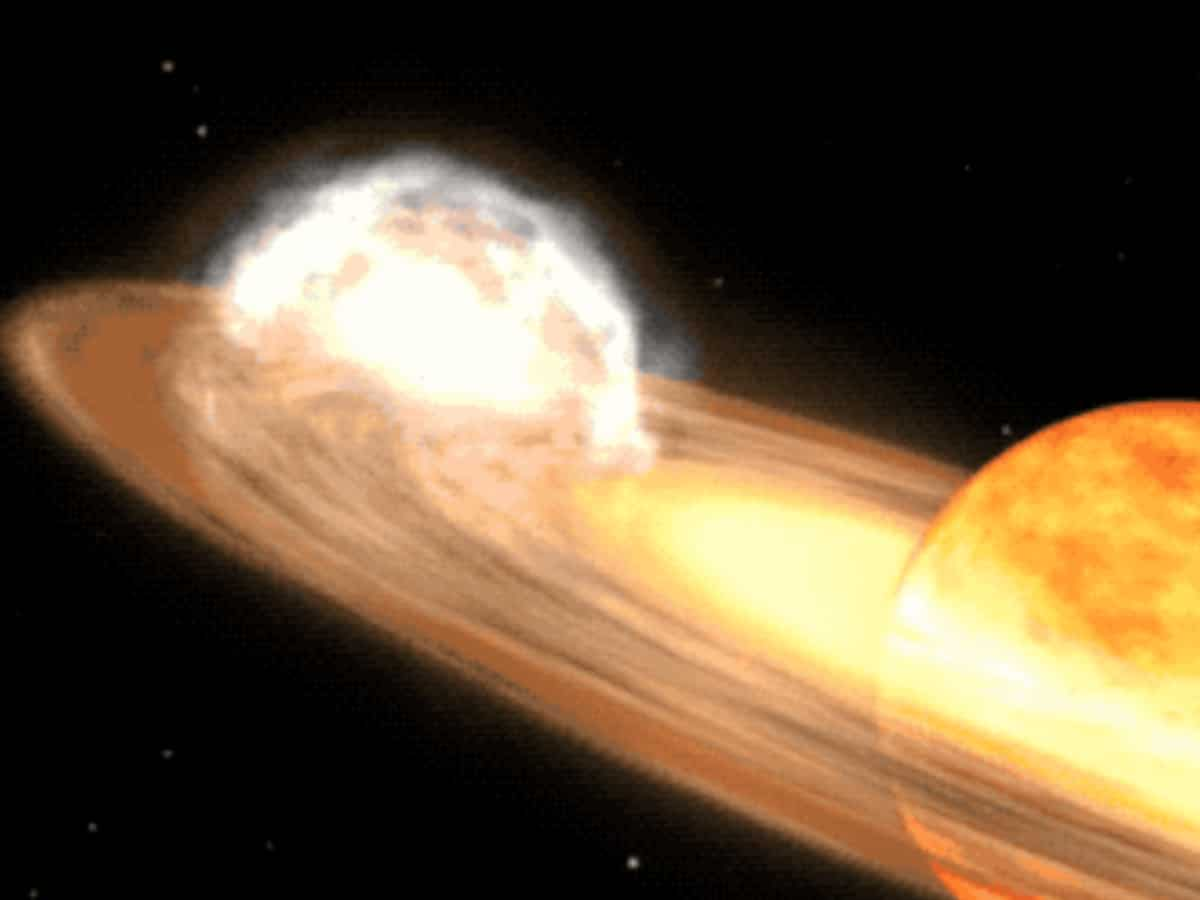
Artist's Concept of Nova Explosion
The universe could bless stargazers with a “once-in-a-lifetime viewing opportunity” of a 3000 light years away star system that will soon be visible to the naked eye from Earth, said NASA. The star system, T Coronae Borealis, also known as T CrB is expected to shine bright in the sky between February and September 2024.
The last time it exploded into a spectacle was back in 1946, and the next time thishappens will be after 80 years.So this is indeed a rare event that many people might witness this year.
The star system will become visible this year
The star system T CrB, normally has a magnitude of +10, which is quite far to see with unaided eyes. But during the Feb-Sep 2024 period, T CrB will jump to magnitude +2, making it quite bright to be seen with the naked eye. As per NASA, the star system will have similar brightness to the North Star, Polaris.
Also Read |7,300-year-old underwater volcano eruption emerges as largest in history, reveals new study
Once its brightness peaks, it should be visible to the unaided eye for several days and just over a week with binoculars before it dims again, possibly for another 80 years.
This phenomenon of a distant star system changing its magnitude and becoming visible to the naked eye is called a nova outburst.
Corona Borealis constellation
The constellation Corona Borealis is also known as Northern Crown, which is a small, semi-circular arc near Bootes and Hercules. This is the site where the outburst will appear as a “new” bright star, as per NASA.

This recurrent nova is just one of five observed within our galaxy. The phenomenon occurs due to the binary nature of the system T CrB, which consists of a white dwarf and a red giant.
The proximity of these stars enables a fascinating process- as the red giant experiences instability due to rising temperature and pressure; it sheds its outer layers, which are then captured by the white dwarf.
Over time, the accumulated matter on the white dwarf's surface ignites in a runaway thermonuclear reaction, resulting in the spectacular nova visible from Earth.
(With inputs from agencies)