China pushes through communications satellite to rival Elon Musk’s Starlink

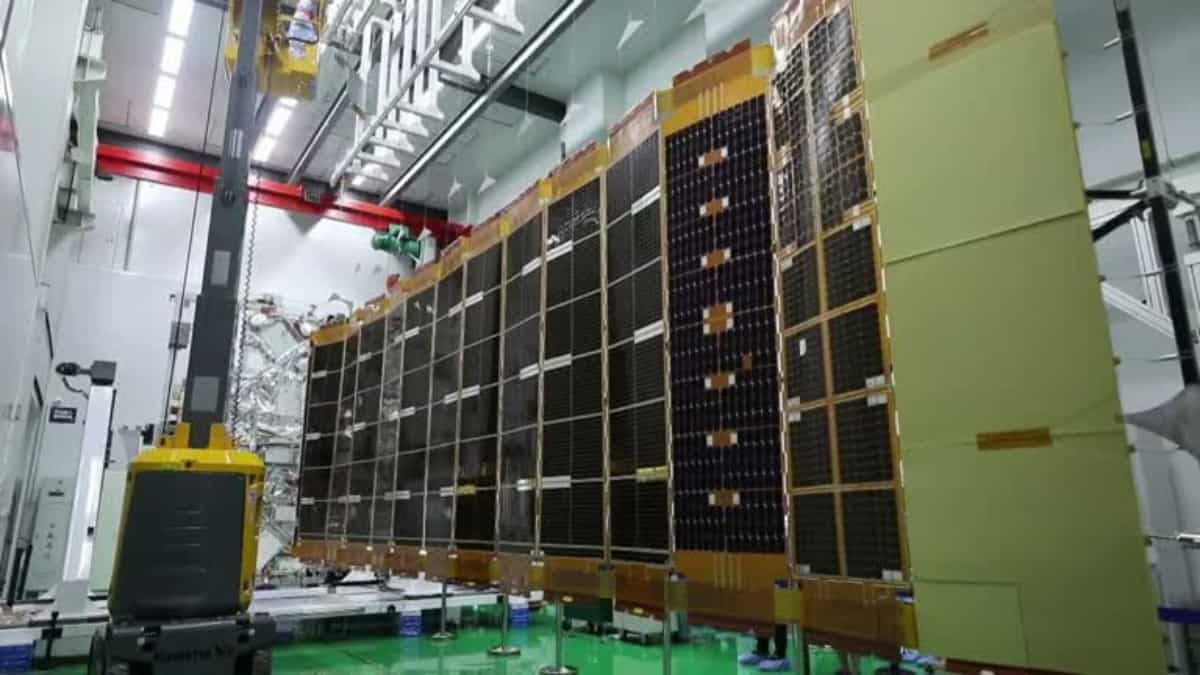
Flexible solar array for China's first flat-shaped satellite.
China's first communications satellite has been launched which is bearing an ultra-thin flexible solar wing as it puts to test the technologies for the 13,000-satellite broadband mega constellation which has been planned by the country in low-Earth orbit to create a rival toSpaceX’s Starlink.
The Lingxi-03, which has been created by the Beijing-based start-up GalaxySpace, was placed on top of a Long March 2D rocket and took off from the Taiyuan Satellite Launch Centre in Shanxi province in central China at 10.50 am on Sunday (23 July).
The bendable solar panel of Lingxi-03 measures about 1mm thick, which is equal to the thickness of a credit card and is only 5 per cent of the thickness that a traditional solar panel has, as per state broadcaster CCTV. When the panel is folded inside a rocket, the thickness of the solar array is 5cm (2 inches) and it can expand to 9 metres long and 2.5 metres wide (29.5 feet by 8.2 feet) once it is operational in orbit.
Earlier, such solar panels have been used by China only to power its Tiangong space station, reported CCTV on Sunday.
“These solar wings are small, lightweight and easy to store. They absorb more solar energy than traditional solar panels do and are especially suitable for large-scale stackable satellite launches,” said Zhu Zhengxian, chief technology officer of GalaxySpace, while speaking to China Science Daily on Tuesday (July 25).
First satellite withintegrated main body structure
The Lingxi-03 is also the first satellite of China with an integrated main body structure, as per Zhu. He stated that the satellite platform has been inspired by used advanced die-cast technologies and the chassis of a car, making it suited to mass production.
The Lingxi-03 has been equipped with a digital payload which can handle tens of gigabytes of data per second and will verify technologies which are connected to active thermal control, next-generation low-orbit broadband communications, and stackable satellite release, among others, said the satellite’s chief commander Hu Zhao, while speaking to CCTV.
WATCH |China gives no reason for removing Qin Gang as Foreign Minister
“It synthesises many functions of a ground-based station and can analyse an enormous amount of user information,” Hu stated.
The Lingxi-03 has been built in an open-frame design which means that all instruments are attached directly to the satellite's exterior and exposed to the harsh space environment. Hu stated that this needed temperature control and extraordinary radiation protection for the electronics on the device.
You cannow write forwionews.comand be a part of the community. Share your stories and opinions with ushere.
WATCH WION LIVE HERE