Caught in the act: Astronomers capture precise moment in which a black hole sucks a star

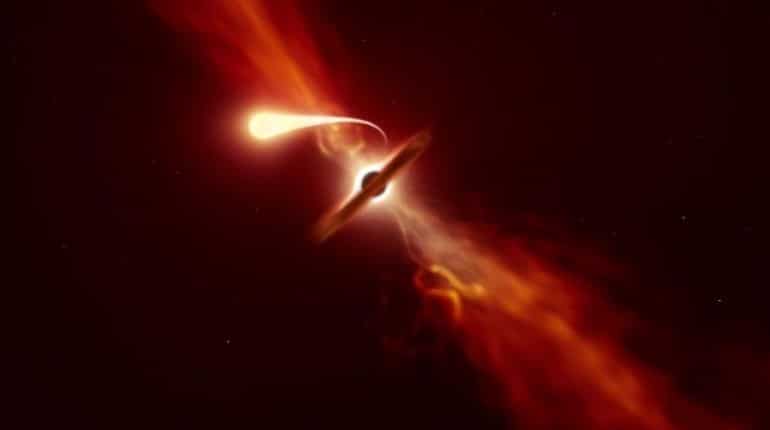
Astronomers capture precise moment in which a black hole devours a star
Astronomers have captured the precisemoment in which a massive black hole devoured a star by a process called 'spaghettification'.
Using the European Southern Observatory'sVery Large Telescope(ESO's VLT), researchers spotted the ''tidal disruption event'' (TDE) which createsspaghettification,is the closest such known event to happen, at only 215 million light years away from Earth.
The TDE, AT2019qiz was first spotted byMatt Nicholl, the new study's lead author and a lecturer and Royal Astronomical Society research fellow at the University of Birmingham in the United Kingdom.
Nichollsaid"The idea of a black hole 'sucking in' a nearby star sounds like science fiction. But this is exactly what happens in a tidal disruption event."
The star, roughly the same size as our sun, was eventually sucked into oblivion in a rare cosmic occurrence that astronomers call a tidal disruption event.
Such phenomena happen when a star ventures too close to asupermassive black hole, objects that reside at the centre of most large galaxies including our Milky Way. The black hole's tremendous gravitational forces tear the star to shreds, with some of its material tossed into space and the rest plunging into the black hole, forming a disk of hot, bright gas as it is swallowed.
Edo Berger from the Harvard-Smithsonian Center for Astrophysics explained,"In this case the star was torn apart with about half of its mass feeding or accreting into a black hole of one million times the mass of the sun, and the other half was ejected outward."
Observing the oscillation of light as the black hole gobbles the star and spews stellar material in an outward spiral could help astronomers understand the black hole's behaviour, a scientific mystery since physicist Albert Einstein's work more than a century ago examined gravity's influence on light in motion.