Blackhole caught gobbling up celestial matter leaving astronomers in awe

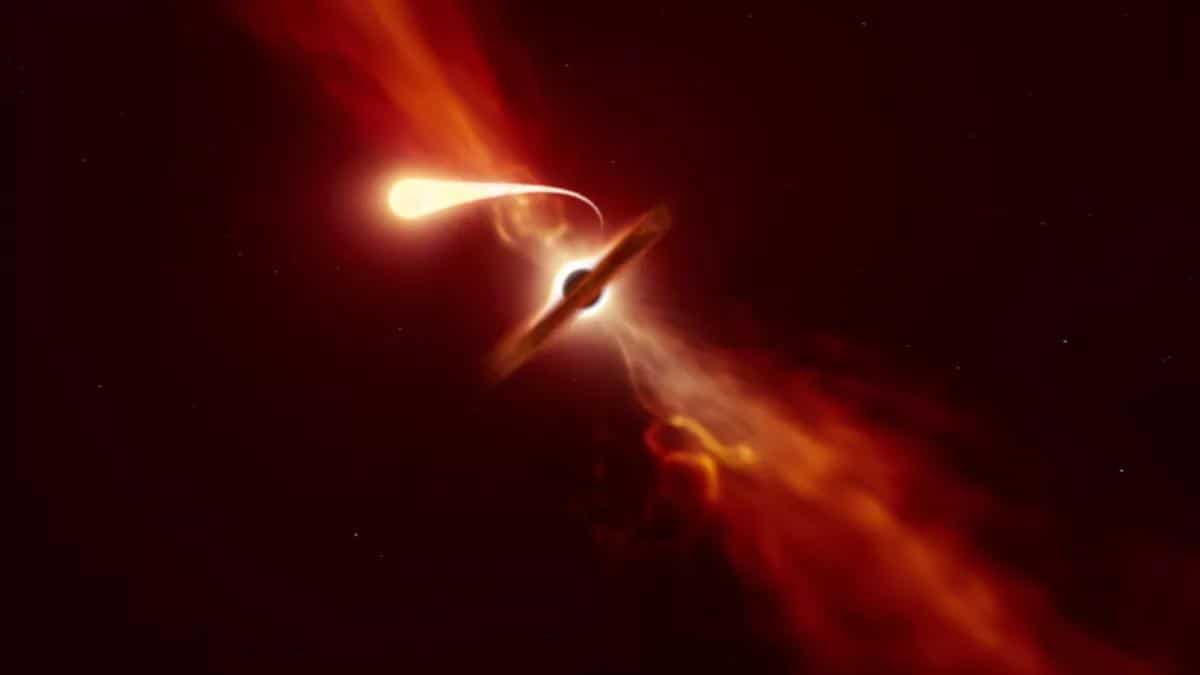
Blackhole eating up
Astronomers watched in awe as a supermassive blackhole began to consume its surrounding matter, emerging as a standout transient "switching on" event about 10 billion light-years away from earth.
Transients refer to celestial events or entities that undergo rapid changes in terms of the intensity of light.
The particular phenomenon generated by this voracious black hole, named J221951, ranks among the most dazzling transients ever documented, according to a Space.com story.
The location of the black hole aligns with the center of a previously observed galaxy, precisely where a supermassive black hole would typically reside.
However, astronomers are yet to ascertain the precise cause behind the transient event observed in J221951.
"Our understanding of the different things that supermassive black holes can do has greatly expanded in recent years, with discoveries of stars being torn apart and accreting black holes with hugely variable luminosities," team member and University of Belfast astronomer Matt Nicholl, said in a statement. "J221951 is one of the most extreme examples yet of a black hole taking us by surprise."
Also watch |Gravitas: Scientists reveal the sound of a super massive black hole
Presently, the nature of the material being devoured by the supermassive black hole remains unknown.
However, reports say that it is possible that J221951 represents a star that has ventured too close to the black hole, ultimately being torn apart by the immense gravitational forces in a process known as spaghettification.
The spaghettification of a star is not the sole mechanism that could account for the luminous transient event associated with the black hole in question.
Another possibility of such an event is that J221951 stems from the nucleus at the core of a galaxy transitioning from a dormant to an active state.
"Continued monitoring of J221951 to work out the total energy release might allow us to work out whether this is a tidal disruption of a star by a fast-spinning black hole or a new kind of AGN switch on," Nicholl added, while referring to Active galactic nuclei (AGNs) – the bright areas at the heart of galaxies that blast out enough light to drown out the combined light of every star in the rest of that galaxy.
WATCH WION LIVE HERE
You can now write for wionews.com and be a part of the community. Share your stories and opinions with us here.