A hint of life in universe? NASA makes breakthrough discovery of carbon molecule in space

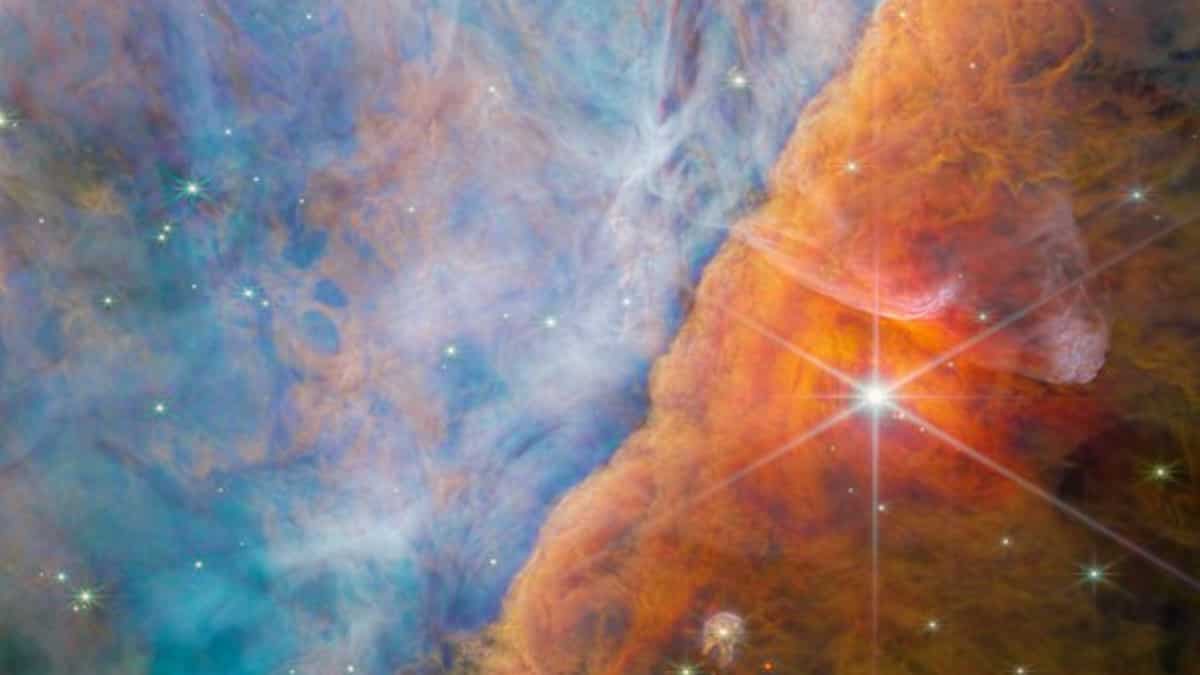
Carbon compounds are present in the foundations of all known life, says NASA.
The National Aeronautics and Space Administration (NASA) made a stunning breakthrough in their search for the existence of life in the universe with the discovery of a carbon molecule which is said to be the foundation for all life known to exist.
The breakthrough discovery of carbon molecules was made by NASA's James Webb Space Telescope.
"A team of international scientists has used NASA’s James Webb Space Telescope to detect a new carbon compound in space for the first time. Known as methyl cation (pronounced cat-eye-on) (CH3+), the molecule is important because it aids the formation of more complex carbon-based molecules. Methyl cation was detected in a young star system, with a protoplanetary disk, known as d203-506, which is located about 1,350 light-years away in the Orion Nebula," stated NASAin its latest website post.
The space agency added that carbon compounds exist in the foundations of all known life, and their discovery is particularly interesting for scientists who are working to understand how life developed on Earth, and how it can exist in some other part of the universe. "The study of interstellar organic (carbon-containing) chemistry, which Webb is opening in new ways, is an area of keen fascination to many astronomers," stated NASA.
James Webb Telescope's key role in carbon discovery
Explaining the role of the James Webb Telescope in the discovery of carbon molecules, NASA stated, "The unique capabilities of Webb made it an ideal observatory to search for this crucial molecule. Webb’s exquisite spatial and spectral resolution, as well as its sensitivity, all contributed to the team’s success. In particular, Webb’s detection of a series of key emission lines from CH3+ cemented the discovery."
Marie-Aline Martin-Drumel, who is a professor at the University of Paris-Saclay in France and a member of the science team, stated that this discovery not only validates Webb's incredible sensitivity but also emphasises the postulated central importance of CH3+ in interstellar chemistry.
WATCH |NASA scientist admits that the Moon 'might already have life on it'
"While the star in d203-506 is a small red dwarf, the system is bombarded by strong ultraviolet (UV) light from nearby hot, young, massive stars. Scientists believe that most planet-forming disks go through a period of such intense UV radiation since stars tend to form in groups that often include massive, UV-producing stars," NASA stated.
NASA said that generally complex organic molecules are destroyed by UV radiation and hence, the discovery of CH3+ is a big achievement.
"However, the team predicts that UV radiation might actually provide the necessary source of energy for CH3+ to form in the first place. Once formed, it then promotes additional chemical reactions to build more complex carbon molecules. Broadly, the team notes that the molecules they see in d203-506 are quite different from typical protoplanetary disks. In particular, they could not detect any signs of water," stated NASA.
You cannow write for wionews.comand be a part of the community. Share your stories and opinions with ushere.
WATCH WION LIVE HERE