5,000-year-old skeleton is of 'Ivory Lady' & not 'Ivory Man', Spanish scientists find

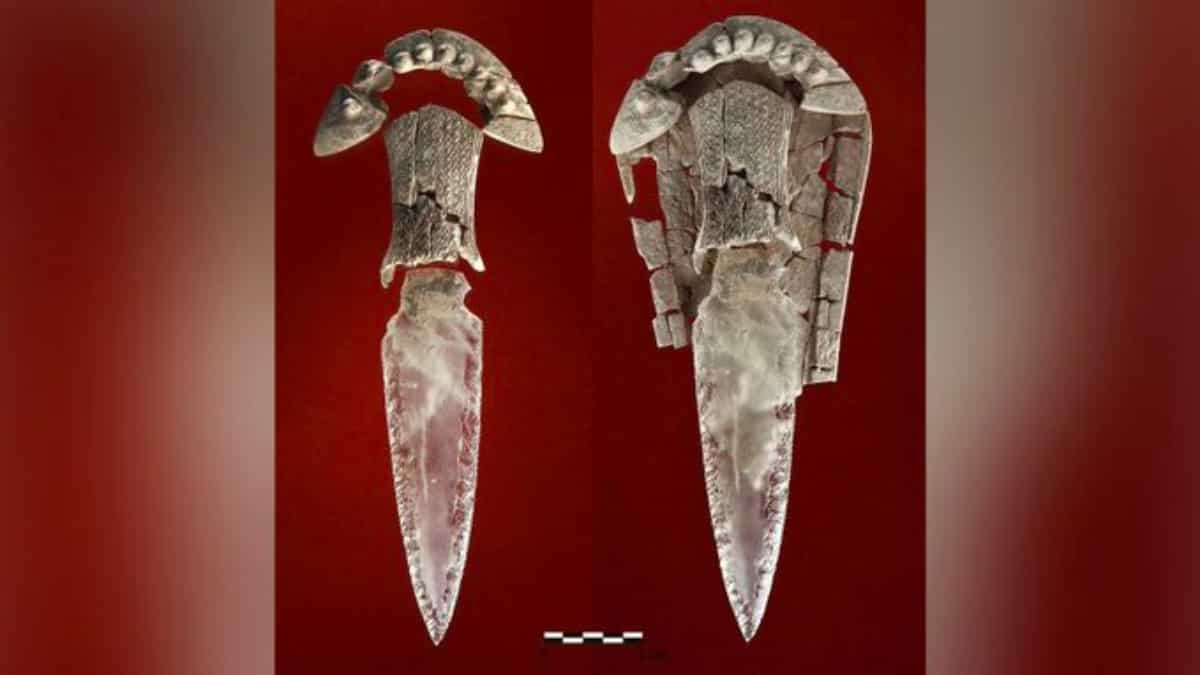
Crystal dagger which was discovered at the tomb near Seville, Spain.
A 5,000-year-old skeleton, which was discovered in a tomb near Seville, Spain, in 2008, along with an ivory comb, a crystal dagger, a flint dagger inlaid with amber, an ostrich eggshell and an elephant’s tusk and believed to be that of man, has now turned out to be a revered woman of her times.
On the basis of the analysis of the pelvis bone, initially, a specialist identified the skeleton as a “probable young male” who died between the age of 17 and 25. The remains, which were dubbed the “Ivory Man”, started being researched by a team of European archaeologists, who called it a “spectacular” find.
Almost a decade later, a new molecular method was used by researchers in 2021 to confirm the gender of the skeleton as part of a broader study on its discovery. However, the results left them in shock as the “Ivory Man” turned out to be a woman.
“This came as a surprise. So, this actually forced us to rethink everything about this site,” stated study author Leonardo García Sanjuan, a professor of prehistory at the University of Seville.
The researchers discovered more about the woman and the society she lived in. “In the past, it was not uncommon for an archaeologist to find (remains) and say, ‘OK, this individual has a sword and a shield. Therefore, he’s a man.’ Of course, deeply mistaken, because it assumes that in the past gender roles were the way we conceive them today,” said García Sanjuan.
“This technique, we think, is going to open up an entirely new era in the analysis of the social organisation of prehistoric societies,” she added.
New method to find the gender of skeletons
The latest method to determine the gender of old bones, which was first used in 2017, involves analysing tooth enamel, which contains a particular type of protein with a sex-specific peptide called amelogenin, which can be identified in a lab.
Speaking about the latest method, Bioarchaeologist Rebecca Gowland, a professor at the University of Durham said, “It’s being used more and more now. It’s exploding a little bit, which is exciting. We are testing the limits… and seeing how far back in time we can go.”
WATCH |Aliens: Are we looking in the wrong place?
She further added that the method can be used on both childhood and adult teeth and is particularly useful for the latter. “That’s because it’s impossible to tell the sex of children’s skeletons until they go through puberty,” she said.
You cannow write for wionews.comand be a part of the community. Share your stories and opinions with ushere.
WATCH WION LIVE HERE