

&imwidth=800&imheight=600&format=webp&quality=medium "1.2 billion light-years away, a triple black hole collision is occurring for the first time")
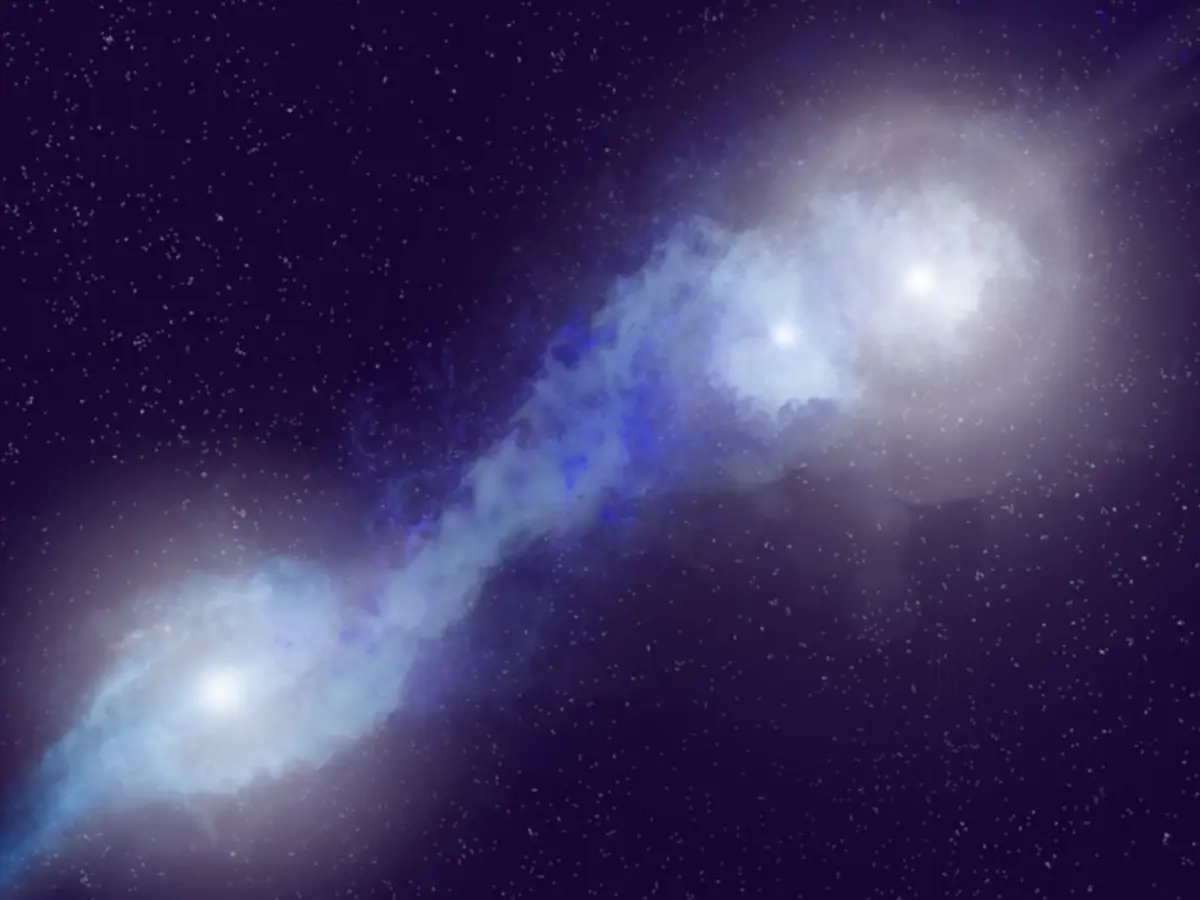
A giant, triple collision is about to happen 1.2 billion light-years from Earth, with three galaxies set to crash into each other. Named J1218/1219+1035, it is a rare cosmic event where a system is forming, where each of the three supermassive black holes will also collide. All of them are gobbling material at extreme speeds, releasing radio lights and actively launching jets. This mind-blowing occurrence will turn the concept of triple radio-active galactic nuclei (AGN) into reality. It also offers a peek into the life cycle of supermassive black holes." Astrophysicist Emma Schwartzman of the US Naval Research Laboratory said, “Triple active galaxies like this are incredibly rare, and catching one in the middle of a merger gives us a front-row seat to how massive galaxies and their black holes grow together.”
How common are galaxy mergers?
Galaxy mergers are quite common in the universe. In the Milky Way alone, three to four major galaxy mergers have occurred over 13 billion years. But that is true for a double galaxy merger. J1218/1219+1035 is rare in more ways than one. Having a triple galaxy collision has hardly ever happened before, and an event where all three come together at the same time, instead of in a staggered manner, seldom happens. Besides, this is the first galaxy merger where all three AGNs are shining in radio light, and only the third where all three galaxies have AGN. The findings were published in The Astrophysical Journal Letters.
The triple galaxy merger was spotted by the Wide-field Infrared Survey Explorer. Initially, it appeared like two galaxies were coming together, with their edges already overlapping. Each had a radio-active galactic nucleus, which was confirmed in later observations. They were around 74,000 light-years away from each other. But then they saw a third galaxy with a blazing AGN located about 316,000 light-years away was also at play. A tail of gas flowing from the third one towards the other two showed that a triple collision was happening.

