&imwidth=800&imheight=600&format=webp&quality=medium "'Not spiral, not elliptical': Hubble spots a bizarre galaxy 67 million light-years away defying all known categories")
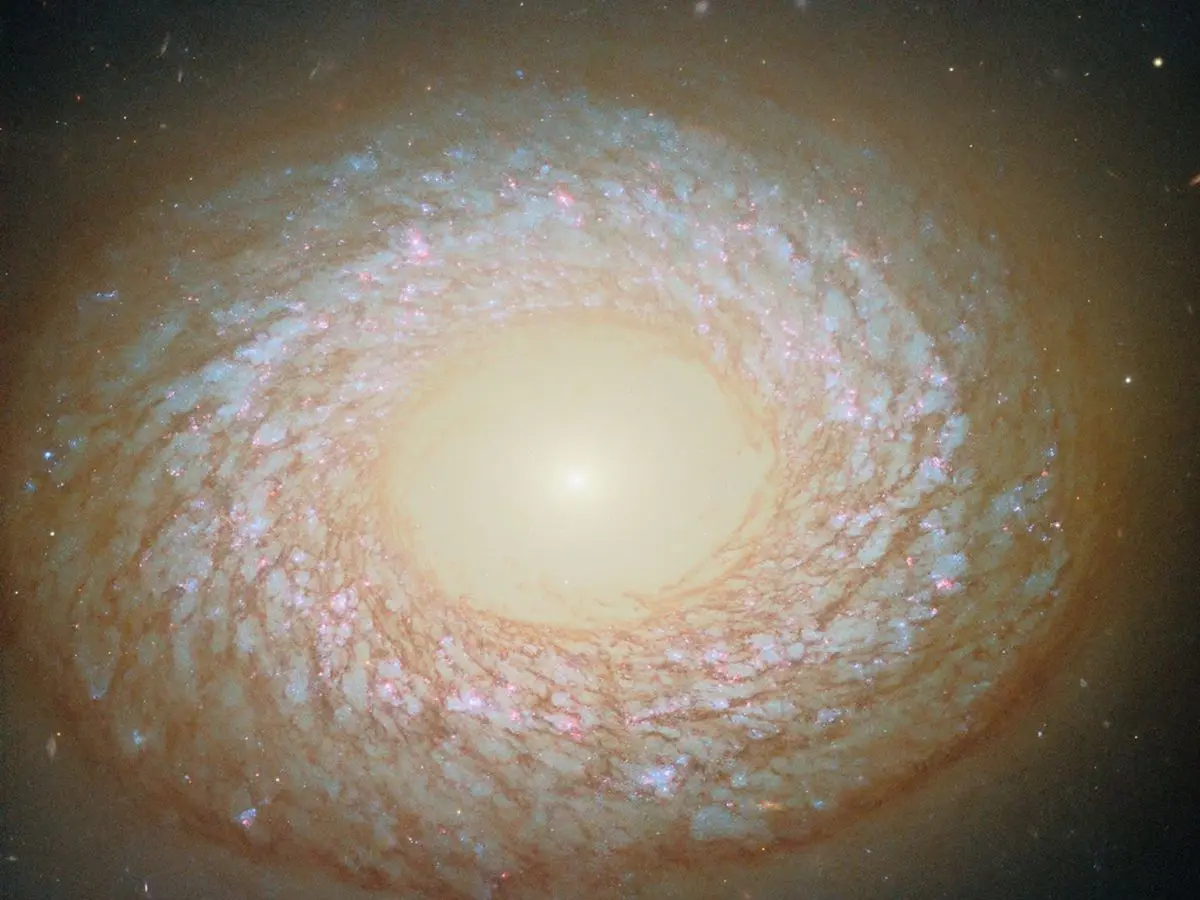
Astronomers have long relied on broad morphological categories, spiral, elliptical, lenticular, to sort galaxies into tidy boxes. But the recent Hubble image of NGC 2775 upends such simplicity. At roughly 67 million light-years distant in the constellation Cancer, this galaxy combines features from disparate classes in a way that resists easy classification. Its smooth, gas-poor central bulge looks like an elliptical galaxy, yet it is encircled by a dusty ring containing pockets of star formation, akin to a spiral.
A Galaxy of Two Worlds
At its core, NGC 2775 presents itself as deceptively simple. The inner region is smooth and devoid of gas, characteristics typical of elliptical galaxies. There, star formation has essentially ceased, leaving behind an ageing population of stars. Surrounding this core, however, lies a ring of dust and gas, punctuated by clusters of young stars and hints of faint, flocculent spiral arms.

Many astronomers lean toward classifying it as a flocculent spiral galaxy, a type of spiral galaxy whose arms are loosely defined and patchy. Yet it also shows features reminiscent of a lenticular galaxy, a class that bridges spirals and ellipticals and is often thought to form when spirals exhaust their gas and lose their distinct structure.
Clues from Past Encounters
NGC 2775’s odd structure may be a fossil record of past mergers or close encounters. Observations have revealed a hydrogen gas tail stretching nearly 1,00,000 light-years, likely the remnant of a disrupted companion galaxy. The nearby irregular galaxy NGC 2777 appears to have a tidal hydrogen tail tracing back to NGC 2775, suggesting they may have interacted in the past. Such encounters could strip gas from the galaxy’s interior, weaken spiral arms, or gradually transform its shape. The shell-like structures in the outskirts and faint tidal debris support the idea that NGC 2775 is in an intermediate evolutionary phase.
Trending Stories
Why This Galaxy Matters
This unusual system offers astronomers a rare laboratory for studying morphological transformation. Because we see it from only one angle, the classification remains uncertain, but that ambiguity is precisely what makes it valuable. It may reveal how spiral galaxies fade into lenticular or elliptical forms, or how mergers and interactions sculpt galactic structure.