Blog: Students creating awareness about hygiene

Students
Who are today’s “the Moon” and “the Sun”? The students start to gather. Some are busy sweeping, some are watering the plants, some are arranging the sound box, and so on, as they are in the school. Once you step inside the school, you can feel the warmth in the morning hours.
Now, slowly, the teachers start to gather too. They’re all coming for the school assembly. A group of students are helping to organise the other students into a proper queue. These students are also helping other students to dress properly, helping them in combing their hair, getting their shirts tucked in, checking that their nails are cut a proper length, and so on.
As the final call for the assembly is aired, some children come running, gasping for air, until they settle in organised rows. There is a small group leading the assembly. The state anthem, a song of Bihar, rings in the assembly, as students sing along. I notice that some students are trying to be more attentive, shutting their eyes. The procedure is going on for quite some time, continuing for the next 20 minutes in total synchronisation.
It features different activities, like story-telling, sharing thoughts of the day, doing a quiz, reading the news – and a selection of “Chanda and Suraj”.
That sounds different. “Chanda” means Moon and “Suraj” means Sun in Hindi and other Indian languages. But in this context, the Moon and the Sun do not play a mythical or special role but serve as an example. Here, the selection of “Chanda” and “Suraj” identifies two children for the day in the school who are the most well-dressed among all. The selection happens every single day during the morning assembly.
This recognition acts as a motivation and positive reinforcement for the other students to be well-dressed. Rounds of applause and the crown on their heads act as a morale booster for the school.
Initiating the idea of cleanliness and hygiene is an important task for the students in the school. Sarva Shiksha Abhiyan (SSA) has launched this approach as a part of the school health and hygiene programme. Quest Alliance, through their Anandshala programme, is tackling it in a more participatory way. They engage the students in the process of selection and coming out with innovative ways of recognising and awarding the students to reinforce health and hygiene. Creative activities about the school’s health and hygiene practices help the students be more inclined towards their school activities and practices in general. As a result, students are trying to maintain good hygiene and come to school enthusiastically.
The schools are framing their vision towards the school hygiene projects, which is binding the students towards the school activities. The students are imbibing the healthy habits, like washing hands before meals.
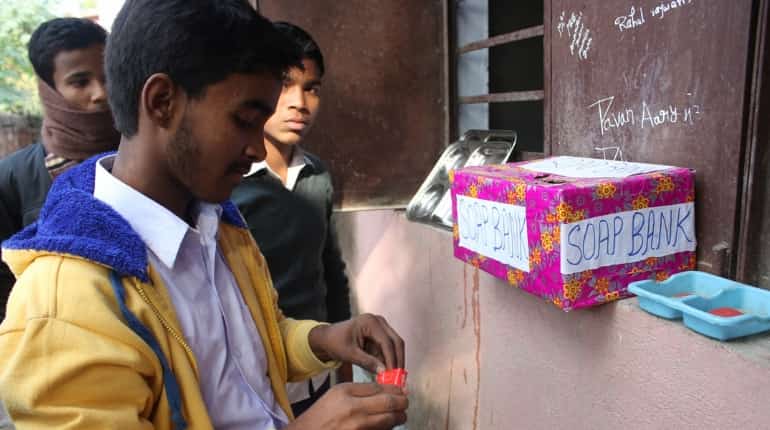
Hand washing is fun now! For example, in the Government Middle School Waini of Samastipur in Bihar, the students have initiated a Soap Bank to create a repository of soaps to bridge the gap of resources. This soap bank has come up with the contribution from the students and teachers of the school, as in one soap per students and five soaps per teachers. Simultaneously, going back home the students are sparking the healthy habit in their communities. This ultimately bridges the gap between the students, the school and the community. “The children are now asking for soaps to wash their hands”, says the Health and Hygiene Minister of the school.
With time, students in public schools in Samastipur, Bihar, are including the school cleanliness programme on their yearly agenda. They are now raising their voices about sanitation issues in the school and trying to come up with solutions for it. Along with the basic cleaning before the morning assembly, they are demanding clean toilets, repairing of the infrastructure, running water facilities, safe drinking water stations, and hand washing stations in their schools. These messages are being carried back to the community. They are also initiating the hygiene practices back in their community, just like encouraging to wash hands before having meals.
They are asking their parents to get them in proper dress-up before coming to school. The community is also attending the parents and teachers meetings to discuss the matters of sanitation and hygiene practice and water crisis in the school. They are paying attention to the trial for innovations in the school. They are developing the motivation towards their school.
Anandshala is playing a significant role in mobilising students in creating changes in the public schools of Samastipur in Bihar. They involve the students in flag discussions and foster creative thinking about their school.
Partnering with the school teachers and headteachers, they are integrating the students into the school development activities. They are also creating a platform and recognising the changes happening in the school with the District Education Department of the government of Bihar.
The students are now also feeling the connect towards their school. These approaches are helping them and especially the girls to stay back in the school – even on their menstruation. This is assuring them to stay back and ensuring the attendance level in the school. Slowly, the students are gathering confidence about their school and building the ownership of their school.
Thereby, it is helping to bridge the gap between the students and the school and also with the community.
(A previous version of this article was originally published by the American India Foundation)
(Disclaimer: The opinions expressed above are the personal views of the author and do not reflect the views of ZMCL.)