India's forgotten heroes: Pingali who designed the 'Tiranga'

Unsung Heros
Batukeshwar Dutt, an Indian revolutionary from the early 1900s, was born in a small village in Purba Bardhaman district
By Puniti Pandey
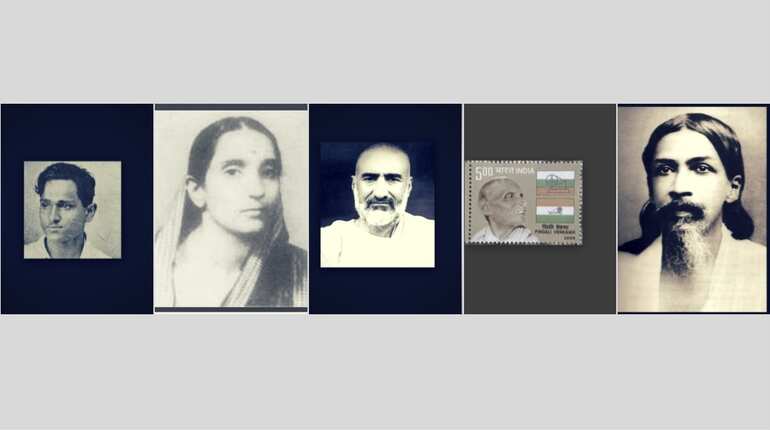
Batukeshwar Dutt
Batukeshwar Dutt, an Indian revolutionary from the early 1900s, was born in a small village in Purba Bardhaman district in present West Bengal on 18 November 1910.
Dutt was the member of Hindustan Socialist Republic Association and was well versed with the bomb making techniques. He was one of the freedom fighters who accompanied Bhagat Singh in the popular bomb explosion of 8 April 1929 in the Central Legislative Assembly.
The explosion was held in protest against the Trade Disputes and Public Safety Bill that gave more power to British Government against Indian freedom fighters.Though Dutt himself did not throw any of the two bombs, he took charge of one of it to show his support for Bhagat Singh. He was later sentenced to life imprisonment where he held a historic hunger strike revolting against the exploitation of Indian political prisoners which gained some rights for them.After his release from prison, in his last days, Dutt suffered from tuberculosis, but this did not stop him from participating in the Quit India movement for which he was again sent to jail.
In the post-independent era, Dutt did not get much recognition and was forced to live a life under immense poverty. He died on 20 July 1965 after prolonged illness and was cremated in Punjab, in the same place where Bhagat Singh, Rajguru, and Sukhdev were cremated long before.
Durga Bhabhi
Wife of Hindustan Socialist Republican Association member Bhagwati Charan Vohra, Durgawati Devi was popularly called Durga Bhabhi by other HSRA members. Durga Bhabhi was one of the few women revolutionaries who actively fought against the British Raj.
She accompanied Bhagat Singh in the train journey where Saunders was put to death. 'Bhabhi' had been an active member of the Naujawan Bharat Sabha before assisting Bhagat Singh and Rajguru in Saunders killing.She helped Bhagat Singh and Rajguru to escape after killing Saunders. On 19 December 1928, two days after the incident, Devi, Bhagat Singh and Sukhdev took a train from Lahore for Bhatinda en route to Howrah. In this escape, Bhagat Singh had shaved his beard, trimmed off his hair and was dressed in a western attire to disguise as Devi's husband. Rajguru acted as their servant and carried their luggage.
Devi even led the funeral procession of Jatindra Nath Das after he died due to the long 63-day jail hunger strike.
Later Durgawati tried assassinating Lord Hailey after Bhagat Singh's surrender in the 1929 Assembly bomb throwing incident. Though Hailey escaped, she was able to kill many of his associates. Consequently, she was imprisoned for three years.
She had also sold her ornaments worth Rs 3000 to rescue Bhagat Singh and others from the trial.
She assisted Vimal Prasad Jain, an HSRA member in running a bomb factory under the name of "Himalayan Toilet".
After India's Independence, Devi lived a common life in Ghaziabad before dying on 15 October 1999 at the age of 92. Her concern for the country and people continued even during her unrecognised stay in anonymity, as she opened a school for poor children in Lucknow. The school was attended by Prime Minister Jawahar Lal Nehru in 1956.
Khan Abdul Ghaffar Khan
Badshah Khan or popularly known as Frontier Gandhi, Khan Abdul Ghaffar Khan was a Pashtun independence activist. A dedicated Muslim, the spiritual leader was known for his nonviolent protest against the British Raj.He opened schools to improve the condition of backward society, as most of the Pathans during his time were uneducated and unorganised.He even published a national newspaper.
Badshah Khan founded the Khudai Khidmatgar movement in 1929. British tried very hard to break down the progressive movement that encouraged non-violence, brotherhood, andhumanity in the name of God.He was imprisoned by the Britishers and inhumanly tortured.
Khan did not approve of the All India Muslim League's demand for a different country. Even after partition, he tried resolving the relations between the two countries but failed. He was frequently arrested by the Pakistani government between 1948 and 1954.
He died in 1988 in Peshawar, Afghanistan. His funeral was attended by a large number of mourners. He died during the Soviet War in Afghanistan. But the Communist Army and the Mujahideen declared a ceasefire to allow his peaceful burial.
Pingali Venkayya
The Indian Tricolour that fills the country with patriotism and pride was painted by Pingali Venkayya. Venkayya was born on 2 August 1876 in the present Indian state of Andhra Pradesh. He designed the 'Tiranga'after an extensive research on flags of 30 countries for five years. He coloured the flag saffron, white and green depicting the sacrifice of the innumerable freedom fighters and the peace and harmony between the people of the country.
A doctorate in geology, Venkayyaalso had expertise in diamond mining and cotton research. He also established an institute in Machilipatnam.
He was part of the British Indian Army from the age of 19 years and participated in the Anglo-Boer War in Africa. During this war, he met Mahatma Gandhi and formed an association which lasted for over 50 years.
He died an unrecognised poverty stricken death in 1963.His name has been considered posthumously for theBharat Ratna award.
Aurobindo Ghosh
Sri Aurobindo, an Indian Nationalist who later took up spiritual teaching and yoga.
The outbreak of partition of Bengal in 1905 led him into politics. During this time he rigorously advocated the boycott of British goods, courts and everything that was English. He was at the forefront of the ongoing national struggle in Bengal. His ideal was ultimate swaraj, to achieve absolute autonomy over one's country and resources.
After he left politics, he moved to Pondicherry where he developed a method of spiritual practice called internal yoga and established the Aurobindo Ashram.
As India celebrates it's 70th Independence day, let's take a moment to honour those faces of freedom who went unmentioned. Watch to know more. (WION)