Rahul takes over as Congress president, but faces greater challenges than mother Sonia Gandhi

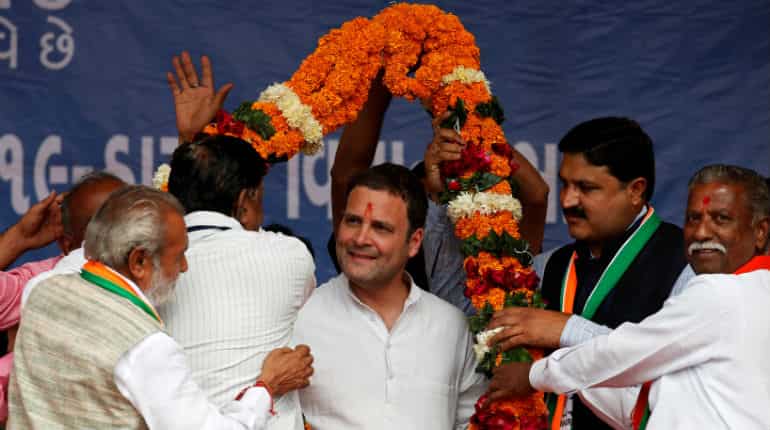
Rahu-Gandhi-garland
Rahul Gandhi has his set of team but most of them have not served at the top rung of the UPA and for that reason for some time will have to depend on the older set when it comes to Parliament.
The job has come easy to Rahul Gandhi as president of the Congress party but the task in front him is cut out. He takes over from Sonia Gandhi who is the longest serving president of the Congress. Sonia Gandhi had certain comforts when she took over the Congress which Rahul does not enjoy, so there are less similarities between both events apart from the family name. Rahul inherits tougher and more challenging circumstances.
Sonia took over reins of the Congress in similar but less enduring circumstances and brought it to power by 2004. For Rahul, things are tougher. Sample this: Unlike 2003-04, Congress has collapsed in many states, number of states under Congress is miniscule, till 2003, the party still had many strong state leaders and seasoned politicians from Rajiv and Indira days which in 2017 are either not there or on the verge of retirement.
Rahul Gandhi, on the other hand, has his set of team but most of them have not served at the top rung of the UPA and for that reason for some time will have to depend on the older set when it comes to Parliament.
Sonia once in charge, gradually brought faces who were handpicked either by Indira or Sanjay Gandhi. Very few from the core team of Rajiv Gandhi were able to make to her inner circle. Whether it was Arjun Singh, Natwar Singh, Ambika Soni, Margaret Alva, Gulam Nabi Azad, Sushil Kumar Shinde, Priyaranjan Das Munshi, Kamalnath, Hansraj Bhardwaj, AK Antony or Ahmad Patel, they had cut teeth into politics much before Sonia Gandhi entered politics.
On top of it, she had to face much gentler Atal Bihari Vajpayee who never brought his political battle to the Gandhi family's home or bastion. On the other hand, Narendra Modi has done all of that. He has made dynasty an issue for Congress, charged them as un-Indian, and openly questioned the Congress abroad. All of it cannot be pinned on Rahul because political flanks were left vulnerable by the Congress and he took advantage of it. Rahul Gandhi will have to deal with all of them apart from a very visible RSS which was not the case under Vajpayee government. Rahul Gandhi will have to work through states where Congress has an organizational vacuum. These states are in plenty unlike 1999. These states are Telangana, Tamil Nadu, Orissa, Andhra Pradesh, Uttar Pradesh, Jharkhand and Bihar. Together, they constitute more than 200 Lok Sabha seats. And it does not stop here. For the first time, even North East is vulnerable where BJP has made massive in roads. For this reason, Rahul Gandhi's journey is going to be tougher.
But in politics nothing succeeds like success. The differentiator between Modi and the rest is that he is a vote catcher and that too a mammoth one. Secondly, despite murmurs he unites all the BJP workers if not the leaders.
Rahul Gandhi has neither proved to be a vote catcher nor a glue to keep the Congress united. In past, most of the Congress leaders from the state and Centre left the Congress accusing Rahul Gandhi. If Rahul Gandhi can unite the Congress party, it will be his first big step. The second step would be to have a victory solely attributable to him.
Third and the most important challenge for Rahul Gandhi would be to create a balance between building a coalition to keep BJP at bay and building Congress party brick by brick which has been corroded from seam by the very regional parties which had supported it at the Centre. Right now, the core has shrunk and regional parties have become assertive to a point where Congress is being treated as one amongst many.
Lastly, he needs to be seen as a sole challenger to Modi in India. He cannot afford another to be like Kejriwal. He has shown a bit of it in Gujarat. If this sense of challenge continues to emanate from Rahul Gandhi, he will be considered as the sole challenger by public against Modi. The public would say that Rahul Gandhi has arrived. For now, jury is out and all eyes are set on Gujarat where Congress has given a good fight.
Watch this WION Special