PM Narendra Modi inaugurates Eastern Peripheral and Delhi-Meerut expressways

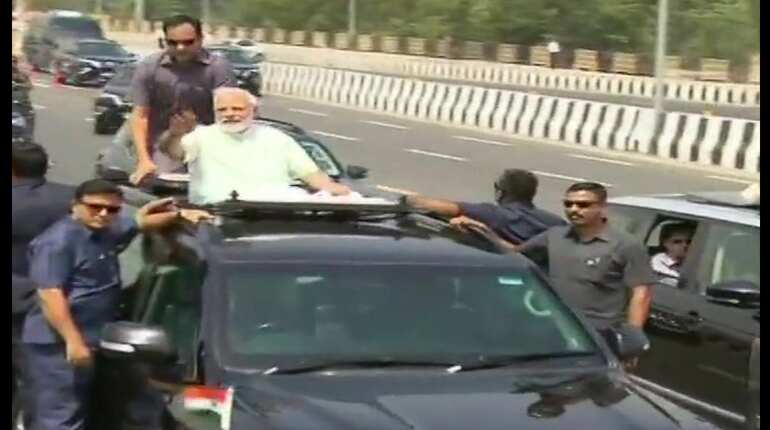
Modi roadshow
PM Narendra Modi hold roadshow after the inauguration of the first phase of Delhi-Meerut Expressway.
Prime Minister Narendra Modi in a grand spectacle on Sunday unveiled the Delhi-Meerut expressway for Capital that will drastically reduce the traffic and pollution.
The BJP has touted the Delhi-Meerut expressway and eastern peripheral expressway as game changers for Delhi’s traffic and pollution and the government is also all set to drive maximum mileage out of it with PM Modi holding a mega road show before throwing open the projects to the public.
PM Modi also inaugurated the Eastern Peripheral Expressway, which is being promoted as India's first green highway.
India’s first smart and green 6-lane highway is impressive for several reasons. For one, it will decongest Delhi-NCR (National Capital Region) and connect crucial areas of Palwal, Gautam Budh Nagar, Faridabad and Ghaziabad. For another, it’s an eco-friendly highway that has been made in a record time of 500 days as against a target of 910 days
Key facts to know about the Eastern Peripheral Expressway:
Built at a cost of Rs 11,000-crore, the 135-km no-signal expressway connects Kundli to Palwal, via Ghaziabad. The roadway is expected to divert much of the vehicular traffic from Delhi-NCR as those commuting from as far as Rajasthan to Himachal Pradesh and vice versa, will not be required to pass through the national capital.
To avoid congestion, the electronic form of payment will be promoted at the toll booths.
The lights across the highway would be powered using solar energy. This is the first expressway in the nation which is using the renewable source of energy to light up the roads.
A total of 50,000 trees have been planted on either side of the highway to tackle the vehicular pollution. Replicas of 25 major monuments, including Lal Quila, Taj Mahal, Jalianwala Bagh, Gateway of India and Qutub Minar, among others, will be installed on either side.
The major parliamentary constituencies which will be connected through the EPE include Kundli, Sonipat, Baghpat, Ghaziabad, Noida, Faridabad and Palwal.
Key facts to know about the Delhi-Meerut Expressway Phase-I:
The first phase of the 101-km expressway stretches for only 9-km -- from Nizamuddin Bridge to UP border. However, it will prove to be critical for reducing the congestion of vehicles passing to and fro from Noida and Ghaziabad.
The expressway is also India's "first-ever 14-lane" highway, which PM Modi has described as "road to freedom from pollution".
The project will be completed in four phases - Nizamuddin Bridge to UP Border, UP Border to Dasna, Dasna to Hapur and Hapur to Meerut.
At its completion, the project will do away with 31 signals between Delhi and Meerut. It will also bring down the time of journey from 2 hours, 31 minutes at present to merely 40 minutes.
When the foundation stone of the project was laid in December 2015, the total cost was pegged at Rs 7,556-crore.
The two highways, Union Minister Nitin Gadkari said, will revolutionise the construction of future roadways in India. He further claimed that both the expressways will collectively rid Delhi of the traffic coming from Punjab, Jammu & Kashmir, Uttarakhand, Himachal Pradesh, Rajasthan and Uttar Pradesh.