New EU Ambassador Hervé Delphin upbeat on 'ascending' ties with India and FTA talks

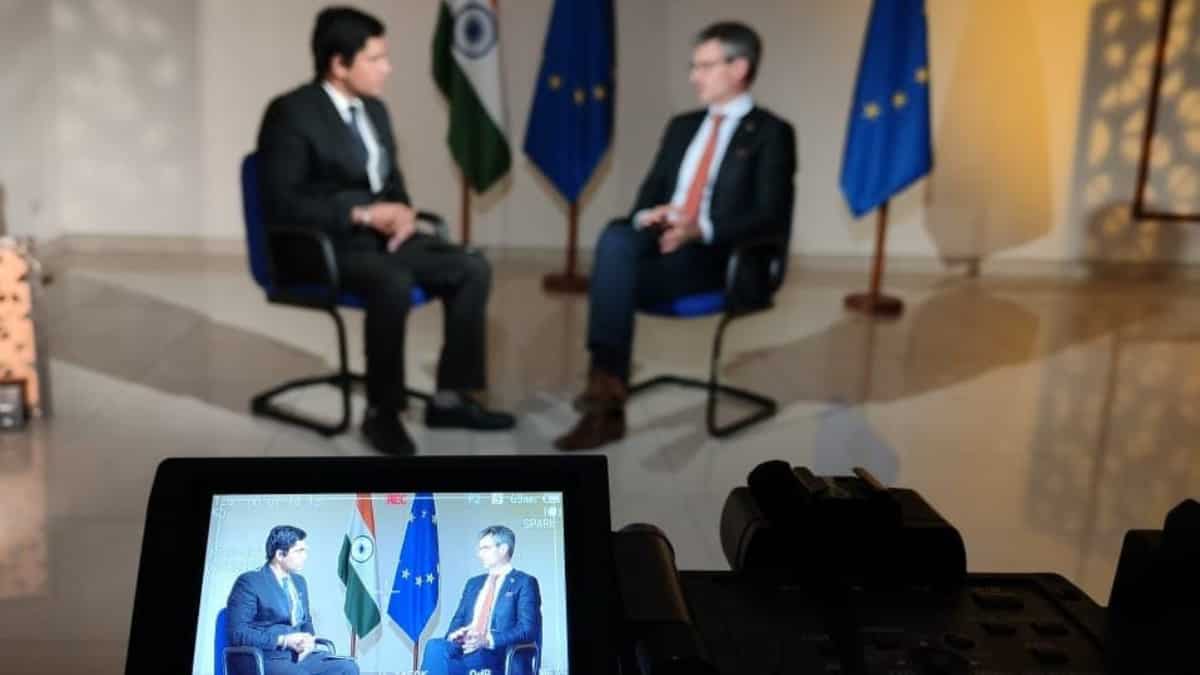
European Union's new ambassador to India Hervé Delphin with WION's Sidhant Sibal
European Union's new ambassador in New DelhiHervé Delphin underscored the positive trajectory of the India-EU relationship, stating, "EU India relationship has grown stronger, and it goes ever stronger. It's an ascending trajectory."
The ambassador presented his credentials to Indian President Droupadi Murmu earlier this month.
The India-EU ties have seen high level engagement, including visits of EU leaders to India for the G20 summit, but also the formation of a Trade and Technology council to accelerate engagement at multiple fronts.
Speaking to WION's diplomatic correspondent Sidhant Sibal, Delphin stated: "We want to develop a state of the art and very modern, comprehensive FTA."
He stressed that these negotiations are not with "a smaller economy" and reiterated the EU's commitment by saying, "we are committed. We are behind and we will do all the necessary to make this FTA negotiation come to a positive conclusion."
Ambassador Delphin also shed light on the India-EU Trade and Technology Council (TTC), describing it as a platform for "creating a sort of matchmaking in between the business ecosystem, the trade ecosystem, the technology and innovation ecosystem in India and the European one."
On the West Asia crisis impacting the India-Middle East-Europe connectivity project, Delphin stated, "So we should not consider that because there is a war, it has simply killed this project. I don't think it has. On the contrary, as I said, I think it simply shows the value of such a project."
The corridor was announced on the sidelines of the G20 summit in Delhi in September.
Read the full interview here:
Sidhant Sibal: How do you see the mandate here; what will be the focus for you here in India?
Hervé Delphin: Thank you Sidhant for having me.I see my tenure as coming at a very important moment in which theEU-India relationship has grown stronger and it is going ever stronger.It's onan ascending trajectoryand my, really my main purpose, is really to make sure that this growth trajectory in our relationship is maintained and sustained and we explore all aspects of our strategic partnership.
And if you look where we were two or three years ago, all the ground we covered in the past few years, past few weeks, just this week we had joint naval exercise in the Gulf of Guinea, there is not a week in which there is no thing happening in our partnership.
There is yet so much to explore, so much to develop.So I think my role is really to make sure that this will continue on in this ascending trajectory.
Sidhant Sibal: If you can talk about the role of the Trade and Technology Council.
Hervé Delphin: So it's true that the Trade and Technology Council or the TTC, the fact that we have one with India is proof of the importance we are placing our relationship with India because there is only one other country with which we have a TTC is the US.
The role of the TTC is really to create a favorable environment on growth, trade and technological relationships.So you've got three working groups, some focusing more on technology, AI, computing, other focusing on research innovation, and a third which is more focused on trade and market issues.
So there was a first meeting, ministerial meeting of the TTC back in May and now we understand that we are looking at having a second Ministers meeting in the coming weeks.
But in the meantime, in each working group, workshops and those people working behind, to make sure that we were able to identify how we can basically create an enabling environment and I think this is what these TTC is about.
The TTC is about creating a sort of matchmaking in between the business ecosystem, the trade ecosystem, the technology and innovation ecosystem in India and the European one, at the same time addressing all sorts of possible obstacles that could come in the way of development or cooperation in all these areas.
So that is what we see. There has been a lot of discussion and progress made on semiconductors and with the objective of coming to a Memorandum of Understanding is on a good way. We are also developing discussions around the ecosystem for electric vehicle batteries. We are looking at ways to favor coordination of our work on AI, we want an AI which is human centric.
So we are comparing notes. and it paves the way for the trajectory of our future economic relationship and its going quite okay. For the time being, it's good progress.
Sidhant Sibal: Sir, you mentioned the second ministerial, is it the 2ndTTC meet that will happen in India?
Hervé Delphin:There is a commitment on both sides, to meet at ministerial level and I think this is what is now being discussed in both parties. Where and when I cannot says but I think thecommitment is there which is again a proof that they feel that there is a momentum there and we they want to take stock and in bring further momentum into that, that TTC.
Sidhant Sibal: India-EU summit is expected to happen in India, any plans on that?
Hervé Delphin:Yes, it's true that the summit is to take place in India, this time around and the 2 leaderships are in contact to find the best possible date for that.
So we are hopeful that this will come in the coming weeks, coming months but certainly it is to be to take place and we are looking forward to it because there is so much that we want to take stock of at the summit but also to continue to give the direction to the different segments of our partnerships for the month and the years to come.
So I think there is strong support on both sides for this relationship and the summit is precisely the moment where we can make the harvest of all what we have developed but also pave the way for the next steps.
Sidhant Sibal: What is the status of India-EU Free Trade Agreement? Any timing that is expected to conclude it.
Hervé Delphin:I'm often asked this question. To be clear and I realise it's of importance to India as much as it is of importance to the EU. People sometimes maybe lose sight of the tall order this FTA represents because both for India and for Europe it is quite a unique FTA , by its scope and by its size.
Sowe want to develop a state of the art and very modern, comprehensive FTA that's the way we approach and we think it's the kind of FTA that we need to develop with India because for what India is, we are not, we are not negotiating with a smaller economy.
So for that reason, if you look at the last year, there's been six rounds of negotiation, there's been good momentum, good progress as well made in this.
The two negotiating teams have sort of mapped out in every domain and every chapter where the position is and inevitably in the initial phase of a negotiation or even you have to adjust to compare and you'll see that you're not necessarily seeing eye to eye on everything, which is normal.
So now the both sides and following the guidance on the EU side, European vice president Dombrovskis and minister (Piyush) Goyal on the Indian side, have understanding, they are going back to reassess where their red lines are and where the space for compromise is. I think this is now we are at this stage and I think then in the coming weeks, based on the stocktaking and having mapped out.
I think there will be a moment where they will see where we can actually define a package , where basically the balance of compromise and adjustment comes to the satisfaction of both sides. So now for your question of timing.
I don't think on the EU side,we are unnecessarily obsessed with timing.It's another way of saying what matters is the quality of the negotiation. So if we feel that India wants to accelerate, is ready to accelerate, we will accelerate. If there is a moment where India wants to consult and we assess and maybe tell us that we need a little bit more time. Fair enough. The point is,we are committed.
We are behind and we will do all the necessary to make this FTA negotiation come to a positive conclusion saying that I don't want to hide the fact that it is a substantial one. So there are difficult issues to be addressed, but it's normal. It's normal for such a negotiation.
Sidhant Sibal: What kind of cooperation are you looking at the climate aspect?
Hervé Delphin:First I mean our bilateral relations, we have a Clean Energy and Climate Partnership which has really developed over the past years. We have 50 areas of action in many domain and we are sharing all our experience and initiatives to build around them both here in India but also globally, a strong agenda.
So first what we see is thatIndia has made an incredible performance in a reduction of its CO2 emissions.And in the last 15 years, it has reduced by a third which is incredible.
And now every year it's minus 3 per cent of CO2 emissions which is real fast tracking. So we want to accompany India on that journey of becoming a green and low carbon or zero emission economy.So India has set itself targets by 2070.
The EU has got its own target that's 2050 Zero neutral carbon emission economy.
So of course we would like to accelerate so that's the reason why we have this global energy targets project inthe EU and we want also our partners around the world and this is in the context of something called COP28 to rally around that, that is the doubling of energy efficiency, the tripling of renewable energy capacity.
And we engage and we discuss this with India because as much as India has made incredible progress. We think that there is a huge potential here also to add even,leapfrogging in terms of going green in terms of energy and when I look at all the sort ofecosystem around energy and real economy in India, it's impressive the way it's advancing.
Sidhant Sibal:So from climate to conflicts, and I know that while you are EU's ambassador to India, this is something that we all are concerned about the ongoing situation in West Asia. What is EU policy on the situation in West Asia, we saw the terror attack in Israel and now a very deteriorating situation in Gaza as well. So if you can elaborate about the EU stance, especially when it comes to the calls of ceasefire?
Hervé Delphin:Yeah, so actually, it's a very timely question because there was a European Council or the EU heads of state and government met and, and there was a conclusion of that meeting that really reiterating the EU position that we stood in solidarity with Israel when it comes to its security and its right to exist in a peaceful environment, and a strong condemnation of the terrorist attacks by Hamas.
But we also restated our long standing policy for the two state solution in general and in the short run the absolute priority and a call for humanitarian pools and humanitarian corridors.
International humanitarian law (IHL) must be abided by and no one stands above it and that is a powerful message.
There is no place for civilians bearing the brunt of suffering and becoming the collateral of the conflict. So thatIsrael wants tofight the Hamas threat. I think it's a legitimate aspirationand action that they want to take but protecting the people, this is something which is absolutely key and in the international humanitarian law, they have the principle of distinction between armed forces and civilians, the principle of proportionality, the principle of distinction, proportionality, and protection.So all these international principles must be ensured in the strip of Gaza.
Sidhant Sibal:On the ceasefire aspect, what's the policy like? I mean, have you called for a ceasefire...
Hervé Delphin:The EU has called forhumanitarian corridor at the junction, and when it comes to the conflict, the EU has not come to a position of a ceasefire and is working with all parties in the region to precisely go into that direction.
Sidhant Sibal:So talking about connectivity, and we know that there was a big bang announcement here in Delhi during the sidelines of the G20 Summit of the India Middle East Europe connectivity corridor. Now, my question to you is, do you think that the ongoing development in West Asia poses a challenge towards this connectivity corridor? Does it impact the formation of this corridor, which is still in conversation with many of the countries who would like to be part of it?
Hervé Delphin:I think that the first point is that this project is transformational one for the region. And when I say regions, I'm talking about West Asia, but I'm also talking about Europe.The tragic developments that we're seeing now, actually, I would say vindicates the necessity to provide stabilizers for this region, and I think at the core the IMEE project is about that, to develop infrastructures that are conveyor belt of growth of economic prosperity, not only for India, but also for West Asia, but also Europe.
When you create an environment that is conducive to economic growth, economic opportunity, you create a form of glue for cooperation and economic cooperation.
Of course, you need the political conditions to be right for that. At present, they may not be there but it doesn't mean that we should be distracted or delayed in preparing and laying the foundation of the IMEC.
And I think all key stakeholders in the IMEC have the same message.We will carry on with this project.And if there's so much at stake mobilizing the private sector, mobilising the different studies that need to be undertaken, because it's massive, whether it's undersea cables, whether it's about sea lanes in nodal hubs for logistics, there is a lot to be done.So we should not consider that because there is a war, it has simply killed this project. I don't think it has. On the contrary, as I said, I think it simply shows the value of such a project
Sidhant Sibal: And arethere any hostages as well? With Hamas from the EU region when it comes to this conflict?
Hervé Delphin:Yes, yes, they are. And I think there is active diplomacy underway to obtain a sort of release of those European hostages that are currently in Gaza.
Sidhant Sibal: What is the EU's policy on the Indo Pacific?How does the EU plan to increase its own presence in the region and Vedas India plays a role.
Hervé Delphin: First, the EU has been present in the Indo-Pacific for a long time.If you simply look at the data in terms of trade, or direct investment or even our official development assistance, most of it has been geared toward that region, and for a reason because that's one of the main hubs of growth and economic growth and trade.
So, we have been there. We have developed a lot of policies in that region.The Indo Pacific strategy, simply put that and frame that into a more strategic approach to the region.
So you know, in other words, it will enhance our engagement, but we are not starting from scratch, on the contrary, now we are putting the emphasis on several axes.
One is clearly building the interconnectivity. So we were just talking about IMEE but there is a lot in terms of development of connectivity infrastructure in the region. And I think this ties perfectly with the aspirations and plans of India as well.
The second is security and defense. I think that the reason why this region has been one of the hotspots of international and globalization is because the economic environment was thriving for it, and the economy and trade has been also the glue, bringing these countries together.
What we see now at risk is destabilisation andescalation.So the EU's interest here is to prevent escalation, to prevent instability. So, while we advocate for economic openness, we want to ensure that the supply chains are secured, we want to ensure that maritime routes are secure.So this is what our engagement is about. So we work with all partners in the regions that adhere to that vision for the region.
Sidhant Sibal:Now, coming to your part of the world, which we have already discussed, but essentially there's a conflict happening there as well , the Russia Ukraine conflict, what is the current situation...
Hervé Delphin:First I mean, this, what we've seen with this war of aggression by Russia, is simply an imperialist, Neo colonialist agenda on the part of Russia that is tramples on all international principles and the UN Charter just to invade its neighbor for no reason and causing immense suffering and destruction in Ukraine, but also causing incredible negative impact on the world. So for all the narrative projected by Russia, that Europeans are the source of the problem. This is turning the arguments on its head.
The reality is, if there is a global food impact, if there is a Global Energy Impact, it's all of Russia's own making. So what we are supporting an independent country to protect itself. We are also trying to address the negative consequences. The fallout of that war, caused by Russia.
That's the reason whywe tried to maintain through the Black Sea grain initiative that the shipment of grain and exporter of cereals is not undermined. So through our European support, we've ensured that two thirds of grain goes to the developing countries which are badly in need.
And I think when it comes to the impact of energy, we simply acted upon the consequences of our dependency on Russian oil and gas and we have reduced dramatically and now even almost come to a stop with energy.So it has forced us to diversify our supply chain in terms of energy.
When it comes to the global impact of that war, we stand with Ukraine. We want the true and just peace initiative, supported by Ukraine, to be adhered to by all our partners around the world. And this is not the objective to fight a war for the purpose of it but simply to restore the independence and territorial integrity of Ukraine. So that's what the EU agenda is in Ukraine, and also visibly the partners and we've engaged all countries around the world, including India to make sure that Russia's aggression comes to an end.
WATCH WION LIVE HERE

You can now write for wionews.com and be a part of the community. Share your stories and opinions with us here.