India: Rajasthan stands against same-sex marriage, 6 states demand time to examine matter

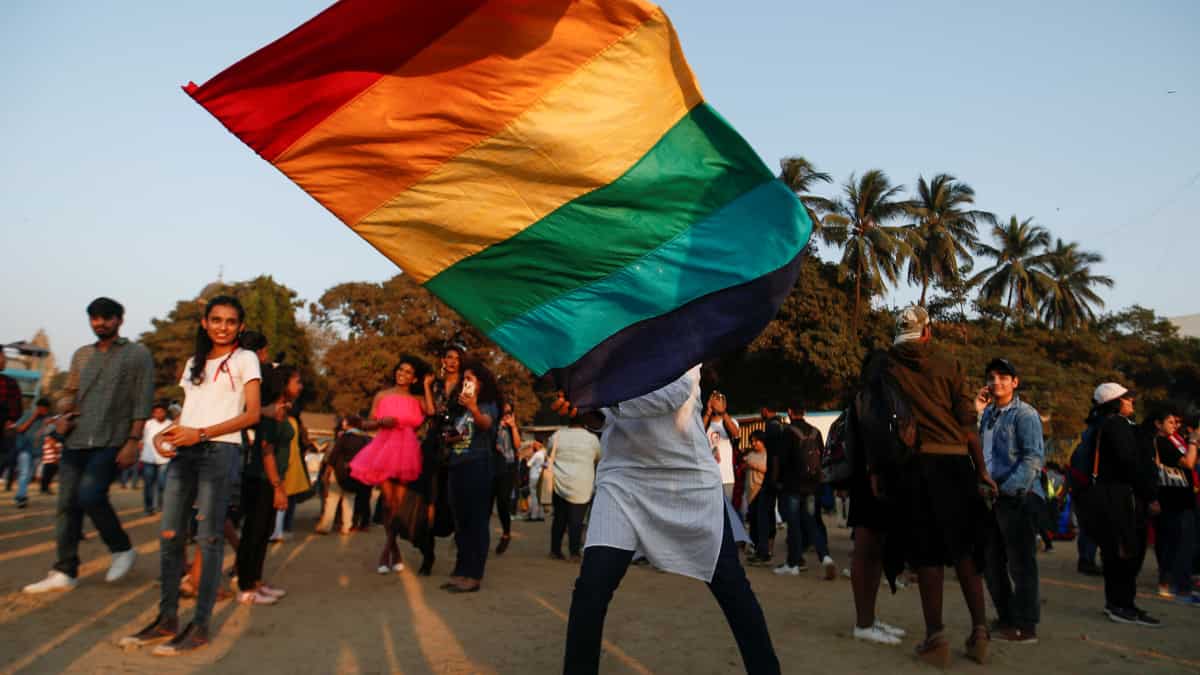
A participant waves a flag during Queer Azadi Pride in Mumbai.
The Indian government on Wednesday told the Supreme Court that replies were sent by seven states on the issue of same-sex marriage issue. The idea was opposed by Congress-led Rajasthan and states like Andhra Pradesh, Assam, Uttar Pradesh, Maharashtra, Manipurand Sikkim demanded more time to examine the issue.
"We have received seven responses from state governments. Rajasthan has taken a position that they have examined and opposed it, while the rest say that this needs an expansive debate," said Solicitor General Tushar Mehta to the court.
Various religions and underlined Acts, which fall under the Constitution, were quoted by the opposing states to support their stand against same-sex marriage.
The Rajasthan government, opposing same-sex marriage's legalisation, said that people's sentiments were against homosexual marriages.
The provisions regarding marriage in Muslim Law, Special Marriage Act and Hindu Marriage Act were quoted by the government to justify its stand.
“Section 5 of the Hindu Marriage Act (HMA) states the essential conditions of marriage. These provisions make it clear that any matrimonial ceremony between a bride and a groom shall be valid only if the age of the groom is not less than 21 years and the age of the bride is not less than 18 years,” the state government said.
“In the Act, marriage between two persons of the opposite sex is considered valid, and the minimum age of separation has been fixed for them. Thus, marriage is a sacrament in Hinduism,” it further added.
“Son born from heterosexual marriages liberates 21 generations from sin - 10 from past generations and 10 from future generations - including self. Therefore, matrimonial belief in Hinduism is connected to the birth of a son. Marriage in Muslim law is considered a contract between man and woman," the government argued.
“Nikah (marriage) in Muslim law has three components 1. A willing couple 2. Witness, and 3. Mehr. The concepts of "mehr" and "iddat" also resolve that even in Muslim law, marriages are valid only between two persons of the opposite sex, where mehr is seen as a gift from the groom to the bride as a token of respect,” it said in its reply.
Meanwhile, the Asssam government said, “It may be said that even across cross-sections of societies, the legal understanding of marriage has been that of an agreement/contract between two persons of opposite genders."
WATCH | Central government files affidavit against same-sex marriage
“Marriage, divorce and ancillary subjects so related, fall under entry 5 of the Concurrent list of the Constitution and hence it is also in the domain of the state legislature in a manner that it is in the domain of Union Parliament,” it further stated.
Meanwhile, the apex court earlier stated that Indian laws permit a person to adopt a child irrespective of his/her marital status as it asserted that the law does recognise situations which may not fit in the category of an “ideal family”, where couples have their own biological children.
The National Commission for Protection of Child Rights (NCPCR), in its submission, argued that the idea of gender may be “fluid” and may not be restricted to mothers and motherhood.
You cannow write for wionews.comand be a part of the community. Share your stories and opinions with ushere.
WATCH WION LIVE HERE