Joint naval exercise in Malabar will further deepen cooperation between India, Japan & US: PM Abe

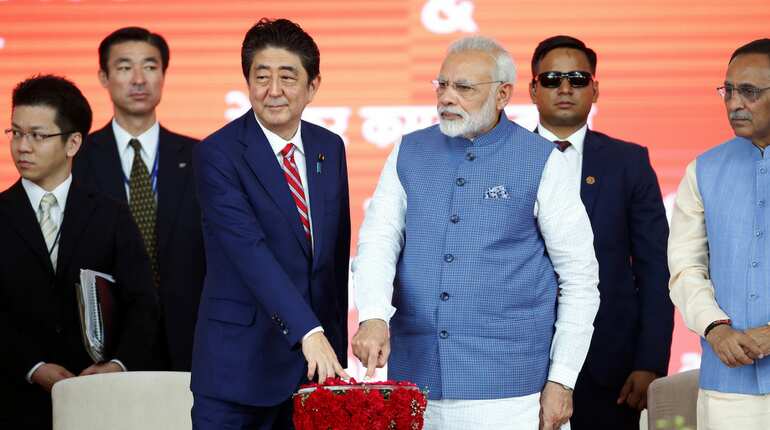
Modi Abe
The Japanese government even specially employed Mizuho Financial Group for discovering investment opportunities in India
Prime Minister Shinzo Abe today acknowledged India and Japan's military cooperation citing the Malabar military exercise undertaken by the two countries including the US in July.
PM Abe in the joint statement said: "It (joint naval exercise in Malabar) will further deepen cooperation between India, Japan, and the US."
He further added that "India, Japan, and the US conducted joint maritime exercise Malabar for the first time, based on strong ties of trust between PM Modi and President Trump".
PM Modi emphasised on employing Japanese technology to help India grow economically.
"I urge Japanese business community to open a maximum number of Japanese restaurant chains in India," Modi said.
Here is a look at the two countries and their military and economic alliance.
Indian and Japan: Military ties
The two nations have a history of close military ties. They have acommon motive of maintaining security in sea-lanes in the Asia-Pacific and the Indian Ocean region.
The two countries often hold cumulated military exercises and co-operate on technology.India and Japan concluded a security pact in 2008.
Japanese Prime Minister Shinzo Abe who is frequently termed as an "Indophile" is taking closer security cooperation measures with India, in response to the rising tensions in territorial disputes with Japan's neighbour North Korea.
In July 2017, the Indian Navy took part in a week-long military drillwith the Japanese and US navies called the Malabar naval exercise, realigning their common vision on the Indo-Pacific maritime security apparatus.
The movecame amidthe standoff between India-China over the Doklam issueand Japan's growing anxiety over North Korea's missile tests.
Indo-Japan ties turned into a "substantial"friendship on July 20 last yearwith the signingof the India-Japan civil nuclear agreement. The pact was signed in 2016during PM Modi's three-day visit to Japan.
This was the first time that Japan had signed adeal with a non-signatory of Non-Proliferation Treaty.
Indian and Japan: Economic ties
The agreement between India and Japan to build a bullet train between Ahmedabad and Mumbai using Japan's Shinkansen technology was signed in December 2015.
The two nations are also working on Asia-Africa Growth Corridor (AAGC), which was unveiled on May 23, 2017.Japan alsoprovided assistance and know-how for the first phase of Delhi Metro.
The Japanese are also involved in other mega infrastructure projects, such as the Delhi-Mumbai Industrial Corridor started a decade ago.Over the last fifteenyears, investments from Japan have played a symbolic part in India’s progress.
Over a span of seventeen years, beginning 2000, Japan has invested more than $25 billion across various sectors in India.Japan is among the top four largest investors in India, and investment from Japan increased substantially during 2016-17.
Japan invested 4.7 billion in 2016, which is 80 per cent higher than 2015-2016.
In fact, Japan has promised to invest roughly $35 billion for the period between 2014-19 to boost India’s manufacturing and infrastructure sectors.