NASA images show stubble burning in Punjab, Haryana

NASA FIRMS fire map
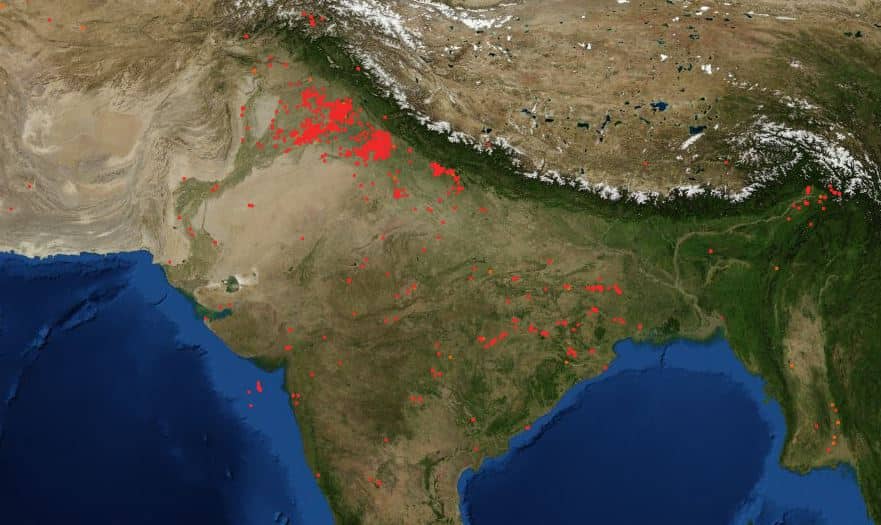
As air quality in the national capital region continues to dip, NASA's Fire Information for Resource Management System (FIRMS) depicts stubble burning in Delhi's adjoining areas.
While the fires were highlighted in isolated places across the country, the concentration intensified as one moved northward on India's map near Punjab, Haryana.
According to reports, the Delhi government also shared the NASA images pointing at the "large scale crop residue burning in states adjoining Delhi".
The Kejriwal-government has long blamed the stubble-burning activities in adjoining states like Punjab, Haryana and other areas for the drop in the air quality of the national capital during the winter months.
Previously conducted studies by NASA showthe drop in North India's air quality during winters.
Research published in November 2015 by NASA's Earth Observatory stated, "satellites began to detect large numbers of active fires in mid-October. Normally extensive agricultural burning lasts for about three weeks. Although most of the haze appears to originate from the agricultural fires, other factors such as urban and industrial smog may also be contributing".
It explained how several types of particles and gases are released into the atmosphere, "including smog-forming carbon monoxide, and nitrogen dioxide" due to this fire.
"Haze that forms over Punjab rarely stays there. While the fires burn, smoke often blankets much of the Indo-Gangetic Plain, exposing millions of people in the densely populated plain to elevated levels of air pollution," it added.
Another piece shared by the Earth Observatory way back in the year 2010 described skies over northern Indian as "some of the haziest in the world".
"After the rains of the summer monsoon clear the dust, the composition of the air shifts in the fall crop-burning season (October and November) for farmers, particularly in the northwestern Indian states of Punjab and Haryana. When MODIS passed over on November 4, 2010, the sensor observed numerous small fires and a large smoke plume lingering downwind."
The finding published on NASA's webpage attributed the change in air quality in Northern India to a host of factors ranging from smoke originating from cooking, heating stoves in rural areas, "smattering of agricultural fires that continue through the winter", adding that the urban community adds to the worsening air quality by the means of vehicular pollution, "coal-fired power plants, and other industrial sources".
Meanwhile, the National Green Tribunal (NGT) on Tuesday sought a report from the governments of Uttar Pradesh, Haryana and Punjab over the action taken to stop stubble burning in their respective states, news agency ANI reported.
The NGT said that the report should be filed by November 15 which is also the next date of hearing.
The bench observed that the burning of crops is still taking place and that the states have not been able to communicate with the farmers and educate them about the same.
"If you have not succeeded then it is the failure of the state. Ultimately, the citizens are suffering," the tribunal observed.
Farmers residing in Haryana and Punjab have begun burning their crop residue in order to clear the fields of the summer harvest. Smoke from these two states travels to Delhi, leading to a spike in the air pollution levels.
The air quality index (AQI) in the national capital remains in the 'poor' category according to the Centre-run System of Air Quality and Weather Forecasting and Research (SAFAR).