Chandrayaan-3 rover to fire laser on lunar rocks, vaporise them to perform studies

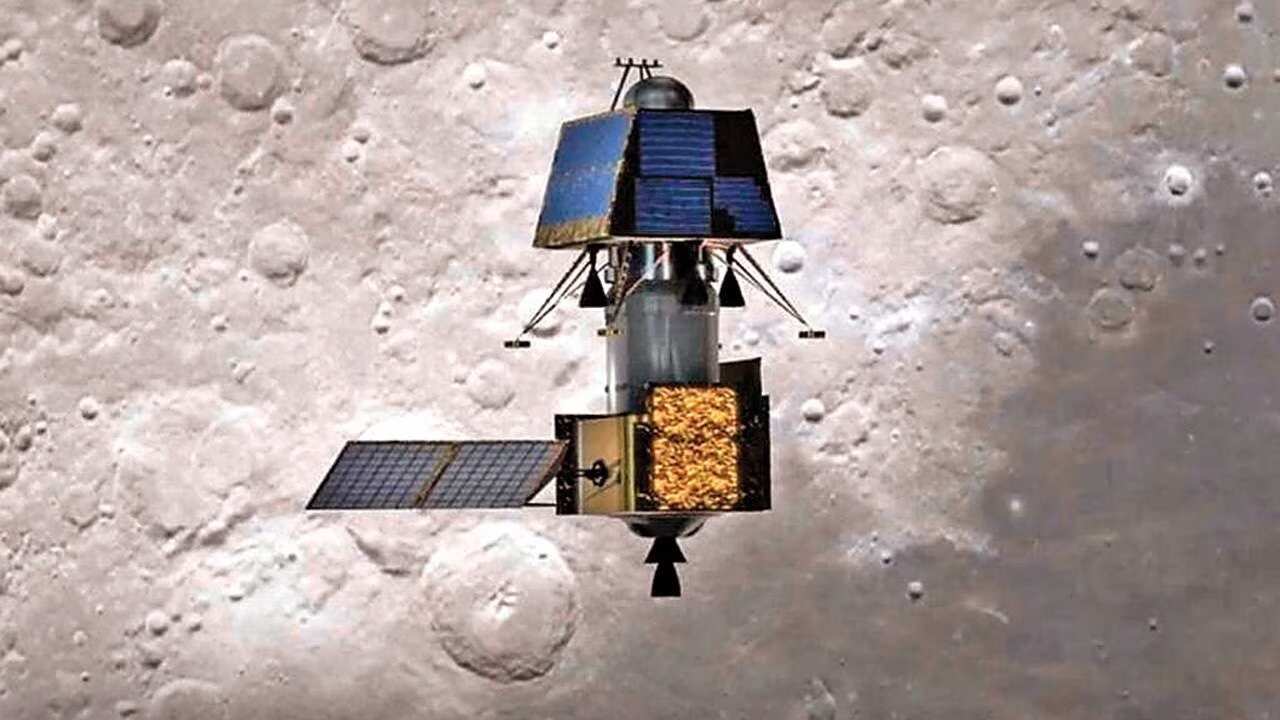
Chandrayaan-2
Imagine firing a laser on the Lunar dust/small rocks (known as regolith), vaporising them and then studying the vapours to understand the chemical composition of the lunar surface. This would help identify the rare and otherwise unknown elements that exist on the Moon's surface and possibly help trace how it came to be. Sounds like science fiction? No, this isn't. India's 'Pragyaan' lunar rover will be performing this spectroscopy experiment, among a host of other experiments, when it rolls on the lunar surface during its planned 14-day mission there.
ISRO Chairman DrS Somanath shared details regarding Chandrayaan-3on the sidelines of a media interaction during the G20 Space Economy Leaders Meeting in Bengaluru.
On Thursday evening, ISRO officially announced that India's third lunar mission Chandrayaan-3 would be launched at 14.35 hours (local time) on Friday, July 14. The 3,84,000-kilometrejourney towards a lunar soft landing is expected to take around six weeks for the 3,900kg or 3.9-tonne lunar spacecraft. ISRO is targeting a lunar soft landing on either August 23 or 24. Landing dates are determined based on the availability of sunlight at the particular landing spot. Sunlight is essential for the lunar lander and rover to utilise their solar panels and generate power, and thereafter perform their scientific tasks.
ISRO has designed the Chandrayaan-3 lander and rover to function for a duration of 14 earth days (which would be the approximate length of a Lunar Day). After that it would be a period of 14 earth days of darkness at the landing site, hence the rover and lander will not be able to recharge their batteries during that lunar night, when temperatures could be as low as -180 degrees Celcius. However, ISRO says they have tested their lander and rover for extreme conditions and expressed hope that they could "come back to life" once sunlight is again available to them.
"The rover will be moving only within a limited range that is within the sight of the lander's cameras. All data collected by the rover will be transmitted first to the rover and then to the orbiter and then back to Earth. So, after the lunar night both the lander and rover must work, for our mission life to get extended. If both our lander and rover are working after surviving the lunar night, then we will use them for further experiments' DrSomanath responded to WION's question on the mission life.
Chandrayaan-3 is India's third lunar mission
India is undertaking its third lunar mission and second lunar landing attempt, after the previous mission Chandrayaan-2 could not perform the soft landing. When it was barely two kilometres above the lunar surface, while approaching for a vertical landing, ISRO lost contact with the then 'Vikram' lunar lander.
The lander made a hard landing onthe lunar surface, which it did not survive, thus leaving the lunar landing mission incomplete. However, the orbiter from Chandrayaan-2 continues to circle the Moon and provides scientific data from its payloads. Therefore, Chandrayaan-3 will not be having an orbiter that is mounted with multiple science payloads. Instead, it will serve as a propulsion module that will help the integrated spacecraft reach the lunar orbit.
While the Chandrayaan-3 orbiter weighs lesser than its predecessor, the integrated spacecraft (orbiter, lander, rover) weighs 3.9 tonnes or 3,900 kgs, which is approximately 300 kgs more than the integrated Chandrayaan-2 spacecraft. However, the payload mass reduced from the orbiter has been added to the Chandrayaan-3 lunar lander.
"The added mass on the Lunar lander comprises more fuel, more ruggedisation, measures for failure tolerance and strengthening of landing legs and increased scientific payloads, larger solar panels for better power generation," Somanath told WION.
On Thursday, the 640-tonne launch vehicle has been moved to the second launch pad at the Indian spaceport. A day or prior to the July 14 launch, a countdown timer is started and a crucial phase of multiple health checks on the vehicle and its systems, sub-systems is carried out. Towards the final stages of the countdown, the Earth-storable liquid fuels and the super-cooled cryogenic fuels are filled into the second and third stages of the rocket, respectively.
Queried about the scientific discoveries and outcomes from Chandrayaan-3, Somanath explained to WION that the initial gains from the mission would be the pictures and data from the Moon. However, the scientific studies would take time to conclude.
"We have explained to major Indian academia, labs, research institutions, etc about the data that we expect from the Chandrayaan-3 experiments. The processing of that data and deriving of scientific inferences from it will be carried out by them. Results will take time", he said.
WATCH WION LIVE HERE
