Kate Middleton’s 2016 Vogue cover used for post-surgery family pic? Here’s what we know so far

Kate Middleton
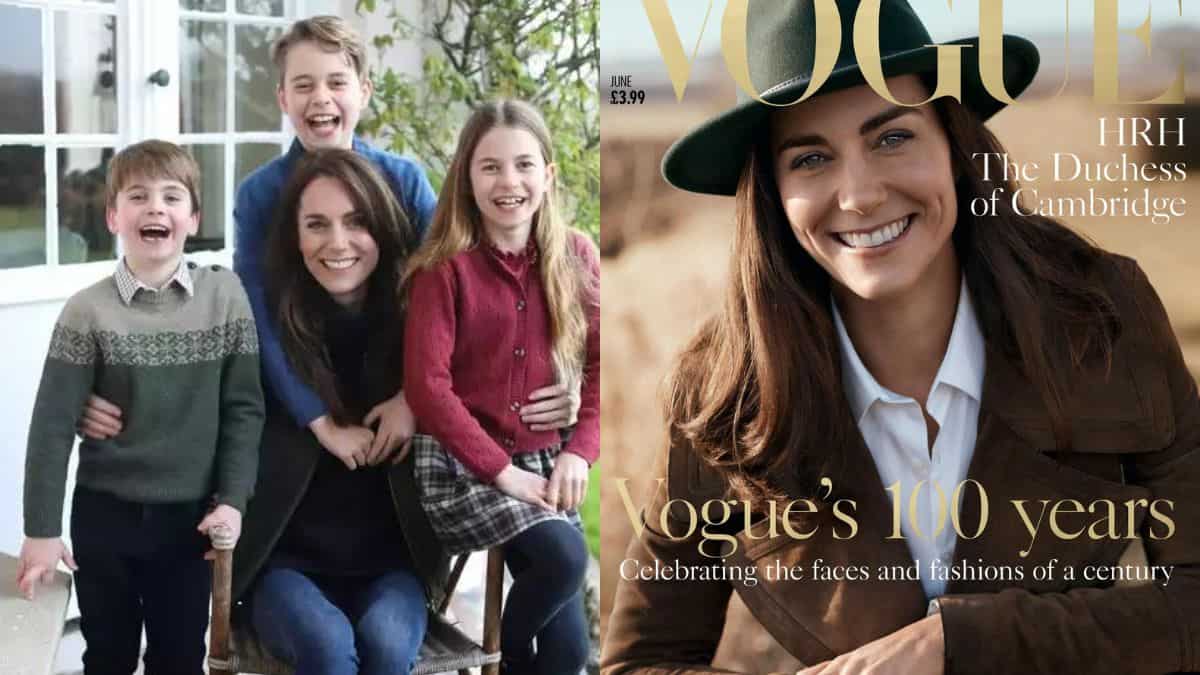
Royal fans have raised suspicions about a recent family portrait shared by Kensington Palace on Instagram, suggesting that an old Vogue cover from 2016 featuringKate Middleton could have been used to edit the image. The controversy arose after the Associated Press and other news agencies confirmed that the photo had been edited, leading to a retraction of the image.
On Sunday, AP announced that they would be retracting the image, stating, "At closer inspection, it appears that the source has manipulated the image."
Kate Middleton addressed the issue on her Instagram Stories, where she shared a statement expressing her apologies for any confusion caused by the family photograph. She explained, "Like many amateur photographers, I do occasionally experiment with editing. I wanted to express my apologies for any confusion with the family photograph we shared yesterday caused."
Ruby Naldrett, from the UK newspaper the Daily Mirror, shared her theory on social media, suggesting that the 2016 Vogue cover image was used in the family portrait. She wrote, "My analysis of the Kate Middleton photo saga is that they took her face from the Vogue cover she did years ago and edited it in," alongside comparisons.
While some users agreed with Ruby's theory, others were less convinced. Some defended Kate, pointing out that it's common for a person's face to look similar in different photos.
TJ Thomson, a visual media and communication expert at RMIT University, shared his analysis with Yahoo Lifestyle, stating that while there are similarities between the Vogue cover and the family portrait, it's not an exact match.
"I overlaid the Vogue cover on top of the Instagram image and think there are some similarities, but it's not, in my estimation, an exact match. Perhaps something like an 80-90 per cent overlap?" Thomson said.
He suggested that the portrait may have been slightly edited."It's probably more or less real, there could be a little bit of airbrushing, a little bit of smoothing, teeth whitening — that kind of thing, I think the basic components probably are accurate. But it's just a matter of if they are all accurate at the same point in time, at that same location that the photo is claiming it is," Thomson stated.