Will Erdogan's support to Azerbaijan create conflict between Turkey and Russia?

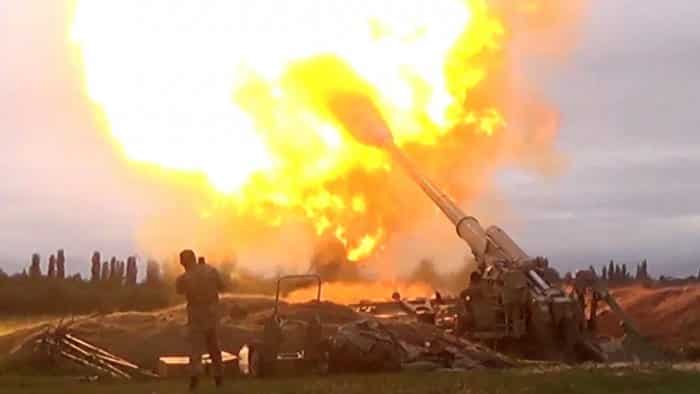
Clashes in the Nagorno-Karabakh region
Turkey's president Recep Tayyip Erdogan seems intent on burning bridges. He is now wading into the conflict in the Caucasus, openly backing Azerbaijan -- even though it means antagonising one of his few remaining allies - Russia President Vladimir Putin.
Dozens have been reported killed and hundreds wounded since clashes between Azerbaijan and Armenia over the Nagorno-Karabakh region broke out on Sunday in a new eruption of a decades-old conflict.
Nagorno-Karabakh is internationally recognised as part of Azerbaijan.
Armenia and Azerbaijan reported further bloodshed on Tuesday, as heavy weaponry was moved to the front lines.
Erdogan on Monday demanded Armenia put an end to its “occupation” of Nagorno-Karabakh and called for it to leave the territory.
But Russia is not happy. It has urged Turkey to work on bringing an end to deadly clashes
Armenia has even accused Turkey of sending mercenaries to back Azerbaijan, its close ally, a charge Ankara denies.
The Turkish president even said Armenia is the biggest threat to peace in the region.
Turkey conducted joint military drills with Azerbaijan last month. It has also established an army and an air force base within the country to support Azerbaijan.
This aggressive posturing puts Erdogan at odds with Vladimir Putin. The Russian president is already dealing with a full-blown crisis in Belarus.
He is keen to avoid another one in the Caucasus.
And one can simply say Turkey is risking its relationship with Russia for the same reason it triggered the conflict with Greece -- energy, oil and gas.
In 2019, Azerbaijan delivered 9.2 billion cubic metres of natural gas to Turkey. It was delivered through the South Caucasus pipeline, which is part of a US-backed energy corridor.
The region is also rich in crude oil reserves.
Oil is exported to an energy terminal on Turkey's Mediterranean coast. In short, most of Azerbaijan's energy exports end up in Turkey.
And this fits perfectly into Erdogan's plan of making Turkey a crucial cog in the energy trade between the Caspian sea and Europe.
Most of the pipelines in the region run perilously close to the disputed border.
If Azebaijian takes control of this land, Erdogan would be able to dictate energy exports to Europe.
But that's not all.
Azerbaijan's former president once described the relationship as 'one nation with two states'. Turkey was the first nation to recognise Azerbaijan back in 1991.
Last month, when tensions flared between Greece and Turkey, Azerbaijian was unequivocal in its support for Ankara.
On the other hand, Turkey's relations with Armenia have always been troublesome.
The Armenian genocide at the hands of the Ottoman empire is not something the country will so easily forgive. Armenia claims as many as 1.5 million people were killed or expelled.
Turkey on its part rejects the use of the word 'genocide' for what happened between 1914 and 1923.
Now, by positioning himself with Azerbaijan, Erdogan has put himself in a tight spot.
Most of the world leaders, including Putin, want both sides to stand down.
If Azerbaijan and Armenia do opt for diplomacy, Erdogan's warpath may end up denying him a seat at the negotiating table.