WHO SE Asia candidate Saima Wazed puts spotlight on mental health, dismisses political criticism

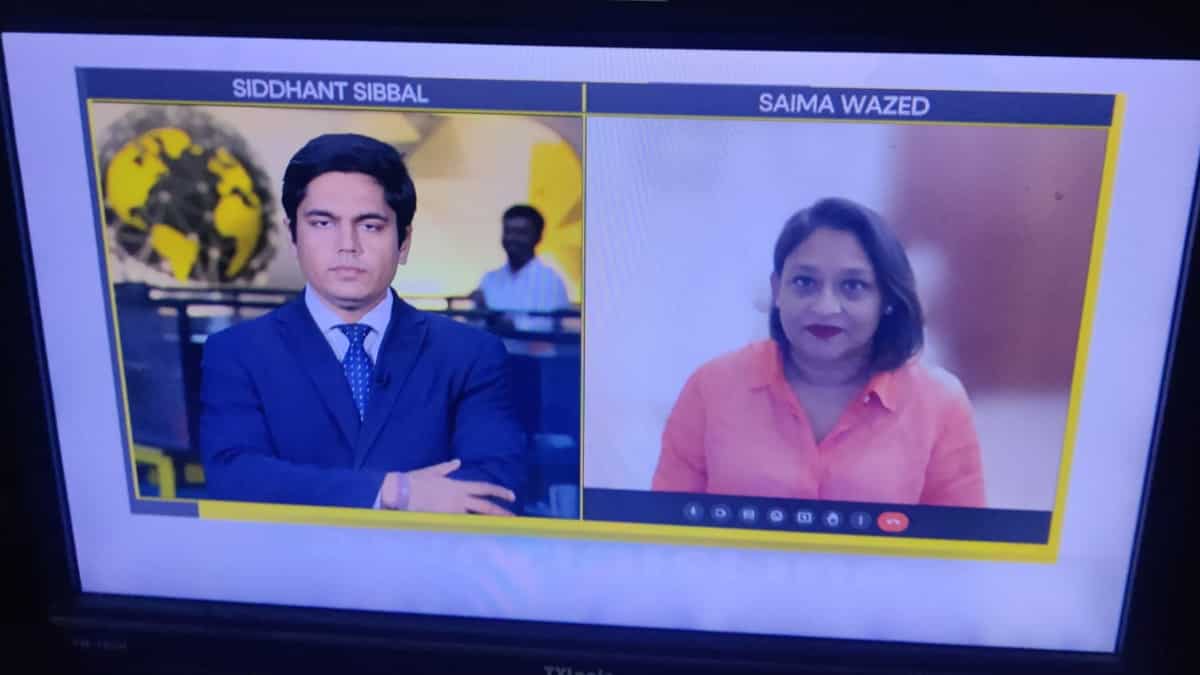
WION correspondent Sidhant Sibal speaks to WHO SE Asia candidate Saima Wazed.
Saima Wazed, who is one of the candidates for the post of World Health Organization or WHO's regional director for Southeast Asia office is hopeful of her win for the post, referring to a lot of "positive" feedback.
Speaking to WION's diplomatic correspondent Sidhant Sibal, Wazed, who has worked in the field of autism, said, "If elected, my real goal is to ensure that mental health which has been sorely neglected and is a huge challenge is incorporated within the entire health system."
HO's South East Asia office is one of the six key regional units and works with 11 member states.
The seventy-sixth session of the WHO Regional Committee for South-East Asia will be heldin Delhi from October 30 to November 2 to elect its next head.
Asked about allegations by other candidates about her, and her political links given she is the daughter of Prime Minister of Bangladesh Sheikh Hasina, she said, "I have always known who I am, and I know that there will always be a reminder of that, but I was also raised as a refugee, I was also raised by a mother who had lost everything overnight,"adding, "When you're the daughter of somebody very, very big and very successful,everybody assumes that things are much easier for you, but you don't get to be successful unless you work hard".
India, during PM Modi's 2021 Dhaka visit, indicated its support for Wazed. Full Interview:
WION: How hopeful you are of your win during this election that will take place here in the Indian National Capital.
Saima Wazed: Firstly, thank you so much for having me here. It's really a pleasure to be here. As for how hopeful, I've had a lot of positive feedback, I have made many opportunities over the last year or so in the last two years, I've been to many of these countries. So these ministers have been there for a long time and I've worked with many of them and the ministries, worked with mental health and autism and they have all always been very positive interactions. And of course, once the campaign started recently, my engagement with them was very positive. So their commitment is steadfast and on top of which Bangladesh has very good bilateral relationships with these countries. We've been mutually supportive of one another throughout, particularly dealing with the pandemic or many other issues in our region. Bangladesh plays a very important role and has been a supportive country to many of them. So I am hopeful that this time, ultimately of course, it is a very important decision for each of our countries. There are many implications, long term implications in a very important issue with is our health. So I hope that they will make a good decision and they will choose me, so one of my priority areas of work is mental health. And that is a priority for them as well. So I'm fairly hopeful.
WION: Yeah, Ma'am, your work in autism is well known if you can elaborate about your work in that field so that our viewers can get to know more about you and your work.
Saima Wazed: I'm a school psychologist, was a clinical psychology professional before that, and I've been working in the field of autism in public school systems. I became involved in a larger scale as far as advocacy and policy development around 2009-2010. A few met with many of the parents in our country, had the opportunity to join forces with the UN World Autism Awareness Day events and other NGOs as well as the World Health Organization. We organized the global autism public health initiative and the Southeast Asia Autism Network formation, with a conference that we organized here in Dhaka in 2011, so my work in the area of autism goes back pretty much from my professional career. It's been an area of interest, but now, it has evolved from just simply doing assessment and intervention planning for individuals and working with families directly into the larger sort of country-level policy, into the global advocacy. And I've used that experience to know, coming from a very set system, a western system and how to adapt that into our realities of shortage where we don't have the health professionals. We don't have the education specialists, we don't have the parent training, We don't have the school systems that have good support or even the very laws in Bangladesh and even in our region. So I have taken my education with learning and evolved into working for what would be suitable for our country and our culture and the realities of the challenges that we all face. My belief in particular interest in autism is that it is such a wide spectrum of need from you know, individuals who are very highly functioning, who can be very independent or very productive to those who have complicated complex needs from a health perspective, from a life perspective, and families that are in desperate need of support. So it's very multifaceted, very complex, and to take that, that complex medical condition, so to speak, and not just address it from like, just as a social sort of like, we'll give them some little bit of support to actually help my country develop policies and programs that help that ensures greater equity, that ensures more opportunities for them to be integrated into the social fabric of our system. So it has been a huge challenge because the tremendous stigma that families and individuals face whenever they have any kind of disability, the taboo that we have, culturally in our region, in fact, is of you know, we all know that, it's tremendous. It's very difficult to understand and just having laws and policies aren't enough to really change people's attitudes and people's beliefs. And that is been the primary focus because if you cannot change the attitudes and the beliefs you have towards somebody with a disability, somebody with an autism spectrum disorder, somebody with a mental health condition, that stigma that exists within the family takes away 90% of any effect, any treatment, any support service, you can have because you're sort of looked down upon or you're not misunderstood and you're not accepted, right. Seeing the reality that you have to change how people think and believe the biggest challenge is making people think differently, believe differently, and that's where I come from, and that's where true change needs to come. I firmly believe in the inclusion of people. I believe that everybody will, regardless of what strengths or weaknesses they have and how we've labelled or decided, as you know, health professionals to give them a diagnosis. They are people they have. They have fantastic qualities within them. They have skills with them, they have people that love them. They're a part of a family, that part of a society and they should be treated with equality. Their human rights should be appreciated, they should be accepted, we should treat them not just with kindness, we should accept them as they are and we will communicate with them the way they need to communicate. And so that has been my philosophy and what I've been working on and I know it's going to constantly be an endless job because like I said, in our part of the world, the stigma of taboos that exist. We strive for perfection, and we value education and we value very important careers. So having any kind of learning difficulties or communication difficulties or not being able to be perfectly engaged and not look perfectly present , is always going to be very stigmatizing. So it's going to be an ongoing work.
WION: If you get elected to the director of the World Health Organization's regional office, what will be your vision?
Saima Wazed: Well, you know, I see the World Health Organization as an expert organization that supports our country's health infrastructure. And in order to have a good health infrastructure, it has to be inclusive of these various groups. We have so many health issues and health challenges that we have to also address communicable diseases, we have to address the growing issue of non communicable diseases, we have to, you know, deal with antimicrobial resistance, we have to deal with workforce shortage. So there are complex issues that we're constantly having to deal with. But my real goal is to ensure that mental health which has been sorely neglected and is a huge challenge is incorporated within the entire health system. And again, marginalized groups, so, those with these kinds of complex disorders, those who are socially culturally marginalized. Groups that have, in many ways, been neglected. So, for example, you know, women's health has always been very neglected within the medical health profession, particularly because so many women supported women, but they didn't really have the medical treatments. And so, ensuring those core issues are within this health infrastructure that our countries and our region develops is going to be my primary goal. And I see that working sort of parallel and working side by side with many countries as well as with the WHO, I've realized that there are many commonalities, many challenges within our countries, but along with the many differences, we have some similarities but when it comes to our health area, we need greater cooperation and collaboration. We need to have partnership among countries, there is this great diversity in what is available in one country versus another and if we don't have greater partnership among countries, that WHO can facilitate then certain countries, then their health systems and health structures will always fall behind. And, you know, every country cares about the people, we want our region, we want our people to be healthy. So what I want to do as regional director is ensured that I can facilitate that because being a regional director gives me the opportunity to have a neutral position for being available for every one of those countries to do so, facilitate cooperation with a partnership and collaboration so that every country at least has universal health coverage and quality equitable health coverage across that and that we share some of these resources and resource development planning that, you know, we feel is strongly needed. So that's what I would like to do as Regional Director
WION: An early indication of India’s support for the Bangladesh emerged in a joint statement issued after Prime Minister Narendra Modi’s visit to Dhaka in March 2021. How do you see Indian support.
Saima Wazed: Well, India was certainly one of the first countries when Prime Minister Modi had visited Bangladesh and we had just announced informally that I would be the candidate, he had expressed support for Bangladesh and we're happy to say they have been steadfast in that. I think they see an opportunity for Bangladesh, yeah, given how well we have done in our health sector. That support has been firmly there. I know some questions were created, I think India has been steadfast, there are many sectors in which India, Bangladesh have worked together to address and health has been one of them.
WION: Every election has a bit of controversy, and some remarks have been made against you by other candidates. There is the political link as well, you are the daughter of Bangladesh PM Hasina, how do you see these comments as and of course, the comments on your political linkages and your candidacy?
Saima Wazed: Yes. Well, you know, when I was born, I was the granddaughter of the Father of the Nation, Bangabandhu Sheikh Mujibur Rahman, you know, so I have always known who I am, and I know that there will always be a reminder of that, but I was also raised as a refugee, I was also raised by a mother who had lost everything overnight. And so how we were raised and how my brother and I were brought up is to learn to stand on our own feet, work hard at what we have to do. And you know, at any given point, that could be taken away. So make something of yourself and find a way to contribute to your country. And that is all I have been doing, the first opportunity I had, as a professional as a psychologist to give something back to my country, I have taken it. So you know, you're being criticized for being somebody's daughter, and it's a little bit laughable for me, because I am who I am. I was a daughter when she was in opposition. I was her daughter when being a politician's daughter wasn't that great as a teenager, you know, in a boarding school, it wasn't the best thing. And now of course, she's a successful Prime Minister. So that is also something I have to deal with, but I really don't give it much credit. I know I have many more opportunities, certainly, to meet people perhaps that I would probably not have but I have worked hard for my country, hard work hard for the region for the cause that I believed in. And I'm very appreciative of all the help and support people have given me to get here, but I know that I have learned the hard way and worked hard at it and I want to continue to be able to do that just like any other professional. So yes, It really doesn't. Doesn't matter to me, What people assumptions people make, When you're the daughter of somebody very, very big and very successful. Everybody assumes that things are much easier for you, but you don't get to be successful unless you work hard. So if you're the child of somebody who works very hard, you have to work extra hard to meet their standards. So yeah, the fact that she was appreciative of recognition, it means a lot more to me than any other criticism that's out there.
WION: You are also chairperson of the International Jury Board meeting of UNESCO for Digital Empowerment of Persons with Disabilities. If you can talk about that
Saima Wazed:Well, I think the digital platform is a tremendous opportunity, the advancement that has been made from training the health workforce, to bringing treatment methods, even surgery and, and connecting with specialists all the way across the world. All of those things can be brought into our region and that advancement that has been made. I want to be able to take advantage of those advancements within the digital system and other resources and make sure particularly for our region where we have people live in more inaccessible areas, where we have a shortage of specialists, where we have a shortage of, you know, people aren't always as well informed or have information available to them. So there are many ways that the digital system can be utilized. There are many resources that are there even in the research phase that can be adapted. Our country or region has been the most densely populated region. So we can not just use what has been developed but help pilot newer methods and make sure that the digital platform when it comes to the health system and help your workforce development as well as service development that can be, you know, used as a way to create even better methodologies that perhaps other countries could utilize because when you're using something and you find it usable in a challenging situation that other countries that have it could learn from that and perfected even more. So our region could then actually be a way to further evolve the systems that exist. I know in Bangladesh, we've done information dissemination into training of mental health workers and health workforce at various levels. We've even done e- mental health services where you know the specialists in Dhaka are actually providing you know, assessment and intervention strategies for people living in very rural areas. So guiding treatment, it would ensure that there are less interesting mistakes because, you know, we do have a strong lack of specialists. So using this platform, there are many opportunities and I think it would enable greater well being and better health for everybody in our, in our countries, particularly those who are less able to get to the, you know, tertiary care center, so and having, again, using it as partnerships to develop the health workforce and information dissemination, data can also be used very easily, much more easily and much. And ultimately, it's much more cost effective so it'll be much more sustainable, financially feasible for countries.
You cannow write for wionews.comand be a part of the community. Share your stories and opinions with ushere.
WATCH WION LIVE HERE