US Supreme Court partially lifts Trump travel ban

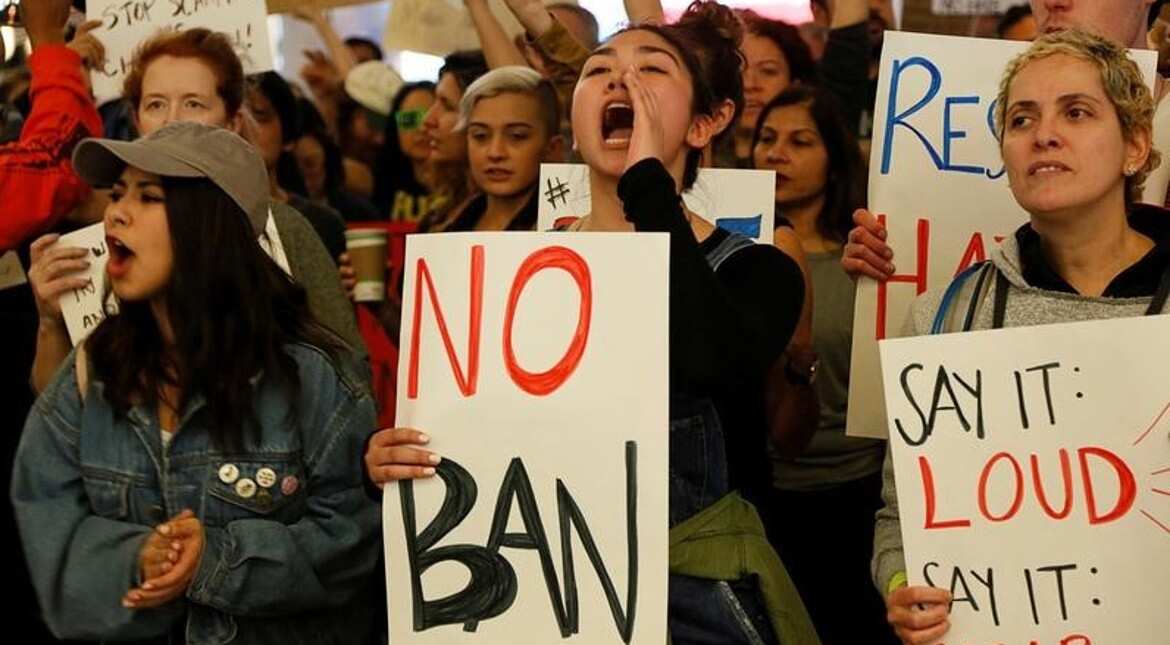
US travel ban
The top court agreed to hear the case on the controversial travel ban barring citizens from six Muslim-majority countries from entering the US.
The US Supreme Court Monday allowed the Trump travel ban - barring citizens from six Muslim-majority countries from entering the US -to partially take effect.
The travel ban will apply to those "who lack any bona fide relationship with a person or entity in the United States," until the court hears the case in October, the justices ruled.
The top court ruled that the government could enforce its measure against "foreign nationals unconnected to the United States" without causing injury to the parties who filed suit. Conversely, those with a "close familial relationship" in the US are not affected.
President Trump hailed the ruling as a "clear victory for our national security."
"Today's unanimous Supreme Court decision is a clear victory for our national security," Trump said in a White House statement.
On Twitter, he later added: "Great day for America's future Security and Safety, courtesy of the U.S. Supreme Court. I will keep fighting for the American people, & WIN!"
"It allows the travel suspension for the six terror-prone countries and the refugee suspension to become largely effective. As president, I cannot allow people into our country who want to do us harm."
The Supreme Courtagreed to hear the controversial travel ban case on Monday.
The high court also ruled that the measure can partially take effect -- a win for the Republican leader, who has insisted it is necessary for national security.
The ban has faced widespread criticism that it singles out Muslims in violation of the US constitution.
Trump had suffered a series of stinging judicial setbacks over the measure aftertwo federal appeals courts maintaining injunctions on the ban.
The appealscourts had argued the president had overstepped his authority, and that his executive order discriminated against travellers based on their nationality.
"Immigration, even for the president, is not a one-person show," the three justices of the Ninth Circuit Court of Appeals said in a ruling earlier this month.
"National security is not a 'talismanic incantation' that, once invoked, can support any and all exercise of executive power," they added.
The Supreme Court narrowed the scope of those injunctions with its order today.
The revised measure, announced in March, seeks to bar travelers from Iran, Libya, Somalia, Sudan, Syria and Yemen for 90 days, as well as suspend the entry of refugees for 120 days.
The original measure, issued by an executive order in January, also included Iraq on the list and had imposed an indefinite ban on Syrian refugees.