UN urges Russia to undertake a 'transparent, independent' investigation into Navalny poisoning

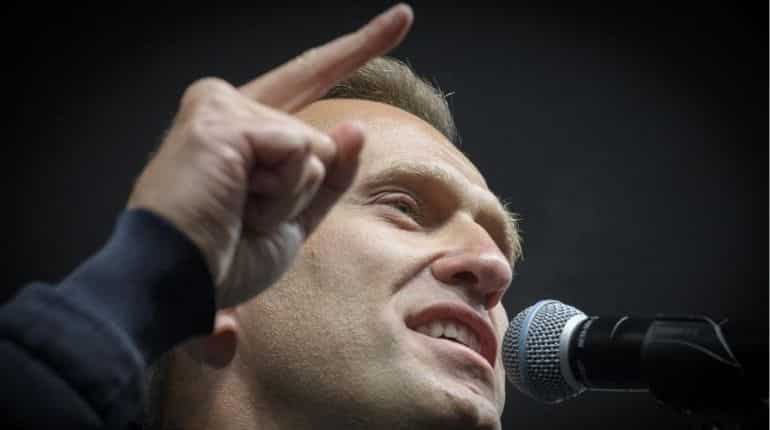
In this file photo taken on September 29, 2019 Russian opposition leader Alexei Navalny speaks during a demonstration in Moscow.
The United Nations on Tuesday called on Russia to undertake a "thorough, transparent, independent and impartial investigation" into the poisoning of opposition leader Alexei Navalny, who was reportedly poisoned with a Soviet-era agent Novichok.
Michelle Bachelet urged all stakeholders to cooperate in order to ascertain who poisoned Navalny. German authorities recently claimed to possess “unequivocal proof” of Novichok being used in the attack.
"It is incumbent on the Russian authorities to fully investigate who was responsible for this crime, a very serious crime that was committed on Russian soil," Bachelet said in a statement.
Navalny, 44, is considered one of Putin’s fiercest critics in Russia. On September 8, he came out of a medically induced coma, and was responsive, a German hospital said.
Bachelet added that “the number of cases of poisoning, or other forms of targeted assassination, of current or former Russian citizens, either within Russia itself or on foreign soil, over the past two decades is profoundly disturbing."
"And the failure in many cases to hold perpetrators accountable and provide justice for the victims or their families, is also deeply regrettable and hard to explain or justify," she further said.
Fierce critic
One of Russian President Vladimir Putin's fiercest critics, Navalny fell sick on a flight from Siberia to Moscow on August 20, after which he was taken to a hospital in the city of Omsk in Siberia following an emergency landing.
As international pressure mounted, he was shifted to Berlin's Charite hospital.
Steffen Seibert the spokesperson to German Chancellor Angela Merkel on September 2 said that after testing by a military laboratory, it was ascertained that “a chemical nerve agent from the Novichok group" was used on Navalny.
Novichok was notoriously famous during the Soviet era, and was also used to poison former Russian spy Sergei Skripal and his daughter who werethen in Britain.
A cholinesterase inhibitor, it is part of a grouping of substances that the doctors had identified in Navalny after he was moved to Germany.
Russia has continuously rejected accusing of deliberate poisoning by the country, calling the accusations "empty noise". Russian doctors who had treated Navalny in Siberia have repeatedly claimed that poisoning was ruled out as no trace of poisonous substances was found in his body.