Turkey-Syria earthquake: More survivors pulled from rubble as death count touches 41,000

Turkey Syria earthquake
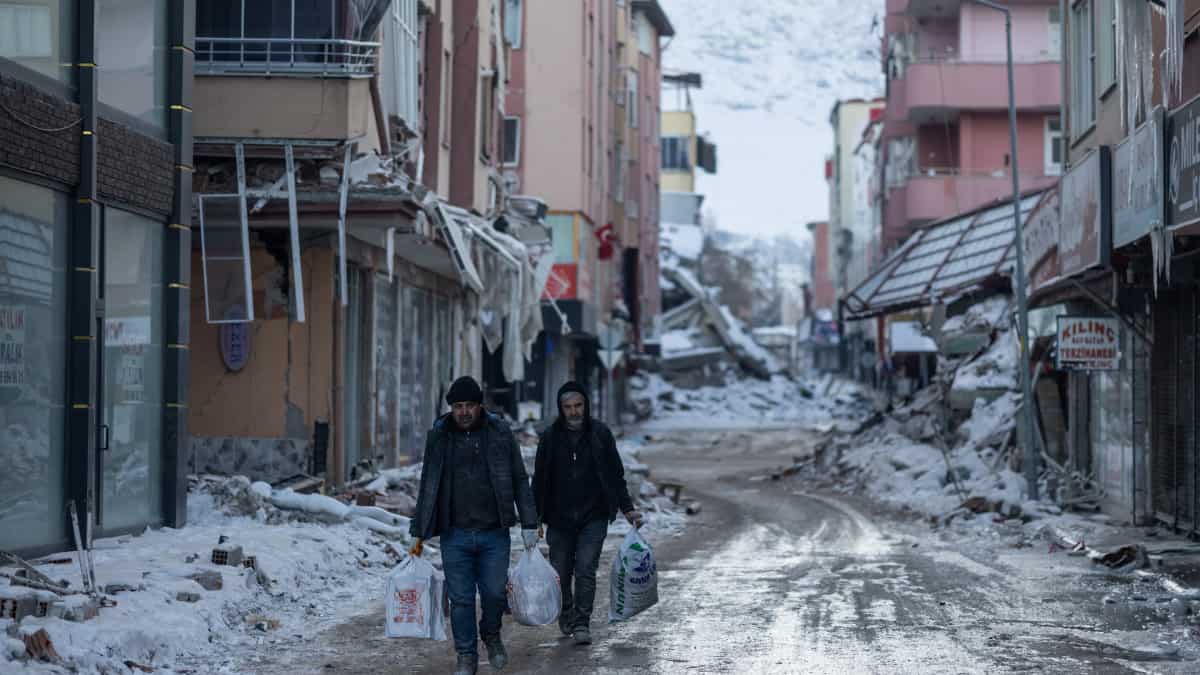
Turkey-Syria earthquake death count:It has been over a week since the Turkey earthquake happened, but rescuers are still pulling out more and more survivors from the rubble. On Tuesday, nine people were rescued. The Turkey-Syria earthquake death count has now gone past 41,000. Images of the Turkey earthquake doing the rounds on the internet show the scale of destruction and devastation caused in the two countries. People are now struggling to survive in the near-freezing temperatures. Initial response to the Turkey earthquake has problems, Turkish President Tayyip Erdogan had acknowledged. However, he says that the situation is under control now. "We are facing one of the greatest natural disasters not only in our country but also in the history of humanity," Erdogan said in a televised speech in Ankara.
Those rescued from the rubble of the 7.8-magnitude Turkey earthquake on Tuesday included two brothers, aged 17 and 21. They were pulled from an apartment block in Kahramanmaras province. A Syrian man and young woman in a leopard-print headscarf in Antakya were rescued after over 200 hours in the rubble. Rescuers are hopeful of finding even more survivors.
However, UN officials say that the window for rescue operations is now closing. They are now focussing instead on food, shelter, schooling, medicines and other amenities.
Survivors suffering from mental health issues
At a Turkish field hospital, people are now no longer arriving with only physical injuries. The earthquake has left people mentally stressed and they are suffering from "post-traumatic stress disorder, following all the shock that they've gone through during the earthquake", Indian Army Major Beena Tiwari said.
The psychological impact of the earthquake in Turkey and Syria, that struck on February 6, has been massive. Families in both Turkey and Syria said they and their children were dealing with the psychological aftermath of the quake.
"Whenever he forgets, he hears a loud sound and then remembers again," Hassan Moaz said of his 9-year-old in Aleppo, Syria. "When he's sleeping at night and hears a sound, he wakes up and tells me: 'Dad, aftershock!'"
In Syria
Syrian President Bashar al-Assad agreed on Monday to allow UN aid to enter Syria from Turkey via two more border crossings. A convoy of UN aid entered rebel-held northwest Syria via the newly-opened Bab al-Salam crossing on Tuesday. The decision marked a shift for Damascus which has long opposed cross-border aid deliveries to the rebel enclave.
The earthquake in Syria has affected nearly nine million people, the United Nations said, as it launched a $400 million funding appeal. Head of the White Helmets main rescue group, Raed al Saleh, said that the search for survivors was about to end in the north west of Syria.
Why did the Turkey earthquake happen?
The Arabian Peninsula is part of a tectonic plate that has been slowly moving north into the Eurasian Plate. This is causing the entire nation of Turkey to get squeezed aside. "Arabia has slowly been moving north and has been colliding with Turkey, and Turkey is moving out of the way to the west," Michael Steckler of Columbia University's Lamont-Doherty Earth Observatory told NPR.
This tectonic shift is the reason for several earthquakes that have hit the region over the last one thousand years. This includes the 1138 quake that hit the Syrian city of Aleppo. The 1999 quake, one of the recent ones, jolted the city of İzmit, killings thousands of people. The January 6 earthquake is believed to be the strongest earthquake to have hit Turkey in the last 80 years.
(With inputs from agencies)
WATCH WION LIVE HERE
You can now write for wionews.com and be a part of the community. Share your stories and opinions with us here.

