There is an ancient underwater 'Stonehenge' beneath Lake Michigan in US. It was created by...

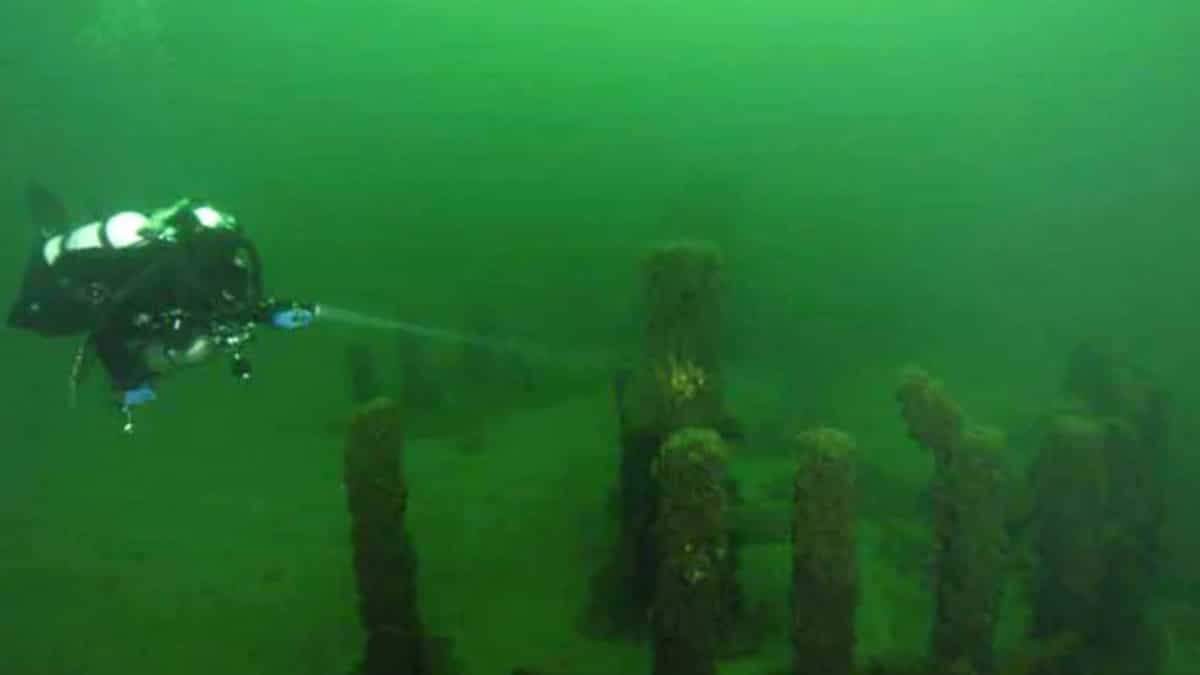
Image of underwater 'Stonehenge' beneath Lake Michigan. (Courtesy: Mark Holley via Archaeology World)
In a mysterious discovery, scientists found an enigmatic stone structure - which appeared similar to the world-famous Stonehenge - sitting belowLake Michiganin the US.
As per experts, this underwater Stonehenge is more than 5,000 years older in comparison to its British counterpart on surface.
A team of archaeologists, headed by the professor of underwater archaeology at Northwestern Michigan College, Mark Holley, had discovered the site in 2007.
A survey of the lake bed was conducted by Holley and his colleagues when they discovered a series of large stones - which appeared to be arranged in a circular pattern near the coast of Traverse City, Michigan.
Holley later said that the discovery of rocks at a depth of about 40 feet (12.1 metre) was entirely unexpected.
In the analysis, it was found that the stones - which weighed around 3,000 lbs (around 1,360 kg) - appeared to have been arranged deliberately by humans in a circular pattern, as reported by Medium.
The circular pattern is nearly 40 feet in diameter and features aninner circle of stones which measures around 20 feet in diameter.
The stones are entirely made of granite and are likely to be around 10,000 years old, which makes them the oldest formation ever discovered in North America.
How was the Stonehenge created beneath Lake Michigan?
The stones in Lake Michigan are relatively similar in size, however, their origin remains mysterious and murky.
“Whilst they do seem to form a perfect geometric shape, they aren't stacked or connected in the same way,” said scientist Rob Nelson, while speaking toDiscoveryUK.
“And while there is evidence that prehistoric tribes roam to the Great Lakes for thousands of years, very little is known about them,” he said, and added that he hasn’t seen anything “remotely resembling this formation in the archaeological record".
Nelson connected to a man named Hank. This man's ancestors were the Anishinaabe people who were the first to inhabit the region.
Hank said that the prehistoric, hunter-gatherer forefathers of his tribe had settled in the area after the last Ice Age and kept those stones beneath the lake for a sacred purpose.
“[In Anishabe culture], we refer to stones as animate objects because they come from the mother, the Earth, who is alive,” he said and added that the presence of the monument in the lake is proof of the existence of his people.
Meanwhile, Holley said that the area had not submerged underwater 10,000 years ago and the people had settled on the spot where they had laid the stones.
“It would've been a wonderful place for people to live – near the coastline, close to resources, transportation's easy,” said the archaeologist, while speaking to Nelson.
(With inputs from agencies)