Syria rebels evacuate Aleppo after ceasefire deal

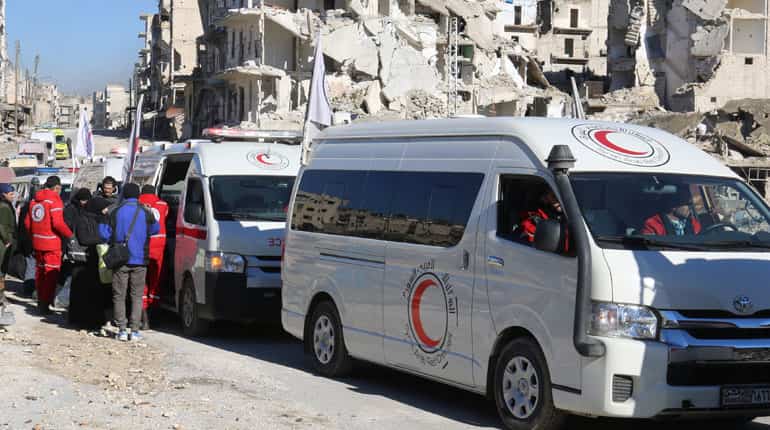
Ambulances wait as they evacuate people from al-Sukkari rebel-held sector of eastern Aleppo on December 15.
Rebels and their families will be taken towards Idlib, a city in northwestern Syria which is outside government control
An operation to evacuate thousands of civilians and fighters from the last rebel bastion in Aleppobegan on Thursday, part of a ceasefire deal that would end years of fighting for the city and mark amajor victory for Syrian President Bashar al-Assad.
A convoy of ambulances and buses with nearly 1,000 people aboard drove out of the devastated rebel-held area of Aleppo, which was besieged and bombarded for months by Syrian government forces, aReuters reporter on the scene said.
Syrian state television reported later that a second convoy of 15 buses had also left.
Women cried out in celebration as the buses passed through a government-held area, and some wavedthe Syrian flag. Assad said in a video statement the taking of Aleppo was a historic moment.
An elderly woman, who had gathered with others in a government area to watch the convoy removing therebels, raised her hands to the sky, saying: "God save us from this crisis, and from the(militants). They brought us only destruction."
Wissam Zarqa, an English teacher in the rebel zone, said most people were happy to be leavingsafely. But he said,"Some of them are angry they are leaving their city. I saw some of them crying.This is almost my feeling in a way."
Earlier, ambulances trying to evacuate people came under fire from fighters loyal to the Syriangovernment, who injured three people, a rescue service spokesman said.
"Thousands of people are in need of evacuation, but the first and most urgent thing is wounded, sickand children, including orphans," said Jan Egeland, the UN humanitarian adviser for Syria.
Behind those fleeing was a wasteland of flattened buildings, concrete rubble and bullet-pockedwalls, where tens of thousands had lived until recent days under intense bombardment even aftermedical and rescue services had collapsed.
The once-flourishing economic centre with its renowned ancient sites has been pulverised during thewar which has killed more than 300,000 people, created the world`s worst refugee crisis and allowedfor the rise of Islamic State.
"Place them all in IDLIB"
Turkey is considering establishing a camp in Syria for civilians being evacuated from Aleppo and thenumber of people brought out of the city could reach 100,000, deputy prime minister Veysi Kaynaksaid.
In Aleppo's rebel-held area, columns of black smoke could be seen as residents hoping to departburned personal belongings they do not want to leave for government forces to loot.
"It's difficult to leave your belongings knowing that your enemy is going to use them. Thugs usuallywill take them ... They will take everything as a prize for kicking us out," Zarqa, the teacher,said.
A senior Russian general, Viktor Poznikhir, said the Syrian army had almost finished its operationsin Aleppo.
However, the war will still be far from over, with insurgents retaining their rural stronghold ofIdlib province to thesouthwest of Aleppo, and the jihadist Islamic State group holding swathes ofthe east and recapturing Palmyra this week.
The International Committee of the Red Cross said close to 1,000 civilians and 26 wounded, includingseveral children, were evacuated, a total it expects to double by day's end. The ICRC said there was"very light screening" by Syrian authorities without identity checks and registrations.
Rebels and their families would be taken towards Idlib, a city in northwestern Syria which isoutside government control, the Russian defence ministry said.
Idlib province, mostly controlled by hardline Islamist groups, is not a popular destination forfighters and civilians from east Aleppo, where nationalist rebel groups predominated.
A senior European diplomat said last week that the fighters had a choice between surviving for a fewweeks in Idlib or dying in Aleppo. "For the Russians it`s simple. Place them all in Idlib and thenthey have all their rotten eggs in one basket."
Idlib is already a target for Syrian and Russian air strikes but it is unclear if the governmentwill push for a ground assault or simply seek to contain rebels there for now.
The International Rescue Committee said, "Escaping Aleppo doesn't mean escaping the war ... Afterwitnessing the ferocity of attacks on civilians in Aleppo, we are very concerned that the sieges andbarrel bombs will follow the thousands who arrive in Idlib."
Britain's foreign secretary Boris Johnson said he had summoned the ambassadors of Russia and Iran toconvey profound disquiet over Aleppo, saying it was crucial to protect civilians and deliver aid. UNchief Stephen O'Brien will brief the Security Council on Friday on the Aleppo evacation.
Shi'ite villages
The evacuation deal was expected to include the safe passage of wounded from the Shi'ite villages ofFoua and Kefraya near Idlib that are besieged by rebels. A convoy set off to evacuate the villageson Thursday, Syrian state media said.
Efforts to evacuate eastern Aleppo began earlier in the week with a truce brokered by Russia,Assad's most powerful ally, and Turkey, which has backed the opposition. That agreement broke downfollowing renewed fighting on Wednesday and the evacuation did not take place then as planned.
A rebel official said a new truce came into effect early on Thursday. Shortly before the new dealwas announced, clashes raged in Aleppo.
Government forces made a new advance in Sukkari -- one of a handful of districts still held by rebels-- and brought half of the neighbourhood under their control, according to the Syrian Observatory forHuman Rights, a monitoring group.
The Russian defence ministry said - before the report of the government forces' advance in Sukkari --that the rebels controlled an enclave of only 2.5 square km (1 square mile).
The evacuation plan was the culmination of two weeks of rapid advances by the Syrian army and itsallies that drove insurgents back into an ever-smaller pocket of the city under intense air strikesand artillery fire.
By taking control of Aleppo, Assad has proved the power of his military coalition, aided by Russia`sair force and an array of Shi'ite militias from across the region.
Rebels have been backed by the United States, Turkey and Gulf monarchies, but that support hasfallen far short of the direct military assistance given to Assad by Russia and Iran.
Russia's decision to deploy its air force to Syria more than a year ago turned the war in Assad'sfavour after rebel advances across western Syria. In addition to Aleppo, he has won back insurgentstrongholds near Damascus this year.
The government and its allies have focused the bulk of their firepower on fighting rebels in western
Syria rather than Islamic State, which this week managed to take back the ancient city of Palmyra,
once again illustrating the challenge Assad faces reestablishing control over all Syria.
(Reuters)