

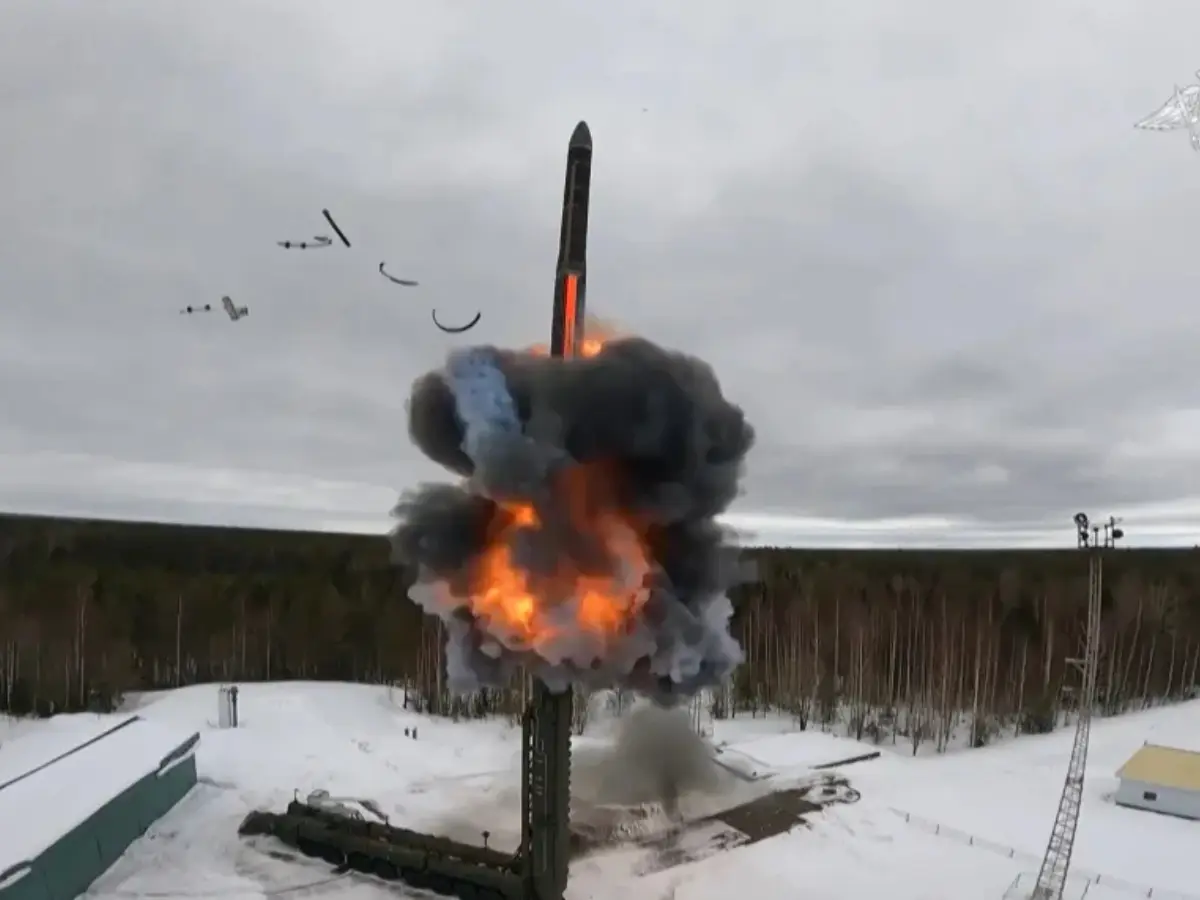
&imwidth=800&imheight=600&format=webp&quality=medium "Russia walks out of cold-war era nuclear arms control agreement, Medvedev blames NATO's 'anti-Russian policies'")
The Russian Foreign Ministry, in a statement on August 4, announced that it “no longer considers itself bound by the previously adopted self-imposed restrictions”. Russia's Former President Medvedev blamed 'NATO's anti-Russian policies'. Notably, the United States had already left the treaty on August 2, 2019, accusing Russia of violating it. Russia continued its self-imposed freeze, and it formally walked out of the deal on Monday.
Dmitry Medvedev, responding to the announcement by the Russian Foreign Ministry, wrote on x, “This is a new reality all our opponents will have to reckon with. Expect further steps.”
What is the Intermediate Nuclear Forces (INF) Treaty? How is it relevant?
Signed in 1987, it was a significant step to control the Cold War era arms infrastructure. The treaty required the “United States and the Soviet Union to eliminate and permanently forswear all of their nuclear and conventional ground-launched ballistic and cruise missiles with ranges of 500 to 5,500 km.” As a result of the treaty Soviet Union and the United States destroyed 2,692 short, medium and intermediate-range missiles. The United States had already left the treaty during the 1st term of the Trump administration, citing violations from Russia, specifically Russia’s 9M729 missile system, also known as the SSC-8 missiles. The US intelligence had been accusing Russia of violating the treaty since 2014. Russia denied any such violations and had maintained a voluntary freeze on similar systems up until now. However, Russia has reportedly used the Oreshnik missiles on Ukraine in November, and Oreshnik's range is also a supposed violation of the INF treaty.
The treaty was the post-Cold War arms control architecture. It was technically a nuclear arms control treaty, even if it applied to conventional ones. Russia cited US action, specifically the deployment of Typhoon missile launchers with Tomahawk cruise missiles in the Philippines and Dark Eagle hypersonic systems used in Australia during the Talisman Sabre drills. Notably, Russia has already withdrawn from the New START (2010) treaty in February 2023, and the Comprehensive Nuclear-Test-Ban Treaty (CTBT) in November 2023. The cancellation of the treaty marks a pivotal moment and the restart of a Cold War-style arms race.

