Russia does not know what to do with $147bn in rupees it has amassed

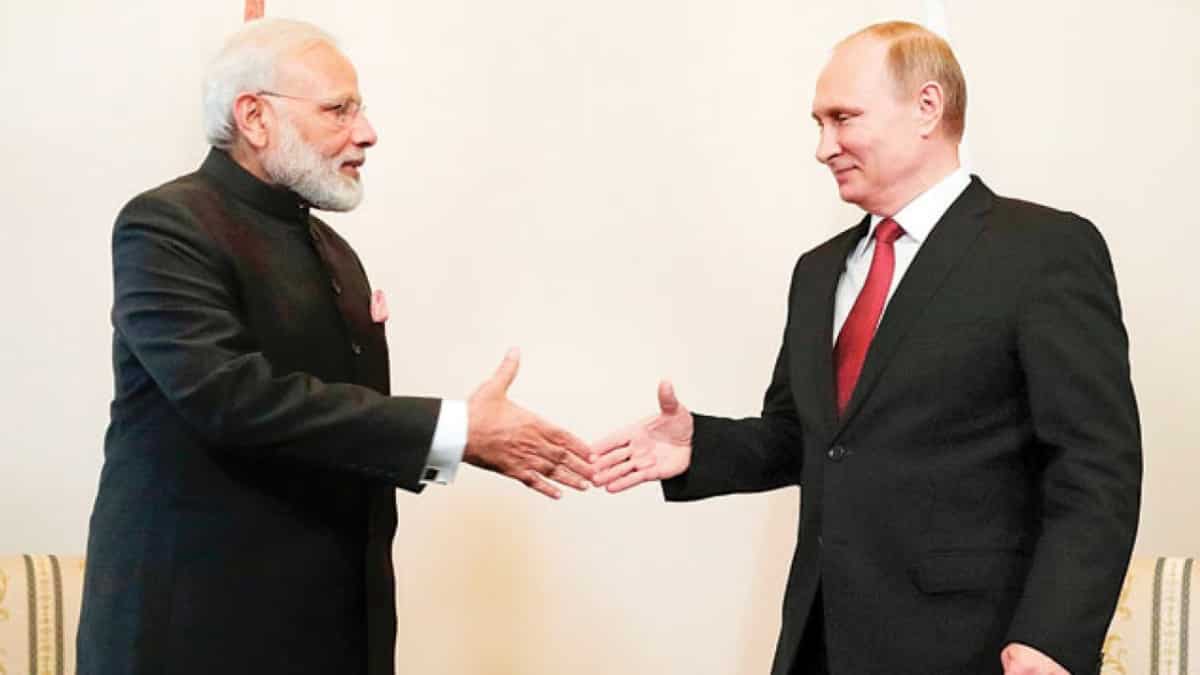
Putin-Modi
India has emerged as one of the top buyers of Russian oil after Moscow invaded Ukraine. Historically allies, the two countries are settling a greater share of the trade in national currencies after Russia was cut off from the US dollar-dominated global payments systems. Though it seems like a win-win situation for everybody, there is a problem. Russia does not know how to reap the benefits of this trade.
Moscow is currently accumulating $1 billion in rupee assets each month that remain stranded outside the country, primarily due to the lopsided trade relationship, a Bloomberg report has claimed.
Every quarter, the trade imbalance is likely to generate the equivalent of $2 billion to $3 billion that Russia can’t use. Over the course of 2022, the amount would have added to an estimated $147 billion in net foreign assets built up abroad, the report added.
The sum stuck is huge and it can be gauged by the fact that Russia spent 5.51 trillion rubles or $68 billion on defence in 2022, according to a Reuters report.
India-Russia back to the drawing board
To find an alternative, the two nations have gone back to the drawing board. One of the ways out is to establish various payment mechanisms, including investments in India’s capital markets by Russian entities.
However, the solution is still not simple as Russia cannot use the entire tranche as India has restrictions over capital flows by foreign investors.
The other option is to use currencies of a third country such as China's yuan or UAE's dirham. Though an agreement on such a solution is highly unlikely.
"Russia’s trade with India is increasingly imbalanced. India’s exports to Russia haven’t caught up with booming imports, but there’s a limited appetite in Russia to save its current-account surplus in rupees," said Alexander Isakov, Russia economist at Bloomberg Economics.
"There are no alternative oil importers of India's calibre on the horizon for Russia, so exporters and banks will gradually accept settlement in rupees," he added.
Will India increase oil imports?
Even if India wanted to increase its oil imports, Moscow decreasing the discount on oil prices has done no favour to bolster that sentiment. Steep discounts that New Delhi enjoyed through most of FY23 have plunged due to Chinese demand and a cut at the oil producers' end, a Mint report claimed recently.
During FY23, by providing discounts amidst the Ukraine conflict, Russia became a significant provider of oil to Indian refiners for the first time. As a result, in the 11 months leading up to February of the previous fiscal year, India imported crude oil worth $27 billion from its strategic partner, placing the Russian Federation in second place for Indian oil imports.
(With inputs from agencies)
WATCH WION LIVE HERE: