Putin dependent on 'authoritarian' leaders for weapons: NATO chief

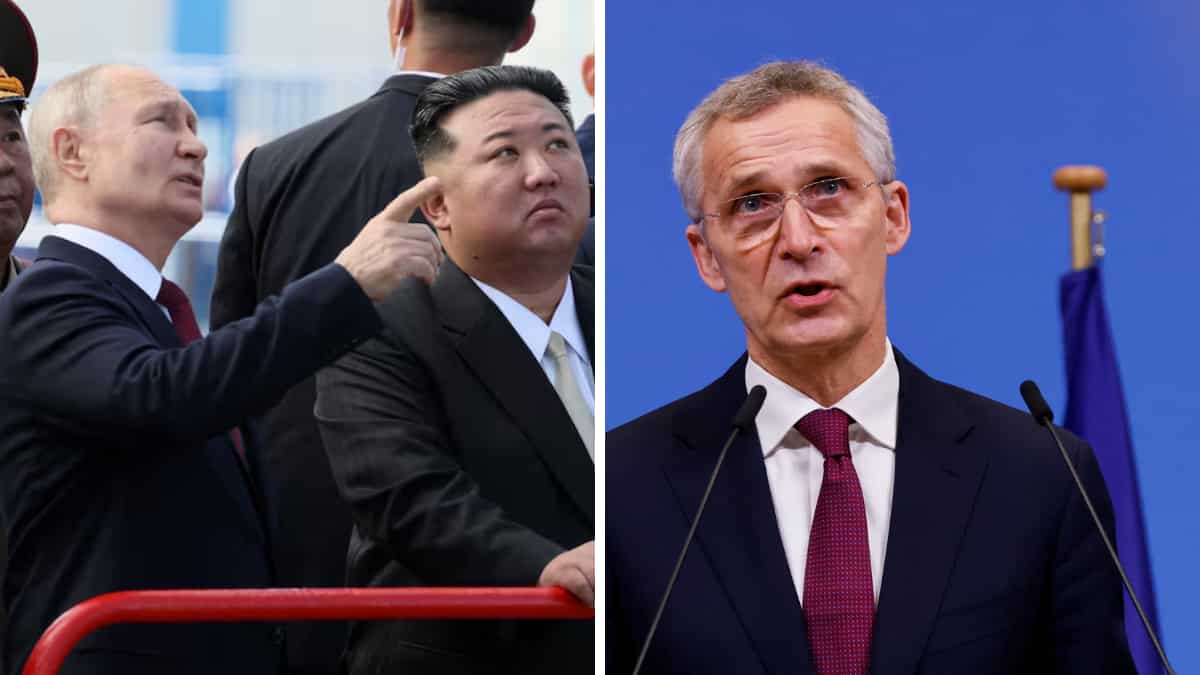
File photo of Russian President Vladimir Putin with North Korea's Kim Jong-Un; NATO chief Jens Stoltenberg
NATO chief Jens Stoltenberg on Monday (June 17) said that Russian President Vladimir Putin's visit this week to North Korea, which has supplied shells to Moscow despite being under UN sanctions, points out that Russia is "dependent" on authoritarian leaders for weapons supply.
Additionally, Stoltenbergcalled on Beijing to face consequences if it continues to support Moscow amid the war in Ukraine. The NATO Secretary-General accused China of worsening the conflict between Russia and Ukraine through an alleged export push to rebuild Russia's defence industry.
President Xi Jinping "has tried to create the impression that he is taking a back seat in this conflict, to avoid sanctions and keep trade flowing," Stoltenberg said.
"But the reality is that China is fueling the largest armed conflict in Europe since World War II, and at the same time, it wants to maintain good relations with the West," he said.
"Beijing cannot have it both ways. At some point — and unless China changes course — allies need to impose a cost. There should be consequences," Stoltenberg added.
China says that it is not sending lethal assistance to either Russia or Ukraine which the United States and other Western nations are purportedly doing.
China did not participate in a summit in Switzerland over the weekend billed by Ukraine's Zelensky as a "peace summit".
Furthermore, Stoltenberg said that Russian President Vladimir Putin's visit this week to North Korea, which has supplied shells to Moscow despite being under UN sanctions, points out that Russia was "dependent" on authoritarian leaders for weapons supply.
Also watch |China says G7 statement 'full of arrogance, prejudice and lies'
Stoltenberg, who led NATO throughout Trump's 2017-2021 presidency, also said that successive US administrations had "an absolutely valid point to say that European allies are spending too little." Donald Trump has repeatedly slammed European NATO counterparts for inequitable funding of the military alliance.
"The good news is that's changing," Stoltenberg said.
"We are not saying that we are satisfied, but we are in a totally different place now than we were back in 2014," he said.
(With inputs from agencies)