Parachute malfunctions on Jeff Bezos' Blue Origin mission

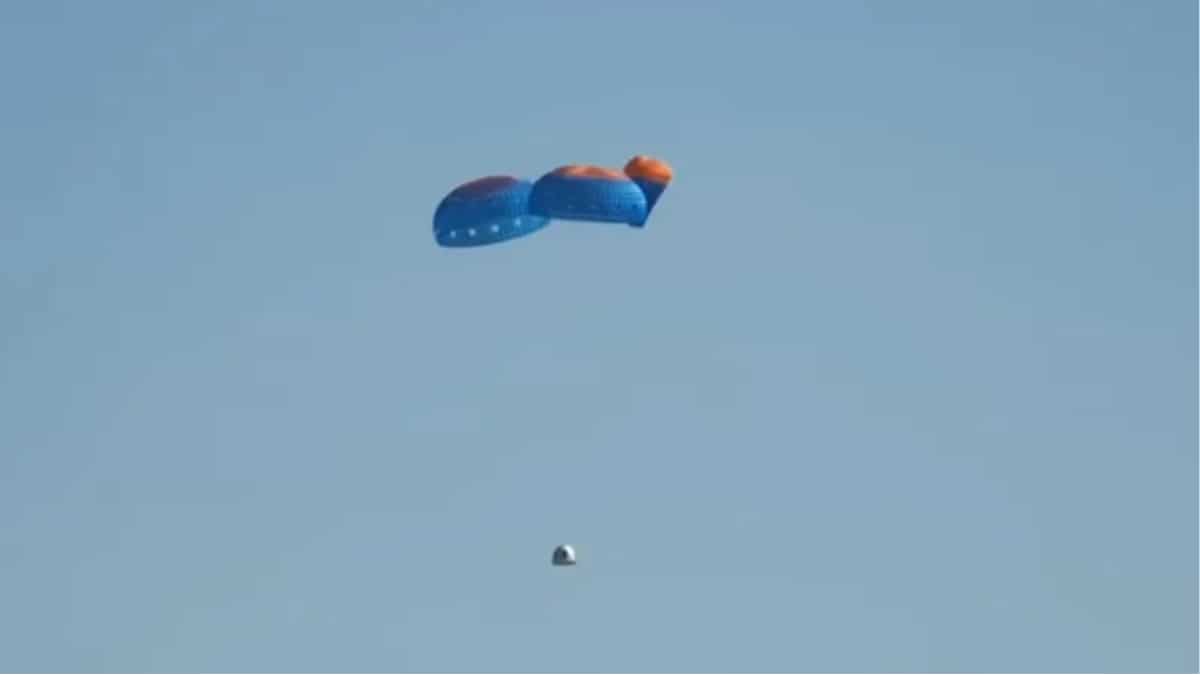
Screengrab from the Blue Origin webcast, shows the unfurled parachute.
Amazon billionaire Jeff Bezos’ company Blue Originhas launched an investigation following an incident during its first crewed flight in two years, in which one of the parachutes on the New Shepard capsule failed to fully inflate.
The company’s New Shepard rocket launched on May 19 and was carrying a six-person crew to suborbital space.
According to SpaceNews reports, "The NS-25 mission saw the crew capsule land to conclude the flight, but only two of its three parachutes were fully inflated."
Steve Stich, NASA’s commercial crew programme manager, recently disclosed the problem during a briefing on the upcoming Boeing Starliner crewed test flight.
However, Blue Origin did not openly announce the parachute issue but instead provided a briefing to NASA officials about the irregularity, given that vehicles like Boeing’s Starliner utilise similar components.
It is worth mentioning here, New Shepard uses three parachutes to slow down the crew capsule as it makes its way back to Earth, although it can land with just one parachute fully deployed.
The parachutes open in three stages, but during the NS-25 mission, one of the three parachutes failed at the very first stage when a line controlling its inflation was not cut like it was supposed to, according to Stich.
Stich was quoted in SpaceNews as saying, "It's a small group of people who work on these parachutes. They've been great at sharing data with us. They don't really have any kind of root cause yet, and we continue to follow along with them."
In September 2022, an uncrewed flight of New Shepard ended in flames around a minute after liftoff. The rocket’s booster exploded mid-flight and its capsule abandoned ship while traveling at roughly 700 miles per hour (1,130 kilometers per hour) and at 29,000 feet (8,840 meters) above the ground.
Blue Origin identified a “thermo-structural failure of the engine nozzle” as the reason behind the rocket’s failed launch.
Although we don’t yet know the severity of the parachute problem or if it will cause further delays, while we’re not parachute experts, it’s fair to say this is concerning; if one parachute fails to deploy, it could indicate the potential for multiple failures during descent, the company said.
A few weeks before the planned liftoff on July 21, 2023, Starliner teams found that the fabric sections of the parachutes had a lower failure load limit than expected.
This indicated that if one parachute failed, the remaining two would not be able to slow the Starliner vehicle sufficiently for a safe landing in New Mexico.
In March 2024, Boeing announced that it had resolved the safety issue.
(With inputs from agencies)