
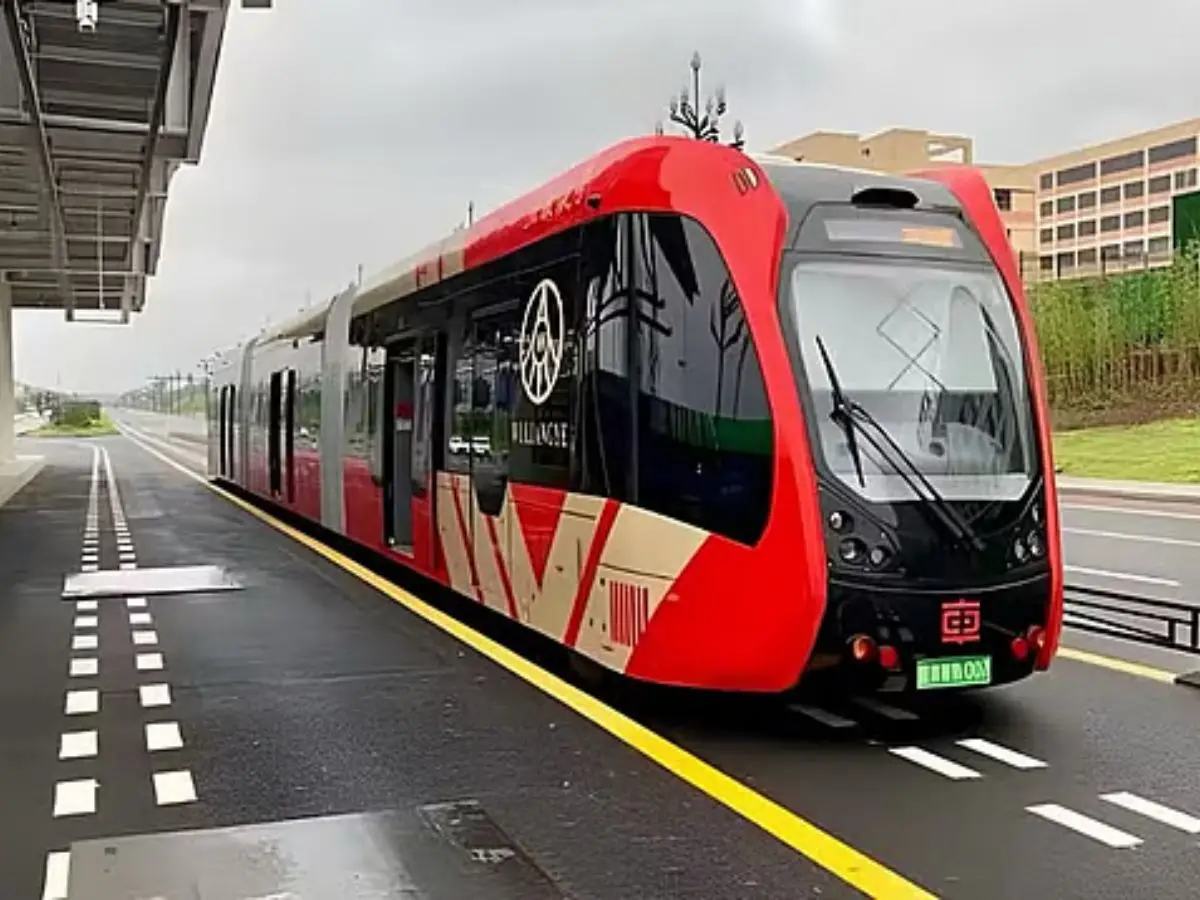
&imwidth=800&imheight=600&format=webp&quality=medium "Pakistan unveils 'Subway on wheels' in Lahore with help from China: Is it really a trackless metro?")
Pakistan has launched what it called South Asia's first ‘subway on wheels’. Unveiled in Lahore, this rubber-wheeled, solar-powered tram resembles a bus but touts to deliver the efficiency of a metro, that too without a track. It is Pakistan's effort to modernise its urban transport and plans to deploy it in 30 cities. The announcement is indeed a fascinating feat, but experts and transport analysts are divided on whether the transport qualifies as a metro. But what is certain is that China's influence is truly reshaping Pakistan's infrastructure.
What is 'Subway on the Wheels'?
The vehicle, which runs on regular roads guided by virtual tracks using sensors and GPS technology, mimics the form and function of a metro system. It is electric and solar-powered and contributes to Pakistan's renewable energy goals. The system also allows multiple carriages to be connected and resemble a train, and can carry up to 500 passengers.

But is it really a metro? Despite the branding, unlike a true metro, it shares roads with other vehicles, raising concerns over traffic and speed reliability. The vehicle's rubber tire makes it closer to a solar-powered bus than a train. It lacks dedicated infrastructure like underground tunnels, stations, or overpasses like those of a conventional metro system.
But its cost-effective nature makes it compatible for an economically troubled nation such as Pakistan; moreover, being environmentally friendly public transport, it will potentially reduce the carbon footprint of the nation. For China, this is another strategic infrastructure export and marks a boost in its soft power in South Asia. For the region, it sparks a broader debate about low-cost, scalable transport innovation in mass mobility. So, despite not being a metro in true essence, it serves the purpose and marks a shift toward pragmatic, futuristic, and politically strategic infrastructure with China's tech and funding.

