Opinion: Why Iran's strategy of engagement post JCPOA might work

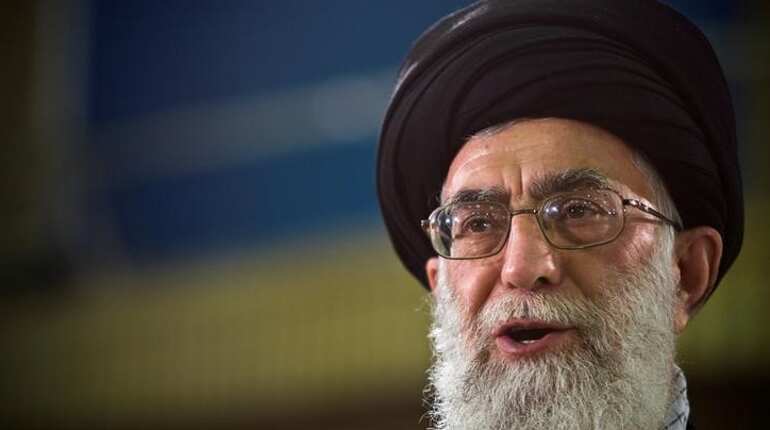
Ayatollah Khamenei
Iran appears to have, at least, for now, decided not to cock a snook at America by going for the nuclear break out option.
Iran’s Supreme Leader, Ayatollah Khamenei, has called for better relations with the world, except the United States. The backdrop and context to this assertion is Trump administration’s withdrawal from the Joint Comprehensive Plan of Action (JCPOA), the nuclear deal arrived at between Iran and the international community and the reinstatement of sanctions against Iran. The abrogation of the deal was followed by some tough talk by the United States which some held to be indicative of putative military action against Iran.
Whether it constituted posturing by the country or whether there is (was) seriousness to it remains to be seen. However, what can de stated with a degree of certainty is that the withdrawal from the JCPOA constituted a U turn by the United States. Many reasons have been cited and proffered for the U turn and of these, the most salient ones seem to be clipping Iran’s wings, so to speak, put the country under immense pressure through assorted sanctions aimed at crippling its economy, with the larger goal of inflicting maximum pain so as to induce Iranians to rise against their government. In other words then, the agenda is “regime change” through measures short of war.
Post the second Gulf War, the country that emerged as the swing factor in the Middle East is Iran. It might not be inaccurate to state that Iran morphed into a veritable hegemon after the war. Its reach and influence and power amplified through proxies, religious influence and sheer hard power stretched from Aden to Baghdad to Syria. Naturally, besides undercutting Saudi Arabia’s influence, this reach and power alarmed the United States. But, all said and said, and despite Iran’s growing clout and influence, there was a downside to it. This lay in the fact that hard power , axiomatically , has diminishing returns, especially if it is not buttressed and complemented by economic growth. In fact, excess reliance on hard power can undercut economic growth.
Iran’s economy, to say the least, is a somewhat monocultural economy, with over reliance on oild , which has neither entirely globalised nor diversified for reasons that pertain to it structure, base and, the fact that the country has been in the cross hairs of the United States since the 1979 revolution. While Iran got by, but its economic vulnerabilities increased with the passage of time. Complemented by its hard power forays, these vulnerabilities might have even grown stronger. It is this very weakness and pressure point that the Trump administration is exploiting.
The question is: Can Iran withstand this acute pressure?
The answer lies in Ayatollah Khamenei’s assertions which suggest that Iran appears to have, at least, for now, decided not to cock a snook at America by going for the nuclear break out option. The country has chosen engagement and diplomacy over confrontation. This approach is not only good for Iran but perhaps for the world too. An outright confrontation could possibly lead to another war in the region, which would obviously have deleterious consequences for both Iran, the region and the world , at large. While Iran is not a military pushover, but war would drain and exhaust it (along with the United States given that the country’s absorptive capacity for war has considerably depleted).
All said and done, despite the nature of Iran’s economy, the world needs Iran, primarily or even exclusively for oil. If, hypothetically speaking, Iran chokes the strait of Hormuz, the world’s oil supply lanes would take a hit. Or , if there is outright war, between Iran and the United States, oil prices would sky rocket. Under either scenario, on account of high oil prices, inflationary pressures and exchange rate gyrations would not only hit many national economies, throwing their fiscal and budgetary positions into a tizzy, among other things, but these would also shrink and put the global economic recovery at risk. Capital movements would demonstrate high volatility with global repercussions. Iran recognises this and has, prudently and intelligently, chosen to engage the world.
The strategy of engagement that Iran appears to have chosen is in the nature of regime survival. The country also appears to recognise that the United States, as polarised as it is, under Trump, might not reelect the man after a couple of years. It then just or merely has to bide for time till sobriety and proportion return to the United States and its foreign policy thereof. Yet, again this is a prudent approach. In the meantime, with Russia, again a player, globally, regionally and in the Middle East, there will be geopolitical manoeuvrings that might or might not be in favour of Iran. But, these merely constitute actions on the chess board of strategy. What actually matters is grand strategy of states. In this domain, at this point in time, everything is fluid or even hazy. The hope is that when and if there is clarity in this all important facet of international relations, peace , within and without would ensue.
(Disclaimer: The opinions expressed above are the personal views of the author and do not reflect the views of ZMCL)