
Opinion: The 'false' debate over immigration in the United States

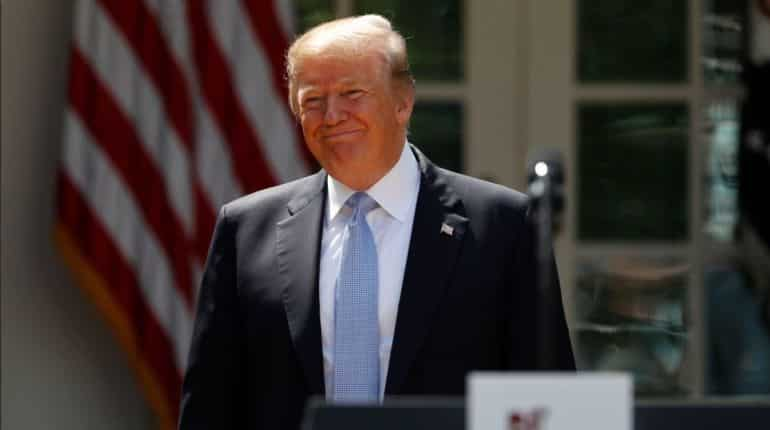
Trump
First, the crime and predation that Trump referred to and amplified was not and is not the monopoly of immigrants, legal or illegal.
Call me a “failed immigrant” with attitude or call me a loony but I have lived on the streets, and in ghettos andshelters of the United States, by choice and ofmy own volition.There was a larger goal and aim to this “wandering”: I was studying the United States (admittedly with very crude methodologiesand approaches given that I was young(er) then). That there is a nether world (out of the pale of law) in the United States was revealed to me all too eloquently and poignantly during my “wanderings” on the streets and in the country’s shelters and ghettos , at odds and in stark contradistinction to “mainstream and polite society”but the more acute insight wasthatin this world,conditions were Dickensian in this world.
This was a world away from the gleaming skyscrapers of New York, a world obscured by the likes of Wall Street, the New York stock exchange and the glitterati of the city. As the iconic symbol of the foundational idea of the United States, the Statue of Liberty, cast her gaze on New York City, some “blacks”, “browns”,and “whites”( yes, whites), slogged it out in the Dickensian parts of the city. The ones that I am referring to were petty criminals, small time thieves, petty fraudsters, or plain wanderers and other assorted people rejected by “mainstream society”. Within this broad and assorted group, there were power plays, attempts at control and domination , deception and even elements of gangsterism. But, to repeat, it was a diverse, motley crowd.
The point of portraying vividly the out of view Dickensian aspects of the United States, with New York City, as a sample study is not an idle one. It perhaps goes to the heart of the false and meretricious debate in the United States over immigration. What might be extrapolated from this is that the country is not a monolith it is diverse in every sense of the term from a broad perspective. (Reducing it to a monolith amounts to a caricature). But, one “fact” may be culled from this diversity and the portrait I have drawn: the United States is an unforgiving society one mistake can make an individual fall from the radar of mainstream society. There then are no second chances for people constituting the firmament of the country. This perhaps stems from its very individualistic nature and its corollary, social Darwinism, all a concomitant of untamed capitalism. (I am neither a leftist, nor a rightist, nor a middle of the roader, so to speak and my indictment of untrammelled and untamed capitalism is not predicated on ideological grounds.Capitalism spurred the Industrial and Information revolutions buta compassionate version of the samemight even be good and prudent))
The nature of raw capitalism is ruthless.The machine that underpins this form of capitalism is defined by productivity, efficiency, effectiveness, the bottom line and the top line, among other things. No matter what economists of a certain school tell us, income inequality and distributional asymmetries are part and parcel of this variety of capitalism.(There is no such thing as a rising tide that lifts all boats. The economic pie is then slanted towards the privileged,that is, those with access to education, capital and networks of success). And, when and if there is no social safety net, the unfortunate are extremely vulnerable to the vagaries of capitalism.
It is this income equality and social Darwinism thereof that, along withassorted people flows, into the United States, thataccount for the class of peoples that Ihave described that created angst filled uncertainty and fear among the white superstructure of the country. To go back into the mists of the history of the United States, it is not an immigrant country. The United States is a settler nation and most, if not all, settlers were white. This white superstructure, especially economically, is not a monolith it is extremely stratified and those “at the bottom of the pyramid” suffer(ed) most in the gale of modern day capitalism, amplified by globalisation. The “problem” then, for this strata of society, was to find an “other” to direct its angst at.
It is here that Trump entered the scene. The man, with his populist instincts, helped define this “other” for the suffering classes of the United States and weaved a new narrative around these. The “others”, in Trump’s schema, were Muslims, browns, the Mexicans, Latino’s and other underprivileged people who had mostly sought to enter the countryin their quest for the so called “American Dream”. Here was a visible group of people who the white superstructure felt had usurped and trod on its economic and social pie. As, some of this underclass of peopleformed the subterranean portions of America( including some whites), Trump amplified their misdemeanoursand , at times, even crimes( a much lower proportion in aggregate and comparativeterms than suggested by Trump). This served the man’s purpose as the white especially the deprived sections of this class, had now an identifiable “enemy” to project its angst, desperation and anger onto.
(Obiter Dictum, in Europe the fear of immigrants might generally be premised upon the fear of nothing)
The debate and the narrative that Trump engineered resonated with many people in the United States but the debate is fundamentally flawed and false. First,the crime and predation that Trump referred to and amplified was not and is not the monopoly of immigrants, legal or illegal. A criminal is a criminal and attributing ethnicity or class to it is not only wrong but patently false. Second,the world is now fundamentally more open. Trumpian populism and its avatars in Europe might be mere aberrations, in the larger scheme of things. Third, the economics of immigration favour people flows. There might even be a supply demand dynamic in operation here against the backdrop of demographics in the United States, especially in Europe, where immigrant flows might be determined, among other things, by dependency ratios. Fourth, given the confluence of these factors, the doors have been opened and flows of people will not be stopped by walls of any nature. Western societies have fundamentally changed. Even though the white superstructure is extant, but underneath this patina, diversity is real. It cannot be wished away.
Trump and his cohort then are going against the grain of the direction of history, in the narrow sense of the term. This broad assertion might be cold comfort for many who are suffering, as this essay is being written but the nature and form of the world that we inhabit has gone beyond the blandishments and siren songs of populism. There will, unfortunately, be people who will pay a price but as the Sufi saying goes, “ this too will pass”.
(Disclaimer: The opinions expressed above are the personal views of the author and do not reflect the views of ZMCL)