Opinion: Iraqi government's inefficiency led to widespread protests

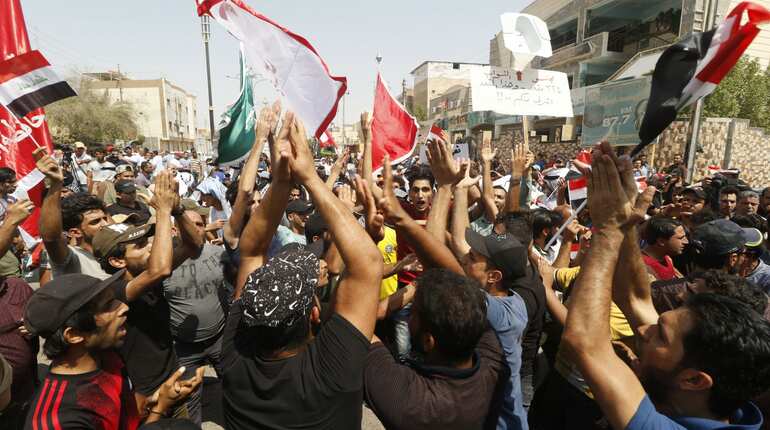
Iraq protests
Iraqi security forces fired live ammunition, tear gas canisters and water cannon to curb the protest movement, but this further fumed the demonstrators.
Soon after Iran halted the electricity supplies to southern Iraq on July 6 over unpaid bills, massive anti-government protests erupted in parts of Basra and other provinces, including Baghdad.
At least 14 protesters lost their lives and over 700 were injured in the protests. Following the massive uproar, prime minister Haider al-Abadi ordered suspension of electricity minister Qassem al-Fahdawai. He said the Qassem's suspension will last until an investigation is concluded.
Thousands on July 8 thronged to streets shouting slogans against the unemployment, poor service and widespread government corruption in the state. The protests swell in other areas and continued for weeks, the palpable anger was such that the demonstrators stormed the buildings of provincial capitals while razing down the buildings of political parties and militia, forcing authorities to curb the internet service and impose restrictions in different parts.
The reasons of public protest in different provinces as Conference of Iraqi Federation and Workers Union opined remain the “consequence of the grave crisis affecting Iraqi society, which is a result of racism, sectarian conflict and the wrong economic and social policies”.
Iraqi security forces fired live ammunition, tear gas canisters and water cannon to curb the protest movement, but this further fumed the demonstrators.
As Sarah Leah Whitson, the Director of Human Rights Watch rightly emphasised “so long as the government fails to address protesters' grievances, the danger of further bloody protests remains real”. The demonstrators, especially in Basra province, have started pressing for a degree of autonomy. A large number of protesters want dismantling of “the corrupt political system and confessionalism that harms and humiliates the people of Iraq” along with “improvement in the deteriorated services”.
“Iraqis really want to do away with this broken kleptocratic-system that has failed to deliver despite having the resources,” Renad Masour, the research fellow at Chatham House, noted.
Iranian decision of halting the electricity also seems to has proven counterproductive for many shiite politicians of Iraq, who are complaining that Tehran’s support to Iraqi political elite undermines the process of reformation in the country. The enchantment has provided Saudi Arabia an opportunity to exploit and increase its influence in the state - in a recent deal on August 4, Saudi authorities decided to construct solar power plants with lower cost to support Iraq electricity crisis.
As the protest escalates, the vulnerabilities, broken system, incompetence of the authority and widening gap of elite political parties and Iraqi citizens have come to the surface. In response to the drop in unemployment rate, Haider al-Abadi government approved the proposal which will enable local workers to get 50 per cent jobs assurance in the foreign companies. This offer too hasn't impressed many.
Iraqi establishment amid political turmoil face challenges in terms of lack of credibility, lacks of resources and strategy to address demands of commoners who are frustrated with the current socio-economic as well as political condition of the country.
(Disclaimer: The opinions expressed above are the personal views of the author and do not reflect the views of ZMCL)