Opinion: Does Trump's Asia Tour sidelines China?

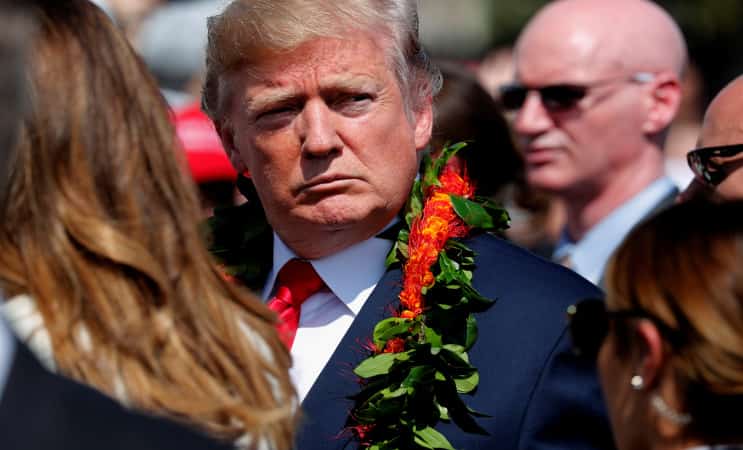
Donald Trump on Asia trip
America?s determination to counter China?s growing assertions is changing the contours of existing power relationships
Donald Trump’s Asia tour was his first overseas trip as the American president and also his longest. Also, it was the most anticipated as it happened at a time when Asia was passing through a politically volatile phase. In the context of belligerent war threats from North Korea, the intensification of geopolitical conflicts among dominant players and the ensuing power realignments, the visit was significant not only for Asian politics but for global peace and security.
While the jury is still out as to whether Trump succeeded in protecting America’s politico-economic interests in the region and assuaging the concerns of ‘allies’ like Japan and South Korea, the American President clearly signaled his intent to work towards initiating a ‘new security order’ in Asia by strengthening Washington-Tokyo-New Delhi partnership as a counter to the developing Beijing-Pyongyang-Islamabad axis.
It was significant that Trump decided to combine his visits to Japan, South Korea and Vietnam with three major regional summits - the Asia-Pacific Economic Cooperation (APEC) and the East Asia and ASEAN Summits-that involved all the major powers around the Indo-Pacific.
Trump did not broach contentious issues like trade imbalances, human rights violations, and China’s control over the South China Sea or its support to North Korea’s nuclear program.
During his tour, contrary to expectations, Trump did not broach contentious issues like trade imbalances, human rights violations, and China’s control over the South China Sea or its support to North Korea’s nuclear program. Also, he failed to extract tangible commitments from China to intensify pressure on North Korea. Again, what was most noteworthy that at no point, either in his speeches or comments, he made any reference to the American leadership in the region.
It was a major departure as all the previous presidents had tried to push the U.S. into the driver’s seat as the guarantor of peace and stability in Asia. It might be construed as Trump’s strategy to put ‘America First’ in foreign policy that signifies a conscious attempt to disengage America from different global crises-gradually withdrawing from conflict zones-and focus primarily upon augmenting its own national power and security.
Trump’s rather moderate and conciliatory approach was quite apparent during his China visit where he received a grand welcome and described Chinese President Xi Jinping as ‘a very special man’. During his visits to Japan and South Korea, where the focus of meetings was on containing North Korea, his tone was on the whole measured and resolute than expected. In South Korea, Trump talked about strengthening bilateral partnership belying Seoul’s fears regarding any disruption in relations. There was a sense of relief that Trump made no further threats of unilateral strikes against North Korea and pointed towards the possibility of exploring diplomatic options to normalise the situation and establish peace.
Praising India’s role, the American President offered a “renewed partnership with America” to strengthen the cooperation, regionally and bilaterally, in the interest of Indo-Pacific.
Amidst all these, Trump did outline his broad vision for Asia as he floated a new framework for the region-the ‘Indo-Pacific’, in his speech on November 10 at APEC Summit at Danang in Vietnam. The idea, centered around the notion of a “free and open Indo-Pacific”, is considered as Trump’s alternative to Obama’s ‘Pivot to Asia’ strategy’, at least in form, if not completely in substance. Praising India’s role, the American President offered a “renewed partnership with America” to strengthen the cooperation, regionally and bilaterally, in the interest of Indo-Pacific.
For Donald Trump, the basis of this cooperation should be built on free and fair trading and commerce environment. What is important to note is that Trump’s repeated referral to Indo-Pacific was not merely rhetorical in nature, but rather was part of a grand strategy to forge the strategic coalition between the U.S. India, Japan and Australia that could counter growing power and influence of China in Asia. In this context, one of the most important strategic takeaways from Trump’s trip was the revival of the Quadrilateral Dialogue comprising the four countries, which met at the level of senior officials on the sidelines of the ASEAN Summit in Manila almost after a decade.
The United States, of late, has enhanced its military operations both in the South China Sea and theKorean peninsula,emphasising freedom of navigations and resisting Chinese assertions. These issues were discussed throughout Trump’s Asia trip and are likely to remain on top of his Asia agenda for some time.
Trump’s speech castigating Asian nations for “chronic trade abuses” and strident stand against Trans-Pacific Partnership (TPP) did not help in creating confidence among his partners.
Still, doubt prevails over Trump’s sincerity in pushing this strategy as the American President neither devised any concrete roadmap for its implementation nor suggested what exactly would be America’s role in the proposed regional order. Also, Trump’s speech castigating Asian nations for “chronic trade abuses” and strident stand against Trans-Pacific Partnership (TPP) did not help in creating confidence among his partners. It is believed that Trump’s rigid stance on ‘economic unilateralism’, in the form of ‘America First’, would hamper its economy in long-term and also affect its standing in important multilateral forums.
Shunning America, the remaining eleven signatories of the TPP chose to carry forward the initiative and work towards mutually beneficial economic exchanges. The Danang Declaration reflected the mood as it referred to “importance of non-discriminatory, reciprocal and mutually advantageous trade and investment frameworks”.
Thus, there is more continuity than change in Trump administration’s approach towards Asia. Rhetoric is replaced by realism as America braces for a new world order where the American supremacy as a dominant player is fading away rapidly. Trump, much to the dismay of his supporters, is treading a cautious path on contentious issues without attempting any radical shift. This is quite apparent as he tones down his diatribe and tries to introduce a credible and coherent policy on Asia that would bear his unique stamp and at the same time protect American interests.
It is really difficult to predict as to whether the Trump Administration would push for a new security order in Asia by promoting the framework of ‘Indo-Pacific’ or would rather choose to strategically disengage itself from the regional quagmire engulfing the continent.
However, America’s determination to counter China’s growing assertions, both in economic and strategic spheres and the emergence of the ‘Quad’ as a dominant block might usher in new power equilibrium in Asia, changing the contours of existing power relationships. Trump’s Asia tour has signalled a new beginning or at least a step forward in that direction.
(Disclaimer: The author writes here in a personal capacity).