North Korea images suggest missile capable of hitting all America: US experts

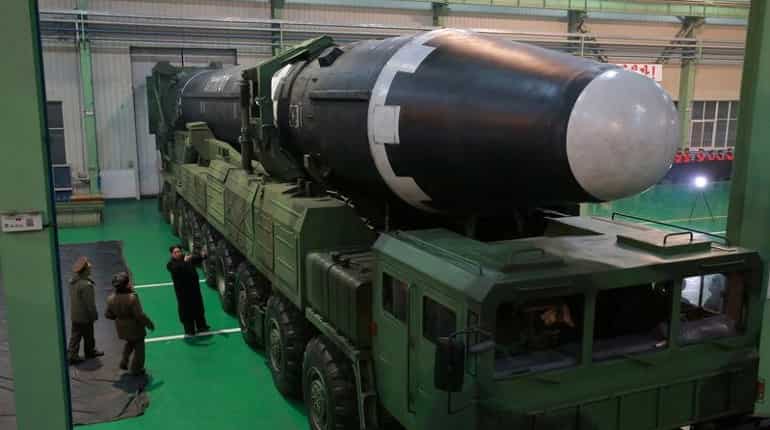
north korea, Hwasong-15?missile
North?Korea?said the the new Hwasong-15?missile?soared to an altitude of about 4,475 km (2,780 miles), more than 10 times the height of the International Space Station, and flew 950 km (590 miles) during its 53-minute flight before landing in the sea near Japan
Imagesreleased byNorthKoreaon Thursday appeared to show it has succeeded in developing amissilecapableof delivering a nuclear weapon anywhere in the United States and it could be only two or three tests away from being declared combat ready, US-basedexpertssaid on Thursday.
NorthKoreareleased dozens of photos and a video after Wednesday's launch of the new Hwasong-15missile, and leader Kim Jong Un declared the country had "finally realized the great historic cause of completing the state nuclear force".
US-basedexperts, some of whom have been sceptical about pastNorthKorean claims to have putallof the United States in range, said data from the latest test and the photos appeared to confirmNorthKoreahas amissileof sufficient power to deliver a nuclear warhead anywhere in America.
Expertsand USofficials say questions remain about whether it has a re-entry vehiclecapableof protecting a nuclear warhead as it speeds toward its target and about the accuracy of its guidance systems.
In an analysis for the Washington-based 38Norththink tank,missileexpert Michael Elleman of the International Institute for Strategic Studies said theNorthKorean photos showed amissile considerably larger than its predecessor.
"Initial calculations indicate the newmissilecould deliver a moderately sized nuclear weapon to any city on the USmainland," Elleman said.
Elleman said themissilewas large and powerful enough to carry simple decoys or other countermeasures to challenge USmissiledefences.
"A handful of additional flight tests are needed to validate the Hwasong-15's performance and reliability, and likely establish the efficacy of a protection system needed to ensure the warhead survives the rigours of atmospheric re-entry," Elleman wrote.
Only two or three more tests might be needed ifNorthKoreacould accept low confidence in the missile's reliability.
Anothermissileexpert, whose employer does notallow him to speak publicly to the media, agreed with Elleman's assessment.
"IfNorthKoreadoes not make high demands on the reliability or accuracy of themissile... two or three more tests would suffice.
"So long asNorthKoreacan hit UScities with thermonuclear warheads, they probably don't need the ability hit every city they target or target specific aim points within those cities to convince the U.S. leadership that war withNorthKoreawould be too expensive to contemplate."
In a callwith USPresident Donald Trump on Thursday, SouthKorean President Moon Jae-in said themissilewasNorthKorea's most advanced so far. But it was unclear if Pyongyang had the technology to miniaturise a nuclear warhead, and it still needed to prove other things, including re-entry technology.
US-basedexpertssaidNorthKoreahad almost certainly developed a warhead light enough to be carried by the Hwasong- 15, which Elleman said should becapableof delivering a 1,000 kg payload.
Larger, more powerful
Jeffrey Lewis of the Middlebury Institute of Strategic Studies said on Twitter the Hwasong-15 was "so big that the warhead wouldn’t need to be miniaturised."
On Wednesday, USDefense Secretary Jim Mattis acknowledged themissilewent higher than any previoustest and was part of aNorthKorean effort "to continue building ballisticmissiles that can threaten everywhere in the world, basically."
NorthKoreasaid themissilesoared to an altitude of about 4,475 km (2,780 miles), more than 10 times the height of the International Space Station, and flew 950 km (590 miles) during its 53-minute flight before landing in the sea near Japan.
Themissile's large size was immediately apparent in the photos, which analysts saidallowed for a more powerful propulsion system.
"This is a very bigmissile," said Michael Duitsman, a research associate at the Centre for Nonproliferation Studies. "And I don't mean 'big forNorthKorea.' Only a few countries can producemissiles of this size, andNorthKoreajust joined the club."
USexpertsand officials said themissilestill appeared to be powered by liquid fuel, something that made it vulnerable as it could take to up to two hours to fuel on-site before launching.
Earlier, one USofficial told Reuters themissilecould have been powered by solid fuel, but expertssaidNorthKoreacould still be a few years away from being able to field a more versatile solid-fuelled ICBM.
The photos appeared to show themissilewith at least two large nozzles on its first stage, instead of the one large and several smaller nozzles on the Hwasong-14.
"The first stage seems touse essentially the same case (as the Hwasong-14) but has two engines," said David Wright, of the Union of Concerned Scientists, a US-based nonprofit science advocacy group. "The second stage looks like it can carry more than twice as much propellant. The combination of those two things means it really is a new, morecapablemissile."
While the photos show a mobile erector vehicle beingused to position themissileupright, it is not seen in photos of the launch itself. USintelligence analysts have concluded that the testmissile was fired from a fixed position, not a mobile launcher, three USofficials said.
The massive vehicle was "100 percent" a domestic product ofNorthKorea, state media quoted Kim Jong Un as saying.
Western analysts said it is more likely the truck was one of about half a dozen vehicles obtained years ago from China, whichNorthKoreahas modified since then.