
&imwidth=800&imheight=600&format=webp&quality=medium "Nobel Prize 2025 in Physics: John Clarke, Michel Devoret and John Martinis awarded for discovery of macroscopic quantum mechanical tunnelling")
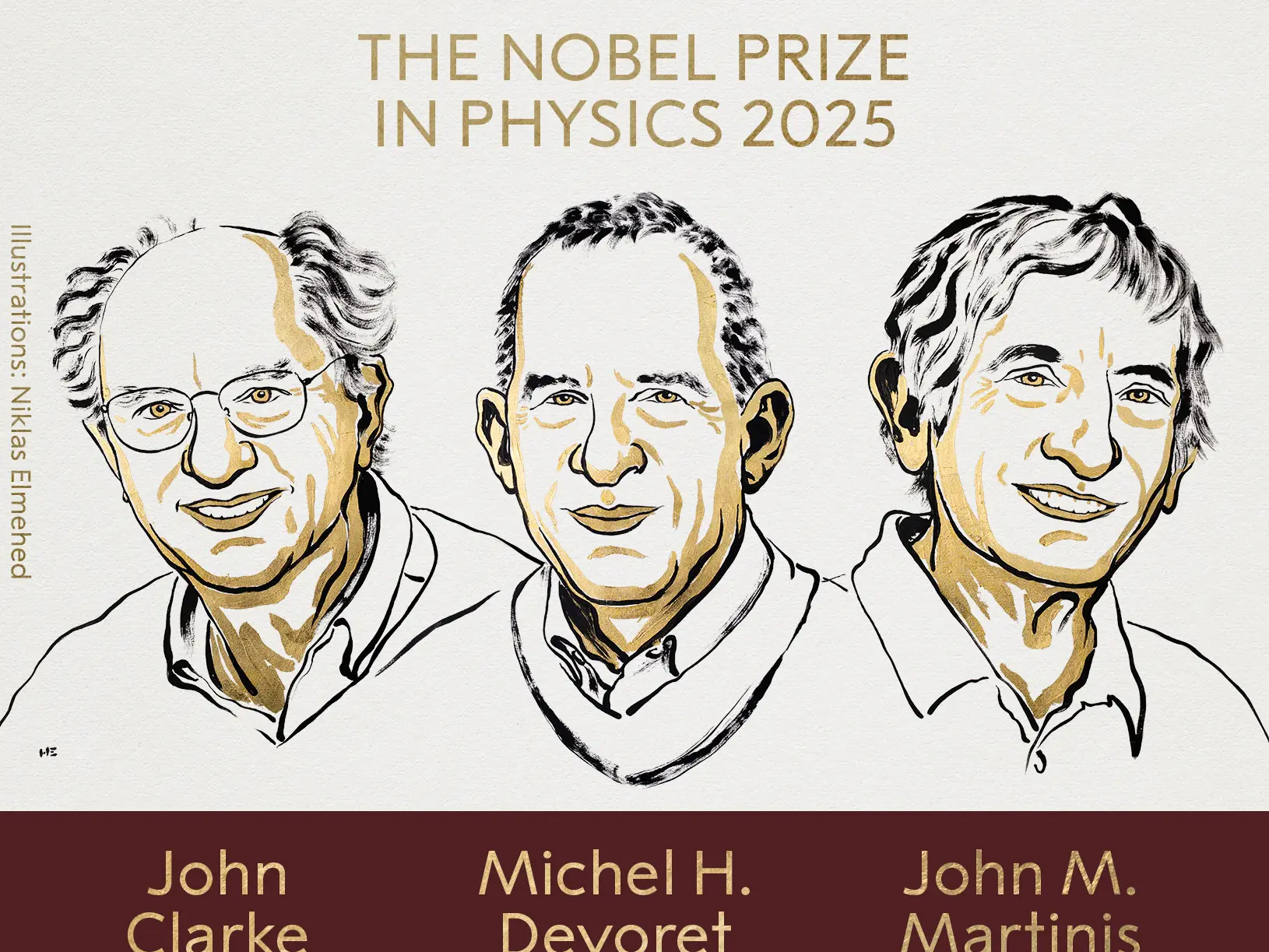
John Clarke from Britain, Michel Devoret from France, and John Martinis from the United States have been awarded the Nobel Prize in Physics for their groundbreaking contributions to quantum physics, the Nobel Committee announced on Tuesday (October 7). The trio received the prestigious award for their work on "macroscopic quantum mechanical tunnelling and energy quantisation in an electric circuit," which was first explored in experiments during the 1980s. Quantum mechanics, which deals with the behavior of particles at minuscule scales, is known for phenomena that seem strange by everyday standards. For instance, while a regular ball would bounce back after hitting a wall, a quantum particle might actually pass through it, a phenomenon called "tunnelling."
The Nobel Prize recognises the trio’s achievement in demonstrating that quantum tunnelling can also be observed on a macroscopic scale—meaning involving many particles at once—through the use of superconductors. Their experiments showed that quantum effects could manifest in systems large enough to be held in the hand, a finding that bridges the microscopic and macroscopic worlds.
The committee noted that these discoveries have paved the way for advances in the next generation of quantum technologies, such as quantum cryptography, quantum computers, and quantum sensors. Olle Eriksson, chair of the Nobel Committee for Physics, celebrated the ongoing surprises offered by quantum mechanics, emphasizing its essential role in driving digital technology forward.

Clarke, 83, is a professor at the University of California, Berkeley; Devoret, 72, is a professor at UC Santa Barbara and a professor emeritus at Yale University; and Martinis, born 1958, also works at UC Santa Barbara. Reflecting on the unexpected nature of the recognition, Clarke said that the news of the award "was the surprise of my life," adding that the team had never imagined their research would have such far-reaching implications. "We were simply focused on the physics itself and never thought about the practical applications," he admitted. This award marks the second Nobel of the season, following the medicine prize, which was awarded to a US-Japanese trio for their research into the human immune system. Last year's physics prize was awarded to Geoffrey Hinton and John Hopfield for their pioneering work on artificial intelligence.
The chemistry prize will be announced on Wednesday, with the literature prize following on Thursday and the Nobel Peace Prize on Friday. The economics prize will conclude the 2024 Nobel season on October 14. Each laureate will receive a diploma, a gold medal, and a share of the $1.2 million prize, which will be divided if there are multiple recipients in a category. The awards will be presented by Sweden’s King Carl XVI Gustaf at a formal ceremony in Stockholm on December 10, the anniversary of Alfred Nobel’s death in 1896.

