Nobel Medicine Prize won by doctors for work on cells' response to oxygen

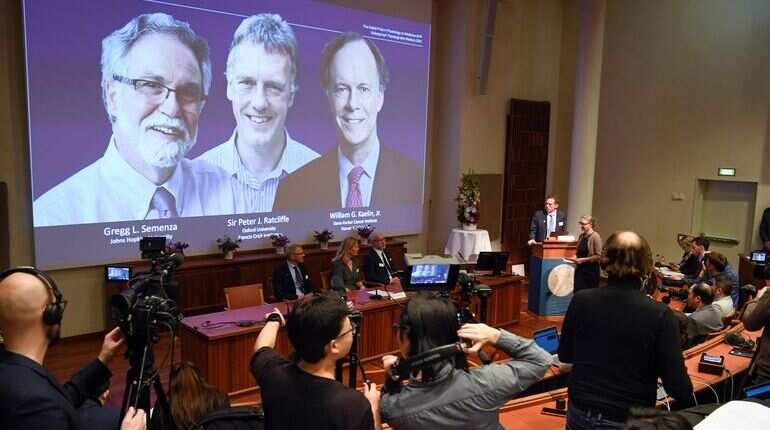
Nobel prize for medicine
Two Americans and a Briton won the 2019NobelMedicinePrizeon Monday for discovering a molecular switch that regulates how cells adapt to fluctuating oxygen levels, opening up new approaches to treating heart failure, anaemia and cancer.
William Kaelin at the USDana-Farber Cancer Institute and Harvard Medical School said he was overwhelmed to get a pre-dawn call to say he and two other doctors, Gregg Semenza of Johns Hopkins University and Peter Ratcliffe of Oxford University, had won the$913,000prize.
"I don't usually get phone calls at 5 am, but I knew this was 'NobelMonday', so it was either going to be a poorly timed mobile call or extremely good news," he told Reuters by telephone. "My heart started racing. It was almost surreal."
Ratcliffe, who is also clinical research director at the Francis Crick Institute in London, said in a statement he was "honoured and delighted at the news".
The scientists' work established the basis for the understanding of how oxygen levels are sensed by cells - a discovery that is being explored by medical researchers seeking to develop treatments for various diseases that work by either activating or blocking the body's oxygen-sensing machinery.
Their work centres on the hypoxic response - the way the body reacts to oxygen flux - and "revealed the elegant mechanisms by which our cells sense oxygen levels and respond" said Andrew Murray, an expert at Britain's University of Cambridge who congratulated the three.
'Vital ingredient'
"Oxygen is a vital ingredient for the survival of every cell in our bodies. Too little – or too much – can spell disaster.Understanding how evolution has equipped cells to detect and respond to fluctuating oxygen levels helps answer fundamental questions," said Venki Ramakrishnan, president of Britain's Royal Society scientific academy.
"As (this) work.. shows us, it also gives insights into the way these processes continue to shape our health and wellbeing."
Randall Johnson, a professor at Sweden's Karolinska Institute where theprizeis awarded, said it was "aprizethat really tells us the fundamental truth about how cells work".
During exercise, for example, the body uses oxygen at a rapid pace, "and this is a switch that helps the cell figure out how much oxygen it's getting and how it should behave."
"If you have a stroke there's suddenly no oxygen going to the brain... Those cells, if they are going to survive, need to find a way to adapt to that level of oxygen," he said.
Medicineis the first of theNobelPrizes given each year. Theprizes for achievements in science, peace and literature have been awarded since 1901 and were created in the will of dynamite inventor and businessman AlfredNobel.
Nobelmedicinelaureates have included scientific greats such as Alexander Fleming, the discoverer of penicillin, and Karl Landsteiner, who identified separate blood types and so enabled safe transfusions to be widely introduced.
Thomas Perlmann, a member of theNobelAssembly, said he had reached Kaelin by phone early on Monday to tell him on the award. "He was really happy, almost speechless," Perlmann said.
Last year American James Allison and Japanese Tasuku Honjo won theprizefor discoveries about how to harness the immune system in cancer therapies.