Moscow believes Turkish president Erdogan will 'officially' offer Ukraine mediation

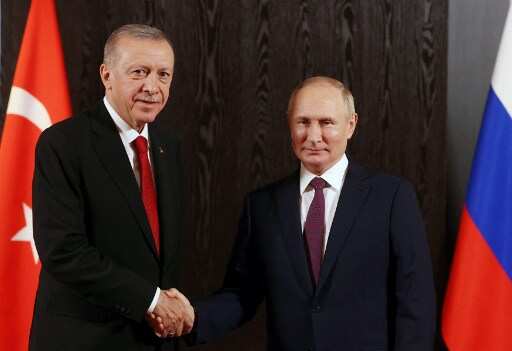
Russian President Vladimir Putin meets with Turkish President Recep Tayyip Erdogan
A Kremlin adviser said on Wednesday that Moscow hopes Turkish President Recep Tayyip Erdogan would "formally" offer to facilitate talks with Ukraine at an upcoming meeting with Russian President Vladimir Putin in Kazakhstan.
"The Turks are offering their mediation. If any talks take place, then most likely they will be on their territory: in Istanbul or Ankara," Kremlin foreign policy adviser Yuri Ushakov told reporters in Moscow.
Erdogan "will probably propose something officially," he continued, at their Thursday discussions in Astana, the capital of Kazakhstan.
Turkey, a NATO member that has maintained its neutral stance throughout the Ukrainian war, enjoys cordial ties with both of its Black Sea neighbours, Russia and Ukraine, and has abstained from supporting Western sanctions on Moscow.
"Turkey on principle does not join the illegal sanctions of the West. And this position of Turkey gives an additional impetus for the expansion of trade and economic cooperation," Ushakov said.
In March, Russian foreign minister Sergei Lavrov and his Ukrainian colleague Dmytro Kuleba met in person for the first high-level discussions to take place since Moscow pushed soldiers into Ukraine. Turkey has previously served as the venue for negotiations between Moscow and Kyiv.
Peace talks have subsequently stopped, and when the Kremlin said that it had seized four Ukrainian provinces, President Volodymyr Zelensky of Ukraine declared he would not have discussions with Putin.
Also Read:China intensifies security ahead of 20th CCP congress, arrests over 1.4 million ‘criminals’
Ushakov told reporters when asked about Zelensky's promise, "I would like to tell him: never say never."
With Moscow and Kyiv, Turkey and the UN-mediated a historic agreement that set aside three ports for Ukraine to deliver desperately needed food supplies over a Russian embargo.
However, Russia has criticised the agreement, stating that its own exports had suffered and asserting without supporting data that the majority of supply was made to Europe rather than to developing nations where grain was most needed.
(with inputs from agencies)