

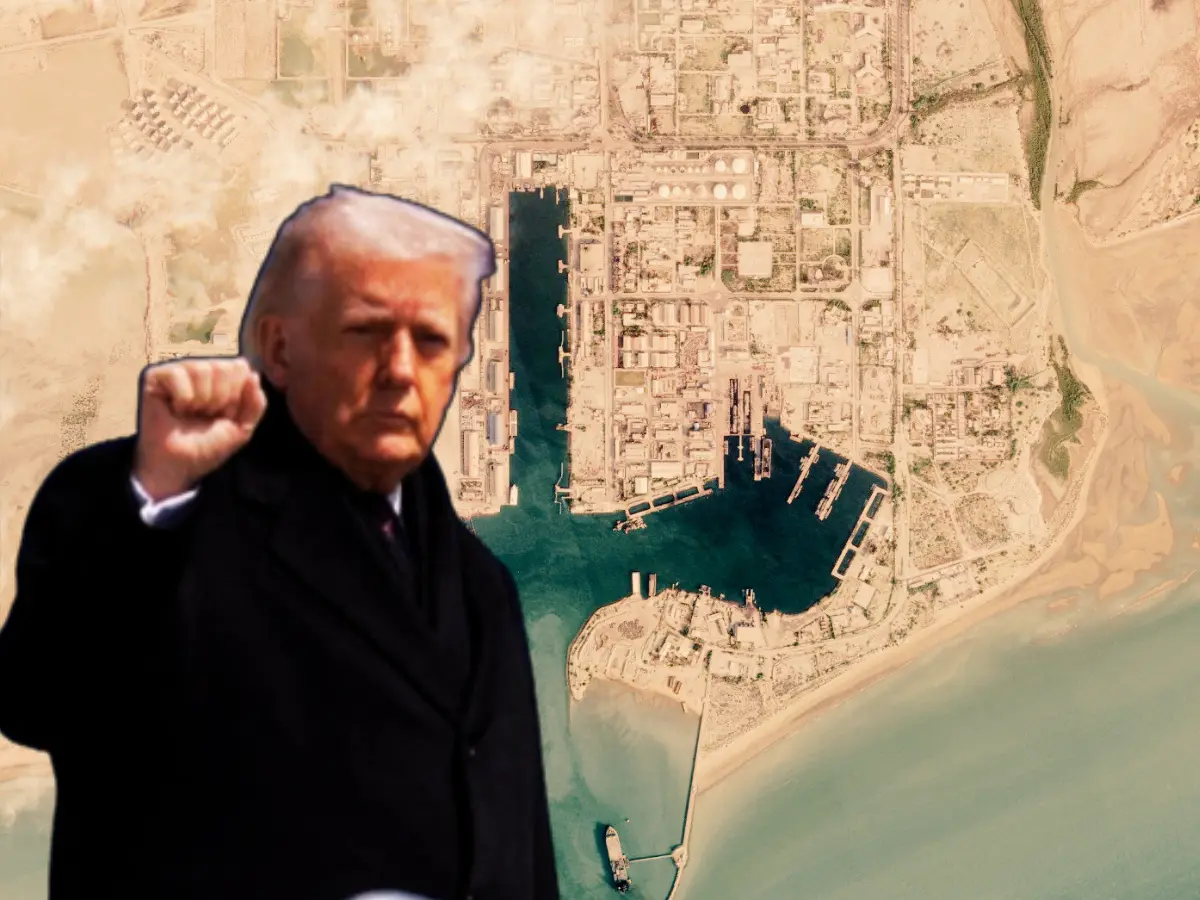
&imwidth=800&imheight=600&format=webp&quality=medium "US‑Iran‑Israel war highlights: Trump orders US Navy to ‘shoot and kill’ Iranian boats laying mines in Hormuz Strait")
Even as Washington and Tehran have formally agreed to extend the ceasefire to create space for diplomacy, Donald Trump has ordered the military to continue its blockade of Iranian ports. The move is intended to strain Tehran’s finances, with the White House claiming the country’s economy is “collapsing” and short on cash as oil storage at Kharg Island fills up.
Meanwhile, diplomatic efforts remain uncertain. Although there are reports of a possible summit in Pakistan, Iranian state media says no delegation has left for Islamabad and insists that a complete halt to Israeli strikes in Lebanon is a precondition for any formal negotiations. "So far, no delegation from Iran has departed for Islamabad, Pakistan; whether it is the main or subsidiary delegation; primary or secondary," Iranian state TV said, dismissing reports suggesting otherwise.
Iran has accused the US of seeking to impose surrender through pressure instead of engaging in genuine diplomacy. Parliamentary speaker Mohammad Baqer Ghalibaf said the US was aiming for a “table of surrender” and warned that Iran could unveil “new options on the battlefield” if tensions escalate again.
Foreign Minister Abbas Araghchi also condemned what he called repeated ceasefire breaches and provocative moves by the US, while President Masoud Pezeshkian stressed that meaningful talks require trust, consistency and respect for commitments. Meanwhile, Pakistan has stepped in as a key mediator and is preparing to host fresh talks in Islamabad. The US is expected to send Vice President JD Vance, though Iran has yet to confirm its participation.
Follow WION for all the latest developments, analysis, and live updates on the unfolding US‑Iran‑Israel crisis.
Iran’s President Masoud Pezeshkian and Speaker Mohammad Bagher Ghalibaf said there are no “radicals or moderates” in Iran hours after President Donald Trump claimed the country’s leadership was embroiled in factional infighting.
Earlier, Trump posted on Truth Social that Iran was “having a very hard time figuring out who their leader is.”
“They just don’t know!” wrote Trump, claiming there is “CRAZY!” infighting in the country between hardliners and moderates.
Pezeshkian and Ghalibaf said there "are no radicals or moderates" in Iran. "We are all 'Iranian' and 'revolutionary,' and with the iron unity of the nation and government, with complete obedience to the Supreme Leader," the statement read. "We will make the aggressor criminal regret his actions."
The Pentagon has hit out against media reports that US forces may need six months to clear the Strait of Hormuzof any mines that pose a threat to shipping.
“One assessment does not mean the assessment is plausible, and a six-month closure of the Strait of Hormuz is an impossibility and completely unacceptable to the Secretary,” Pentagon Chief Spokesman Sean Parnell said.
“The media cherry-picking leaked information, much of which is false, from a classified, closed briefing is dishonest journalism,” Parnell told the BBC.
US President Donald Trump has said that the US Navy has total control over the Strait of Hormuz. He wrote on a social media post that Iran is struggling to determine its leadership, claiming there is intense infighting between ‘hardliners’ and ‘moderates’. ‘They just don’t know!’ he wrote, describing the internal split as ‘crazy’ and suggesting the moderates are ‘gaining respect’ while the hardliners have been ‘losing badly on the battlefield.’
"No ship can enter or leave without the approval of the United States Navy. It is sealed up tight until such time as Iran is able to make a DEAL!” Trump adds.
He has repeatedly said during the ceasefire that began April 8 that his team is in contact with Iranian officials seeking a deal, while also acknowledging that the killing of senior leaders has created complications. Earlier this week, he extended the truce to allow Iran more time to present a ‘unified proposal’ to end the war.
US President Donald Trump has issued a directive to the US Navy to use lethal force against any boats suspected of laying mines in the Strait of Hormuz, as tensions with Iran continue to escalate.
In a post on Truth Social, Trump wrote: “I have ordered the United States Navy to shoot and kill any boat, small boats though they may be … that is putting mines in the waters of the Strait of Hormuz. There is to be no hesitation.” The statement comes two days after the US President said that he was extending the ceasefire because Iran's leadership was ‘fractured’ and needed time to come up with a proposal.
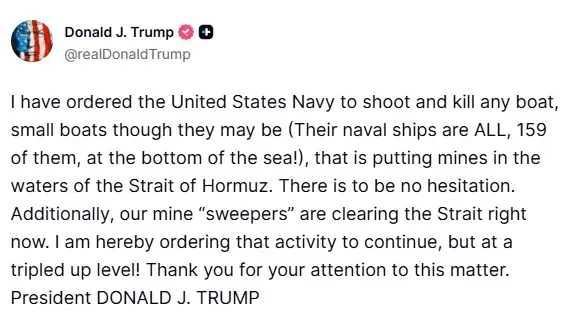
Lebanese rally in Beirut to protest the killing of 42-year-old journalist Amal Khalil by an airstrike in the country's south, where Israeli forces occupy several areas, said AFP.
Speaking at the gathering, a colleague paid tribute, saying, “Amal wanted us to keep going. Amal wanted us to carry this message through to the end.”
Reza Pahlavi, the son of Iran's ousted shah, argued Thursday that any negotiations with the clerical leadership in Tehran amount to "appeasement" and voiced hope that renewed street protests will topple it.
Pahlavi, 65, was speaking on a visit to Berlin, where he was greeted by some supporters but also bitter opponents -- with one activist splashing a red liquid on him before being detained by police.
Pahlavi, addressing journalists, called on European governments that have stayed out of the US-Israeli war against Iran to take other steps, from expelling Iranian ambassadors to helping Iranian citizens access the blocked internet.
Lebanon's president and prime minister accused Israel on Thursday of a war crime, after an airstrike killed a Lebanese journalist in the country's south, where Israeli forces occupy several areas.
Rescuers and the reporter's employer on Wednesday confirmed the death of Amal Khalil, a 42-year-old journalist who worked for the Lebanese daily Al-Akbar.
The civil defence agency said she was killed in a strike on a house in the village of al-Tiril.
"Israel deliberately targets journalists in order to conceal the truth about its crimes against Lebanon," said President Joseph Aoun, in a statement denouncing "war crimes."
UN 'working on' keeping presence in Lebanon after 2027 UNIFIL departure
Israeli settlers have encroached on Syrian territory in the occupied Golan Heights and barricaded themselves on a rooftop near the Druze village of Khader, demanding the establishment of a new settlement.
The Israeli army is conducting extensive operations in southern Lebanon that include burning and blowing up residential homes, according to reports from Lebanon's National News Agency (NNA) and independent monitors. The affected area is Mais Al-Jabal in Marjayoun, south of the country, seen as a Hezbollah heartland.
Gaza is taking its first step toward electoral participation in nearly two decades. While not a general election, the focus is on landmark municipal polls specifically in the central city of Deir al Balah. The polling will be conducted on April 25, 2026.
Lebanon's Health Ministry has condemned the killing of journalist Amal Khalil in the southern town of Al-Tayri in Lebanon. In a statement on the social media platform X, Lebanon's Health Ministry declared him a “martyr” and offered condolences to her family. The Israeli occupation forces pursued her to a house where she was seeking shelter before killing her.
Lebanese President Joseph Aoun has mourned the death of Al Akhbar journalist Amal Khalil, who was killed in an Israeli strike on the town of al-Tayri, and wished a speedy recovery to her colleague Zeinab Faraj, who was seriously injured in the same attack.
In a post on X, Aoun accused Israel of deliberately targeting journalists to obscure the reality of its actions against Lebanon. He described such attacks as crimes against humanity under international law and urged the global community to step in and put an end to them.
Israel Ministry of Defence has placed orders worth about $200 million with Elbit Systems for advanced air-launched munitions as part of its ongoing conflict with Iran. Elbit highlighted its expertise in airborne weapon systems and its long-standing partnership with the ministry, noting that its munitions contribute to the Israeli Air Force’s operational edge. The deal is aimed at boosting domestic arms capability and readiness for future combat scenarios.
Pakistan’s Interior Minister, Mohsin Naqvi, and US Ambassador, Natalie Baker, have talked about the latest regional development and diplomatic efforts to hold a second round of talks in Islamabad between Iran and the US.
The Pakistani Ministry of Interior said in a post on X that Naqvi commended President Trump’s initiative to extend the ceasefire with Iran, and emphasised the need for continuity in diplomatic channels to reach a final resolution. He also voiced optimism about “positive progress from Iran,” adding that Shehbaz Sharif and Asim Munir are making comprehensive efforts at all levels to help resolve the issue.
Mohsin Naqvi expressed hope that the United States and Iran will prioritise diplomacy and work towards a peaceful solution, according to Al Arabiya.
Iran has executed a man found guilty of having ties to the exiled opposition group Mujahideen-e-Khalq (MEK) as well as alleged connections with Israel’s intelligence agency, according to the judiciary’s news outlet Mizan.
Iran’s foreign minister has said that actions by the United States and Israel are the main cause of instability in the Gulf and the Strait of Hormuz. During a meeting in Tehran with South Korea’s envoy, Araghchi urged nations to condemn the attacks strongly. He added that Iran has acted within international law to protect its interests, warning that any consequences rest with those responsible for the aggression.
Iran maintained its stance on Thursday that it would not reopen the Strait of Hormuz as long as the US naval blockade remains, even after the ceasefire was extended, and announced it had seized two vessels attempting to pass through the key waterway.
US Central Command said late Wednesday that it had ordered 31 ships to turn back or return to port as part of its blockade measures. As tensions persist despite the truce, Donald Trump said on Tuesday the ceasefire would continue to allow time for peace talks mediated by Pakistan. Iran welcomed Islamabad’s efforts but did not directly respond to Trump’s remarks.
Turkish President Recep Tayyip Erdogan said the conflict in Iran is starting to “weaken Europe” during a phone conversation with Frank-Walter Steinmeier. According to a statement from Erdogan’s office, the two leaders discussed bilateral ties as well as the ongoing conflicts in Iran and Ukraine. "President Erdoğan noted that the war in our region began to weaken Europe as well, and that if this trend were not addressed with a peace-oriented approach, the damage caused by the period of conflict would be far greater," the post says.

