Indians in US warned after Russia's earthquake, Trump says 'stay strong': Is there tsunami warning in India? Here's what we know

&imwidth=600&imheight=450&format=webp&quality=medium "Indians in US warned after Russia's earthquake, Trump says 'stay strong': Is there tsunami warning in India? Here's what we know")
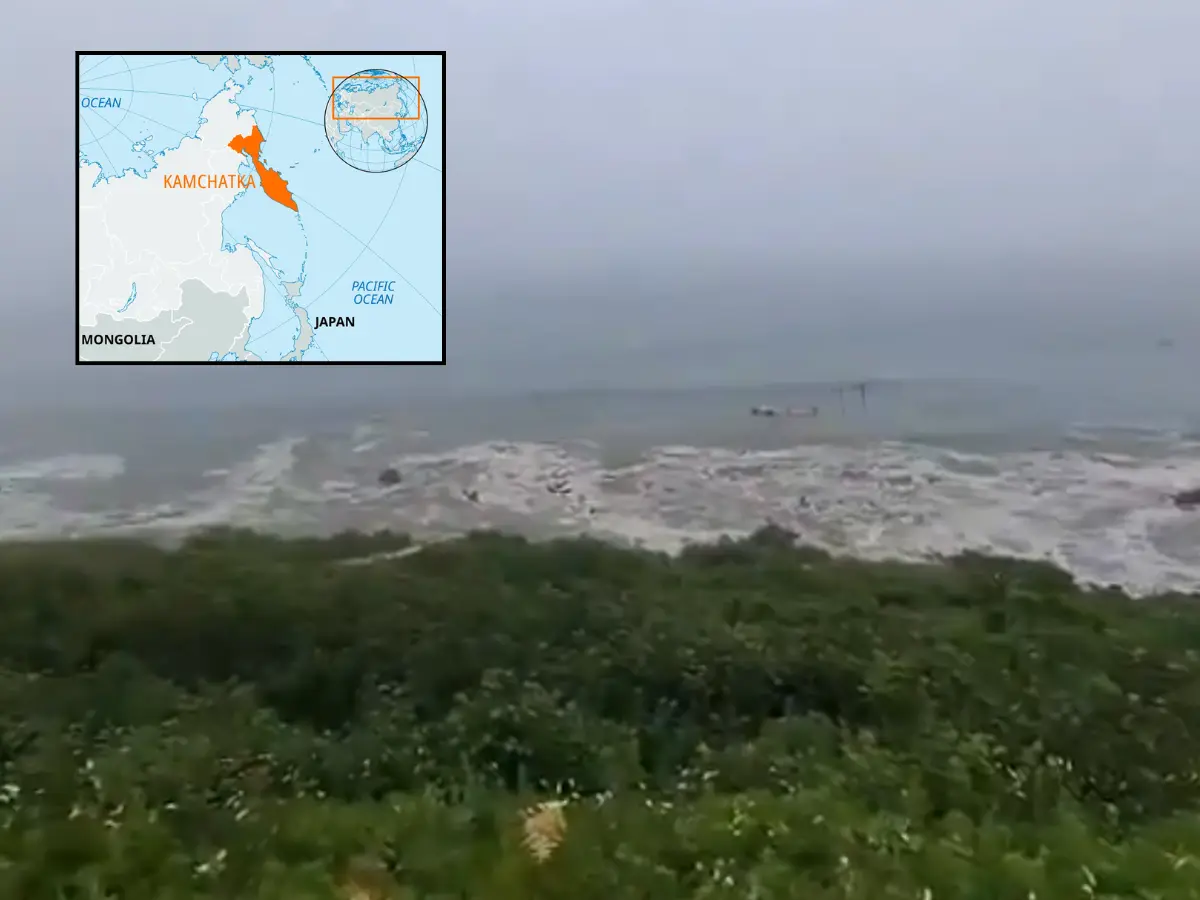
Russia earthquake Photograph: (Screenshot from viral video)
A powerful 8.8-magnitude quake struck off Russia’s Kamchatka Peninsula, triggering tsunami waves in Japan and warnings in the US. The quake’s epicenter was 136 km east of Petropavlovsk at a depth of 19 km. India has also clarified whether there is a tsunami threat here
An 8.8 magnitude earthquake hit Russia’s Kamchatka Peninsula early Wednesday, triggering tsunami waves in Japan, Ecuador and warnings being issued in US and Mexico. United States President Donald Trump responded to the development and asked people to stay strong and safe. The Indian Tsunami Warning Advisory Service said that there is no tsunami threat to India and the Indian Ocean in connection with the Russian earthquake. India's Consulate General in San Francisco and Seattle asked Indian nationals in California, other US West Coast states to follow local alerts and move to higher ground if a tsunami alert is issued. It also asked its citizens to avoid coastal areas.
- US President Donald Trump issued emergency warnings following an 8.8-magnitude earthquake off Russia’s Kamchatka Peninsula that generated destructive tsunami waves across the Pacific Basin. “Due to a massive earthquake that occurred in the Pacific Ocean, a Tsunami Warning is in effect for those living in Hawaii. A Tsunami Watch is in effect for Alaska and the Pacific Coast of the United States. Japan is also in the way,” Trump posted on X.
- India's Consulate General in Seattle said, “National Weather Service USA has issued Tsunami Advisories along parts of the US West Coast, including areas in Oregon, Washington and Alaska. Indian citizens in these areas are advised to follow advisories issued by local government authorities and take necessary precautions to ensure safety. In case of any emergency, CGI Seattle may be contacted at Helpline: +1 (206) 608-0608.”
- India's Consulate General in San Francisco issued an advisory for Indian Nationals in the US West Coast and Hawaii - It asked its citizens to monitor alerts from US authorities and Tsunami Warning Center. It said that citizens should move to higher ground if a tsunami alert is issued. It said that they should avoid coastal areas. It also said that they should keep devices charged.
Russia's earthquake
The massive earthquake is being termed as the region's strongest since 1952, with aftershocks of up to 7.5 magnitude possible, the regional seismic monitoring service said. Russia's emergencies ministry said that a tsunami hit and flooded the port town of Severo-Kurilsk, where the population of around 2,000 people was evacuated. Several people were injured in Russia by the quake, state media reported. The epicentre was located about 136 kilometres east of Petropavlovsk-Kamchatsky, in Russia’s far eastern Kamchatka Peninsula, at a depth of 19 kilometres beneath the seabed. Meanwhile, workers at the stricken Fukushima nuclear plant in northeast Japan -- destroyed by a huge quake and tsunami in 2011 -- were evacuated, its operator said. The quake occurred approximately 250 kilometres from Hokkaido, Japan’s northernmost island. Videos showed buildings shaking, with reports of damage in multiple places. Live footage on Japanese television showed people evacuating by car or on foot to higher ground, including the northern island of Hokkaido, where the first wave, measuring 30 centimetres (one foot) was observed.

