In 2023, China seeks to 'correct course' with United States

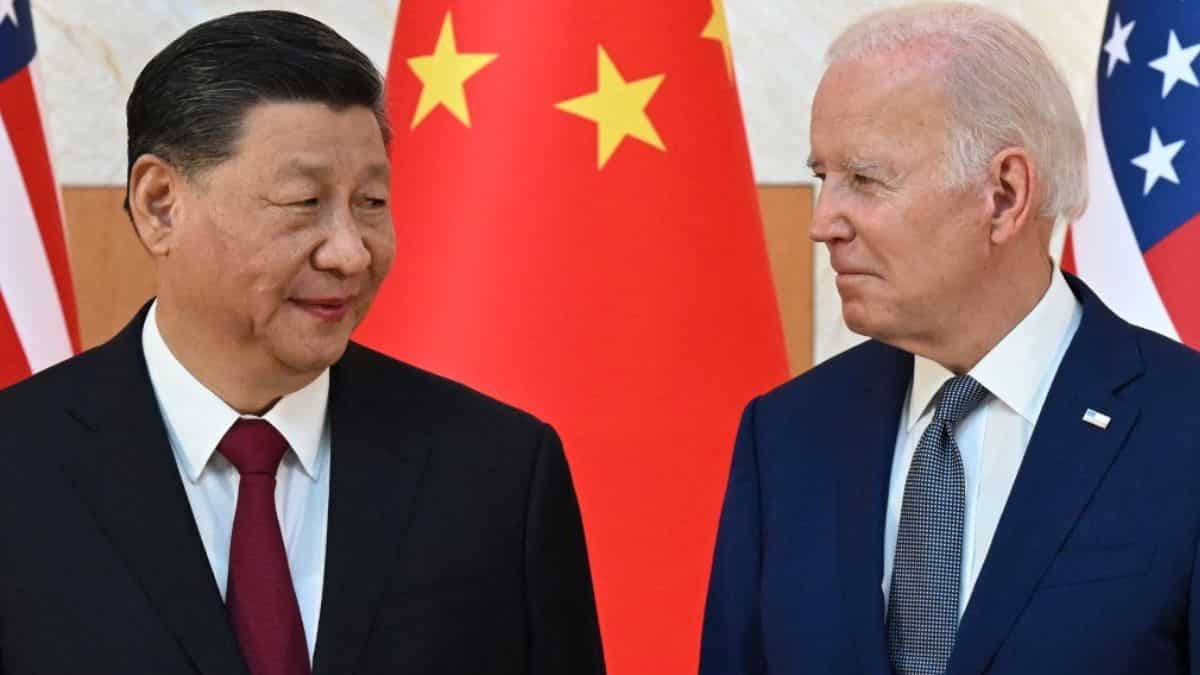
Chinese leader Xi Jinping with US President Joe Biden
In the foreign policy establishment of China, the dawn of 2023 has accompanied the rise of two individuals: Wang Yi and Qin Gang. Wang Yi, the outgoing foreign minister of China took over as the director of Chinese Communist Party’s Central Foreign Affairs Commission (CFAC). Whereas Qin Gang, the current Chinese envoy in the United States, is set to take over as country's next foreign minister.
The Central Foreign Affairs Commission (CFAC) is an institution within the Chinese Communist Party (CCP).
The foreign minister reports to the director of CFAC, who in turn reports to Xi Jinping.
This means that in his new role, Qin Gang will report to Wang Yi, who in turn will be answerable to the supreme leader Xi Jinping.
Qin was appointed as China's foreign minister at the 38th meeting of the National People's Congress last year.
The choice of a serving Chinese ambassador as the next foreign minister was widely reported to be Chinese Communist Party's conciliatory tone to the US amid intense geopolitical competition between Beijing and Washington D.C.
The reflection of a conciliatory tone in the Chinese foreign policy was prominently visible as 2023 began.
In his new year message for a Communist Party journal, Wang Yi, the director of CCP's Central Foreign Affairs Commission sought course correction in ties with the United States.
"(We will) implement agreements reached by the top leaders of the US and China, seek to establish guiding principles of Sino-US relations and correct course (in bilateral ties)," Wang Yi wrote in Qiushi, a CCP-run journal, reflecting the "constructive" outcomes of bilateral talks between US President Joe Biden and Chinese leader Xi Jinping on the sidelines of G-20 summit in Indonesia's Bali last year.
WATCH |Agreeing to disagree: Another blow to U.S.- China ties?
Wang's pitch to "correct course" was followed by his assertion to "fight back" against "all forms of hegemony" by rebuffing attempts by "external forces", in what Beijing says, are attempts of interference into China's domestic affairs.
Wang Yi's course correction pitch and 'stabilising' US-China ties
According to Manoj Joshi, Distinguished Fellow at Observer Research Foundation think-tank, by course correction pitch, "He (Wang Yi) means that the US needs to correct its course", as China believes that it has been doing the "right thing" all along, Joshi added.
"The ties are stabilising but there is no going back to the past. The two countries understand the importance of keeping their relationship within guardrails to prevent an inadvertent conflict," Joshi told WION.
Experts add that there is little course correction in the US-China relations. "The real issues like Taiwan and South China Sea dispute are non-negotiable for the People's Republic of China. The relations would continue to be rocky in the security realm," Suyash Desai, Taiwan-based research scholar on China's military and foreign policy, told WION.
US-China ties: Managing competition and cooperation
The US statement after bilateral talks between US President Joe Biden and Chinese leader Xi Jinping in Bali had underscored the need for cooperation between the two sides on transnational challenges such as climate change, global macroeconomic stability including debt relief, health security, and global food security. "Because that is what the international community expects," the White House had said on November 14, 2022.
The US, while acknowledging the bilateral competition between Beijing and Washington, said that the competition "should not veer into conflict".
Experts say that the US and China understand the need for cooperation on key transnational issues.
"They understand, too, that as global powers they need to cooperate on issues like climate change, trade policy, non-proliferation and so on. But they also know that they are now in a phase of intense political, military and economic competition," Manoj Joshi said.
The US-China ties had hit a low after US House speaker Nancy Pelosi's August-2022 visit to self-governing island nation of Taiwan, that China claims as its own.
The effect of Pelosi's visit was pacified by Biden-Jinping bilateral talks later in November on the sidelines of G-20 summit in Indonesia's Bali.
The engagement is expectedbe furthered by US Secretary of State Anthony Blinken's scheduled visit to China in 2023.
WATCH WION LIVE HERE
You can now write for wionews.com and be a part of the community. Share your stories and opinions with us here.