How religious places of worship can become breeding grounds of COVID-19

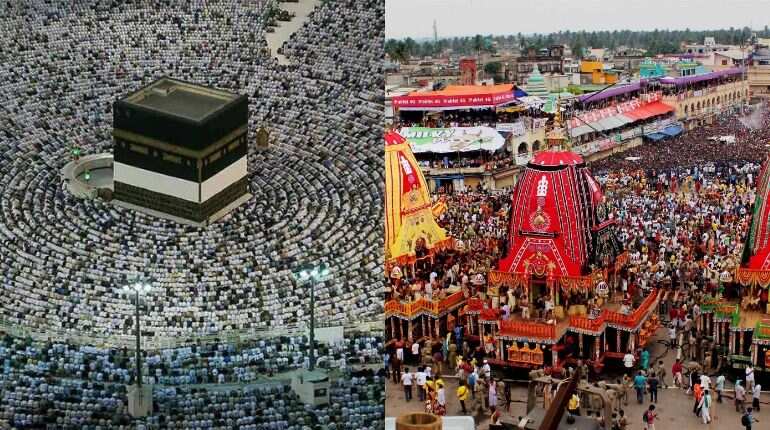
Hajj and Puri
As the world continues to grapple with COVID-19, the novel virus has forced people across the globe to observe several festivities at home.
Fromeaster to ramzaan, the pandemic alteredthis year's religious calendar.
The festivals which were celebrated with joy turned sombre amidprayers at home to combat the Wuhan virus.
However, after six months into 2020, things are beginning to change.
Placesof worship including the nativity church in Bethlaham, Jerusalem's Al Aqsa Mosque and India's Golden Temple have reopened.
SaudiArabia has announced it will hold a "very limited" hajj this year, with pilgrims already presentin the kingdom allowed to perform the annual ritual.
The development comes as the country moves to containthe biggest coronavirus outbreak in the Gulf.
SaudiArabia is strugglingto contain a major spike in virus, which have now risen to more than 161,000 cases,the highest in the Gulfand over 1,300 deaths.
The move was welcomedby the Arab countries as well as nations worldwide.
But lost in the cheer was a critical question: is a limited hajj synonymous to a safe Hajj?
As places of worship reopen one after another,can we rule out the risk of Covid-19?
The hajj, a must for able-bodied Muslims at least once in their lifetime, could be a major source of contagion, as it packs millions of pilgrims into congested religious sites.
A single coronvirus patient who attended a Sunday mass in South Korea was suffice todrag the countryinto the Covid-19 whirlpool.
A similar scenario can occur at any other religious place of worship.
Jagannath Puri Rath Yatra or the chariot festival has begun in India. While all checks were in place on paper, the reality was quite contrary.
Social distancing norms were flouted by worshippers who seemed to be relying on God's grace for their survival.
According to a Dinanath Nayak, servitor at Jagannath Puri Temple, "now that bhagwan (god Jagannath) has come out on the streets to watch the woes of his subjects, he will cure the world. The chariot procession will definitely happen."
Similar sentiments were echoed in Indonesia in mid-April. When the world was respecting a modified ramzan, worshippers in the acehprovince wanted to pray together.Today, Indonesia has nearly 50,000 cases.
Even god helps those who help themselves. Is it too hard to stay at home and pray at home, for one odd year?