Here's how the newly-found door 'plug' may help understand Alaska Airlines' mid-air blowout

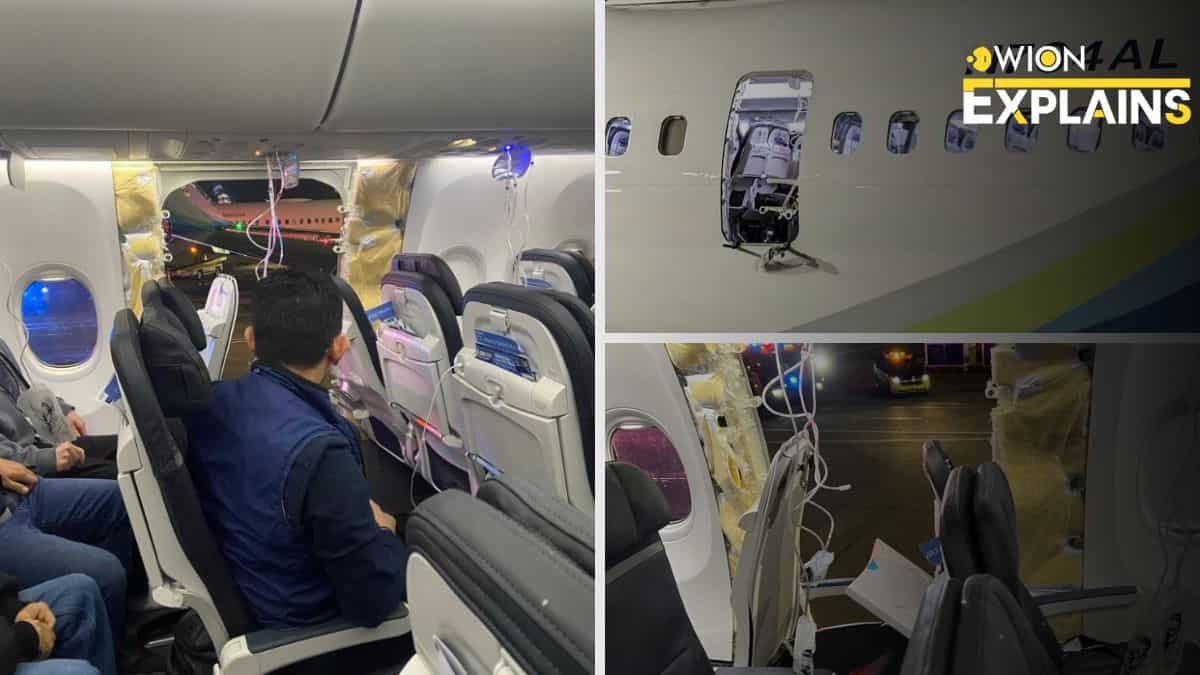
The door plugs fell off from Alaska Airlines plane when it was mid-air and at an altitude of 16,000 feet.
The discovery of the piece of fuselage, which had blown off an Alaska Airlines' Boeing airliner when it was flying over Oregon, Portland on Friday (Jan 5), has given the investigators hope that they will be able to gather physical evidence and understand what went wrong.
The gaping hole on one side of the jet opened up where a “plug” is fitted by aircraft maker Boeing to cover an emergency exit which is not used by the airline. The plugs are attached to most of the Boeing 737 Max 9 jets.
These planes have been temporarily grounded by the Federal Aviation Administration (FAA) andare undergoing inspections.
Why is the plug attached to the jet?
There are emergency exits on fuselages and behind the wings of some large Boeing 737s. These are designed in such a way to meet a federal requirement that the planes need to have a facility to evacuate passengers within 90 seconds, even if half the exits of the planes are blocked. The higher the number of passenger seats inside a plane, the more exits are needed.
Flights of Alaska Airlines and United Airlines have less than 180 seats in their 737 Max 9s and hence, they don’t require the two mid-cabin exits to comply with the evacuation rules of the United States.
Alaska Airlines and United Airlines are the only two airlines in the US which use the Max 9 and replace the side exits near the back of the plane with a permanent plug, which is equivalent to the size of an exit door.
Are door plugs only attached on Max 9s?
Boeing also builds bigger versions of its 737-900, which is a predecessor to the Max and the Max 8, which has space created for more exits in the back. Those purchasing the planes can choose to have either plugs or exit doors installed.
Who installs the plugs in the jet?
Speaking to the New York Times, a spokesperson of Spirit AeroSystems, which is not related to Spirit Airlines, said that the door plugs on Max 9s were installed by the company, which included the plugs which had fallen off from the Boeing airliner mid-air.
Speaking to The Associated Press, a spokesman said that the plugs get assembled into 737 fuselages at the factory of Spirit located in Wichita, Kansas.
Who is the largest supplier of Boeing?
The largest supplier of Boeing for commercial planes is Spirit which builds fuselages as well as other parts for Boeing Max jets. Recently, the company has faced several problems with manufacturing quality on both the Boeing Max jets and the bigger Boeing 787 Dreamliner.
Last year, improperly drilled fastener holes were found by Boeing and Spirit AeroSystems in a bulkhead which helps in keeping the jets pressurised at cruising altitude.
How long will the investigation continue?
The National Transportation Safety Board's officials, headed by the board’s chairperson Jennifer Homendy, reached Portland, Oregon, on Saturday (Jan 6) and started the investigation which is likely to continue a year or longer. However, they did not clarify the possible causes which may have led to such an accident in the press conference.
The NTSB team has a metallurgist and Homendy said that the investigators will examine the exit door plug, along with its hinges and other parts. As per experts, examination of the damaged door will be an important step in the investigation.
Speaking to the Associated Press, Anthony Brickhouse, who teaches accident investigation at Embry-Riddle Aeronautical University in Daytona Beach, Florida said, “The good thing about metal is that metal paints a picture, metal tells a story.”
Watch:United Airlines finds loose bolts on multiple Boeing 737 Max 9 planes
Brickhouse added that the exit doors, even if plugged or not, are not usually the fuselage's weak point.
Did the Boeing jet receive any warnings earlier?
Homendy on Sunday (Jan 7) said that the Boeing jetliner was not being used for flights bound for Hawaii after three different flights reported a warning light, which indicated a pressurisation problem.
It was decided by Alaska Airlines that the aircraft will be restricted from long flights over water so that in case there is a reappearance of the warning light, the flight “could return very quickly to an airport,” Homendy said at a press conference.
However, she added that the pressurisation light may not be connected with the mid-air mishap and the incident needs to be investigated.
How did the mid-air mishap happen?
An Alaska Airlines' Boeing jetliner blew out a part of its fuselage seven minutes after it took off, above Oregon, Portland on Friday night (Jan 5). The fall of the door plug forced the pilots to make an emergency landing as wild winds gushed in and some belongings of passengers were sucked out.
None of the 171 passengers or six crew faced serious injuries. However, the sudden decrease in cabin pressure led to the oxygen masks dropping from the ceiling. National Transportation Safety Board Chair Jennifer Homendy informed that the two seats near the torn-off plug were unoccupied.
The flight had reached 16,000 feet (4,876 metres) before the incident occurred and a hole was created in the cabin. According to the FAA data, the Boeing jet was delivered to Alaska Airlines in late October and received certification in early November.
(With inputs from agencies)